Disclosure: This post has affiliate links. Arocol may earn a small commission at no extra cost to you. As an Amazon Associate I earn from qualifying purchases. Read our disclosure.
Is your employer not crediting PF to your account, while your salary is delayed for months too? That’s been my life at work for a long time, and I never said a word about it.
Not one word.
Salary would come after one and a half months. Sometimes two. Sometimes three or even four.
And every month I had the same question sitting in my chest: “Should I ask?”
But a scarier question always won: “What if they fire me for asking?”
So I stayed quiet. I’ll tell you at the end whether staying quiet was the right call, and what finally changed.
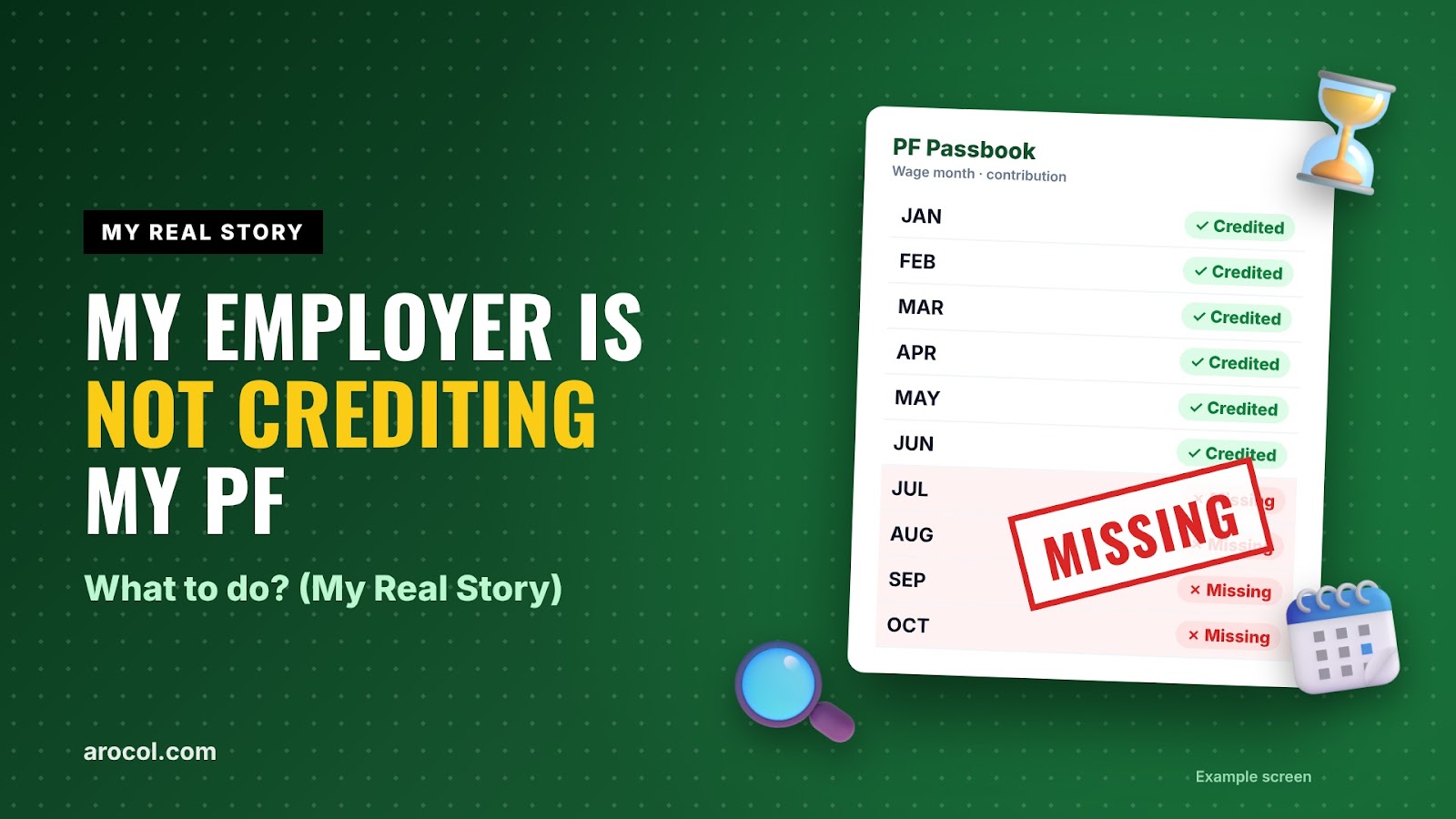
Then one day I opened my PF passbook and found something worse than a late salary. My employer was not crediting PF anymore. The money being cut from my pay had stopped reaching my account.
If any of this sounds familiar, this post is for you. I’ll share what I went through, what the law actually says, where you can complain, and how to survive the months when the money just doesn’t come.
Is it normal to have your salary delayed for months?
No. It’s common in some companies, but it’s not normal and it’s not legal.
I used to think “it happens everywhere”. It doesn’t. Most companies pay on a fixed date every month, and if they’re late, it’s by a day or two.
When you have your salary delayed for months, again and again, that’s a problem with the company, not with you.
I needed to hear that line years ago. So I’m saying it to you now.
What do the salary delay rules in India say?
India’s Code on Wages, 2019 came into force on 21 November 2025. Under it, if you’re paid monthly, your salary must be paid before the 7th day of the next month.
So your October salary should reach you before 7 November. Not December. Not “when the client pays us”.
A few more things worth knowing:
- These timelines now cover all employees, not just low-salary workers, like the old law mostly did.
- If you leave or are removed from the job, your full and final pay is due within two working days.
- Paying late can bring penalties for the employer under the same law.
Rules can be updated, and your state may have its own rules too. Always check the latest version on the Ministry of Labour and Employment website before you act.
Honestly? Just knowing there was a date in the law made me feel less crazy.
Why I never asked about my salary
Here’s the part nobody likes to admit.
I was scared.
Scared that if I asked “Sir, when will salary come?”, my name would go on some list. Scared I’d be the first one let go.
And when the money didn’t come, I’d tell myself, “Gaye mere paise.” My money’s gone. That was the exact thought, every single time.
So who paid my bills? My parents.
I’m grateful they could. But it hurts in a quiet way when you have a job and still have to ask your family for rent money.
My cousin Neha went through something similar at a small startup. Her salary started slipping by a week, then a month. She told me, “Didi, I kept smiling at work and crying in the bathroom.” She left after six months, but only after she’d built a small cushion first.
If you’re in this spot, please know you’re not weak for being scared. Fear is a normal reaction when your income is in someone else’s hands.
Employer not crediting PF? Here’s how I found out
The salary delay was one thing. This was another level.
PF was being deducted from my salary every month. It’s right there on the salary slip. But when I checked my EPFO member passbook, the deposits had simply stopped after a certain month.
Look at this. Month after month, the money comes in. Then nothing.

That’s what an employer not crediting PF looks like in real life. No alert, no SMS, no warning. Just empty rows. Some people call it PF not deposited by employer. Same pain.
If I hadn’t opened the passbook myself, I wouldn’t have known for years.
I’ve written a full guide on what to do when PF is deducted but not credited, and my own story of how my EPFO grievance got rejected the first time. Read those if you’re at that stage.
How to check your PF passbook every month
This takes two minutes. Do it every month, around the 20th, after the employer’s deposit deadline has passed.
- Go to the EPFO passbook portal.
- Log in with your UAN, password and captcha. You’ll get an OTP on your phone.
- Pick your member ID and the financial year.
- Check that every month shows an entry. Look at the “Wage Month” column.
- If a month is missing, take a screenshot and note it down.
Don’t know your UAN or password? You can sort it out on the EPFO member portal. The UMANG app also shows your passbook.

Employers are supposed to deposit PF within 15 days of the end of each month. So if your October PF isn’t showing by late November, something’s off.
Make this a habit, like checking your bank balance. It’s your retirement money. If you want to see why it matters so much, read how EPF, PPF and NPS work together for retirement.
The day hundreds of us complained together
This is the part that gives me hope.
This wasn’t the first time PF had stopped. It had happened before, years earlier.
Back then, a lot of employees complained to EPFO. Not one or two. I’d guess more than 200 or 300 people, though I don’t know the exact number.
And guess what happened?
The company deposited years of missing PF in one go. In my passbook, it shows up as “back period” entries, covering 2021-22 to 2022-23, all credited together much later.

One person complaining is easy to ignore. Hundreds of complaints about the same employer? That’s hard to ignore.
So if you’re scared to complain alone, talk quietly to colleagues you trust. You’d be surprised how many people are checking the same empty passbook and saying nothing.
Where to complain if salary is not paid or your employer is not crediting PF?
Start small and go up only if needed. Here’s the order that makes sense.
1. Write to HR or your manager, politely, by email. Email is better than a phone call because it leaves a record. Keep it short and calm. Just ask when the pending salary will be paid.
2. Keep every proof. Salary slips, bank statements showing late credits, your offer letter, emails. I keep printouts in an A4 document folder, because phones get lost and screenshots get deleted.
3. Complain on the SAMADHAN portal. The Labour Ministry’s SAMADHAN portal takes complaints about unpaid wages, delayed payments and illegal deductions. Some cases may be sent to your state labour department, depending on your employer.
4. Go to your state labour department. Every state has a labour commissioner’s office. They can call your employer for a meeting.
5. Get legal help. If nothing works, a legal notice or a labour court case is the next step. If money is tight, the National Legal Services Authority can guide you about free legal aid.
If your employer is not crediting PF, the route is different:
- File a complaint on EPFiGMS, EPFO’s grievance portal.
- If that doesn’t help, use CPGRAMS, the central government grievance portal. Read the timing rules first, because it asks whether you’ve filed a similar complaint recently.
- Check the main EPFO website for your regional office’s contact details.

Here’s a quick side-by-side so you know which door to knock on.
| Problem | Where to complain | Proof to keep |
|---|---|---|
| Salary paid late | HR email, then SAMADHAN or state labour department | Bank statement, salary slips, offer letter |
| Salary not paid at all | State labour department, then legal notice or labour court | Attendance, emails, appointment letter |
| PF deducted, not deposited | EPFiGMS, then CPGRAMS | Passbook screenshots, salary slips showing PF cut |
| Full and final not settled | HR email, then state labour department | Resignation or exit letter, last payslip |
Can you complain without losing your job?
I won’t lie to you. I can’t promise anything here.
Legally, an employer shouldn’t punish you for asking about wages you’ve already earned. In real life, people still worry, and I understand that worry completely.
What helps:
- Complain together. Group complaints worked in my case. They’re harder to brush off.
- Keep it polite and in writing. A calm email asking for a date isn’t a fight. It’s a question.
- Build your backup first. Update your CV, start a small side income, save what you can.
My friend Vikram worked at a different company where salary was always 45 days late. He didn’t complain. He quietly applied elsewhere for four months, joined a new place, and only then filed for his pending dues. He told me, “I fought better once I wasn’t scared of losing that job.”
That’s not the only way. But it’s a real way.
If you want a small side income to feel less trapped, I’ve listed honest options in my guide on freelancing in India for beginners.
How to manage money when salary is late (or delayed for months)
This is where most of us really struggle. Bills don’t wait for salary.
Here’s the order I’d pay things in, if money is short:
- Rent and food. A roof and meals come first.
- EMIs and credit card minimums. Missing these hurts your credit score and adds penalties.
- Insurance premiums. Don’t let health or term cover lapse.
- Phone, internet, electricity. You need these to work and to job-hunt.
- Everything else. Shopping, eating out, subscriptions can wait.

A few honest tips from my own months of waiting:
Build an emergency fund, even a tiny one. With a salary delayed for months, three months of expenses saved is your best friend. Start with ₹500 if that’s all you can. My guide on building an emergency fund when money is tight has 12 small ways. I like keeping this money in a separate savings account so I don’t touch it by mistake. You can open a Kotak 811 account online for this, or use any bank you trust.
Don’t live on your credit card. It feels like a lifesaver until the interest hits. If you have to use it, read why paying only the minimum due is a trap.
Be careful with loans. A personal loan to cover a late salary can turn into a long EMI. If you must, compare carefully using my guide on getting a personal loan at the lowest interest.
Track every rupee for a month. When income is uncertain, knowing where money goes matters more. I use a simple expense tracker notebook, but any notes app works. My post on where your salary goes every month shows a simple way to start.
My colleague’s sister, Farhan’s wife, runs her home on the “envelope” method when salary is late. She splits cash into envelopes for rent, groceries and bills, and doesn’t touch the next envelope until the month needs it. Old-school, but it works.
Salary delayed for months? Can AI help you plan?
Yes, for planning and writing. Not for legal decisions.
I used AI to make a “survival budget” for months without salary. Here’s a prompt you can copy. Change the numbers to yours, but never type your UAN, PAN, Aadhaar, bank details or company name into any AI tool.
My salary has been delayed for months and I don’t know when it will come. My fixed monthly costs are: rent ₹X, groceries ₹X, EMI ₹X, phone and internet ₹X, insurance ₹X. I have ₹X in savings. Make a simple survival budget that tells me how many months my savings will last, which bills to pay first, and 10 small ways to cut costs without hurting my health. Keep it simple and practical for India.
AI can also help you write a calm, polite email to HR. Try this:
Write a short, polite and professional email to my HR team asking for the expected date of my pending salary and confirming whether my PF contributions have been deposited. Don’t sound angry or threatening. Keep it under 120 words.
Read the answer before using it, and fix anything that sounds off. AI can be wrong, especially about laws. For more ideas, see how I use AI to plan a monthly budget.
How long can a company legally delay salary?
Short answer: for monthly pay, not past the 7th day of the next month under the Code on Wages.
There’s no “grace period” of two or three months anywhere in the law. A company saying “we’re waiting for funds” doesn’t change your right to be paid on time.
That said, the law only helps if someone uses it. Most people with a salary delayed for months never complain, so the delay just becomes “company culture”. I know, because I was one of those people.
If your employer gives a written reason and a firm date, that’s at least something to hold them to. Save that email. If the date passes too, you’ve now got proof that the delay keeps happening.
What if you’ve already left the company?
You still have every right to your pending salary and PF. Leaving doesn’t cancel what you earned.
- Ask for your full and final settlement in writing, with the amount and the date.
- Check that PF for your last months is deposited before you withdraw or transfer it. Once it’s moved, missing months are harder to chase.
- Transfer your PF to your new employer’s account instead of withdrawing it, if you can. Your retirement money keeps growing.
- Keep your exit letter and last payslip safe. These are your main proof later.
Neha did exactly this when she left her startup. Her last two months’ PF was missing, so she raised it on EPFiGMS first and only transferred her PF after it showed up.
What should you do this week if your salary is late?
Keep it simple. Five things:
- Check your PF passbook and screenshot any missing months.
- Download your last six months of bank statements.
- Save every salary slip in one folder.
- Write down your monthly must-pay bills.
- Talk quietly to one colleague you trust. You may not be alone.
If you want to understand money a little better through all this, two books helped me stay calm: Let’s Talk Money by Monika Halan, which is very Indian and practical, and The Psychology of Money, which helped me stop panicking about things I couldn’t control.
So, was staying quiet the right call?
Remember the question I started with? “What if they fire me for asking?”
Here’s my honest answer now.
Staying quiet didn’t protect my money. It only protected my fear.
When my employer was not crediting PF the first time, the thing that actually brought my old PF back wasn’t silence. It was hundreds of people speaking up at the same time.
I’m still learning to be brave about this. Some days I still think, “Gaye mere paise.” But now I check my passbook every month, I keep my proof, and I know exactly where to go.
If your employer is not crediting PF, or you’re living with a salary delayed for months, please don’t suffer in silence the way I did. Start with the passbook. Start with one email. Start with one colleague.
And if this helped you, share it with someone at work who might be quietly going through the same thing.
Recommended reads
- PF Deducted but Not Credited in EPFO? Here’s What to Do
- My EPFO Grievance Got Rejected. Now What to Do? (My Real Story)
- Emergency Fund in India: How Much You Need and Where to Keep It
- Salary Gone by the 20th? 15 Ways to Save Money Every Month
- Planning Your Retirement in India With EPF, PPF and NPS
Disclaimer: This article shares my personal experience and general information only. It isn’t legal or financial advice. Labour and PF rules can change, and your state’s rules may differ, so please check the official websites or talk to a qualified lawyer before you take action.