Disclosure: This post contains affiliate links. If you sign up or buy through them, Arocol may earn a small commission at no extra cost to you. We only recommend products we think are useful. As an Amazon Associate I earn from qualifying purchases. Read our affiliate disclosure.
Paying only the minimum amount due on your credit card might seem manageable, but the unpaid balance can become very costly. Here’s what really happens when you pay only the minimum due, how credit card interest works in India, and how to get out of credit card debt.
Your credit card bill arrives, and it’s higher than you expected.
Maybe you had to replace your phone. Maybe you booked tickets for a family trip. Or perhaps a few ordinary purchases added up without you noticing.
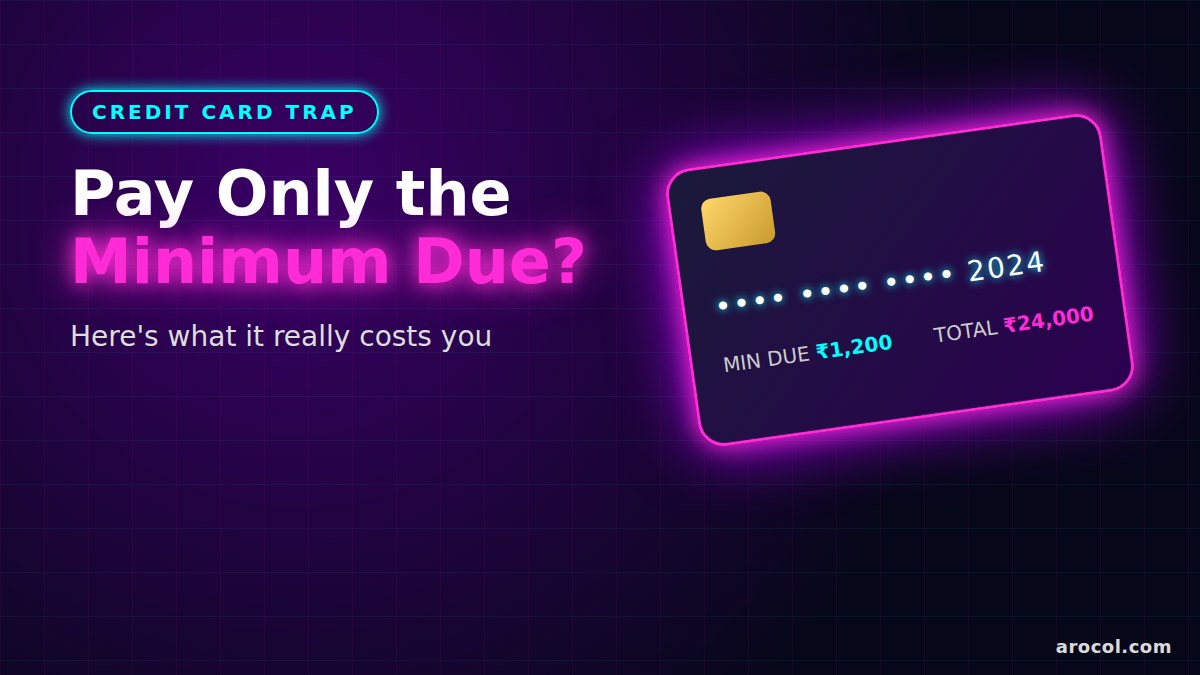
You open the statement and see two amounts: Total Amount Due: ₹24,000 and Minimum Amount Due: ₹1,200.
That second number is tempting. You could pay ₹1,200 today and deal with the rest next month.
But there’s a catch. Paying the minimum amount due doesn’t mean you’ve cleared the bill. It means most of what you owe is still sitting on your card, where interest and other applicable charges can make it more expensive to repay.
What is the minimum amount due on a credit card?
The minimum amount due (MAD) is the smallest amount your credit card issuer asks you to pay by the due date to keep your account in good standing. In India it’s usually around 5% of the outstanding balance, plus any EMIs, fees or overlimit amounts, but the exact formula depends on your card.
It is not the same as the total amount due (TAD).
Let’s go back to that ₹24,000 bill. If you pay ₹1,200, you still have ₹22,800 left unpaid, before accounting for any applicable interest or other charges.
You’ve made a payment, but you haven’t finished paying for those purchases.
This distinction matters because the minimum payment figure can make a large bill look easier to handle than it really is.
| Minimum amount due (MAD) | Total amount due (TAD) | |
|---|---|---|
| What it is | The smallest payment to avoid a late fee | Everything you owe for that statement |
| Late payment fee if paid | No | No |
| Interest charged | Yes, on the unpaid balance and often on new purchases | No interest on purchases |
| Interest-free period kept | Usually lost | Yes |
What happens if you pay only the minimum due?
Credit cards charge interest when you carry an unpaid balance. The rate and calculation method depend on your card agreement.
And once interest starts adding to what you owe, your payments may not reduce the original balance as quickly as you expect.
Imagine paying a small amount every month while continuing to use the same card for groceries, fuel and online shopping. You’re paying something regularly, but new purchases and applicable charges may keep the outstanding amount from falling much.
That’s how a bill from one month can follow you into the next, and the next.
It doesn’t happen in exactly the same way for every cardholder. Your interest rate, payment amount, spending and card terms all affect the outcome. Still, the basic problem is simple: an unpaid balance can cost more than the original purchases.
Credit card interest rates in India: why it adds up so fast
Most Indian credit cards charge finance charges of around 3% to 3.75% a month. That’s roughly 36% to 45% a year. On top of that, 18% GST is charged on the interest itself.
For comparison, a personal loan might cost 11% to 20% a year, and a home loan around 8% to 9.5%. Credit card debt is one of the most expensive kinds of borrowing you can have.
Even one month matters. If you leave ₹22,800 unpaid at 3.6% a month plus GST, the interest for that single month is close to ₹970. That’s almost the entire minimum payment you just made.

How long does it take to repay a credit card paying only the minimum?
Here’s a simple illustration. Say you owe ₹24,000, stop using the card completely, and the card charges 3.6% a month plus GST. Look at what happens with three different payment plans:
| How you pay | Time to clear the debt | Total you pay |
|---|---|---|
| Minimum due only (5% of balance) | About 19 years | About ₹1,17,000 |
| Fixed ₹2,000 every month | About 18 months | About ₹34,300 |
| Fixed ₹4,000 every month | About 8 months | About ₹28,300 |
The minimum keeps shrinking as your balance shrinks, so it never quite catches up with the interest. A fixed payment, even a modest one, finishes the job dramatically faster. Your real numbers will differ based on your card’s rate and terms, but the pattern is the same for every card.
If this reminds you of loans, it should. It’s the same trap we explain in why a lower EMI can cost you more: a smaller payment feels easier but stretches the debt and the interest.

What happens to the interest-free period?
You may have heard that credit cards offer an interest-free period on purchases, often 20 to 50 days.
They often do, but that benefit has conditions.
If you don’t pay the full statement balance, you may lose the usual interest-free benefit on eligible purchases, depending on your card’s terms. That can change how interest applies to both the balance you’re carrying and subsequent transactions. On many cards, new purchases start attracting interest from the day you make them until the full balance is cleared.
This is one reason it’s worth reading your card’s Most Important Terms and Conditions (MITC) rather than relying on a general description of how credit cards work.
Look for the sections explaining finance charges, payment allocation and the interest-free period. If the wording is confusing, ask the issuer to explain how it applies to your account.
Does paying the minimum due affect your CIBIL score?
Paying at least the minimum by the due date counts as an on-time payment, so it won’t be reported as a missed payment. That’s the one thing the minimum protects.
But carrying a high balance month after month pushes up your credit utilisation, which is how much of your card limit you’re using. Using more than about 30% of your limit regularly can pull your score down over time. We explain this in detail in how to improve your CIBIL score.
Missing even the minimum is far worse. You’ll be charged a late payment fee, and once a payment is more than a few days past due it can be reported to credit bureaus like TransUnion CIBIL. The Reserve Bank of India’s credit card rules say late fees can only be charged, and an account reported as past due, after a payment is overdue for more than three days. Don’t rely on that buffer, though. Pay on time.
“I’ll clear it next month” can be harder than it sounds
There’s nothing unusual about having a month when expenses get out of hand.
The problem begins when next month’s income already has other jobs to do.
Rent is due. Electricity needs to be paid. You still need groceries. Meanwhile, the unpaid credit card balance hasn’t disappeared.
If you use the card again to cover everyday spending, you may end up managing an old bill and a new one at the same time.
A payment that looked manageable in isolation can become difficult when it has to compete with your regular expenses. If you’re not sure where your money goes each month, start with where your salary goes every month.
That’s why it helps to look at the entire outstanding balance, not just the minimum payment printed on the statement.
What if you genuinely can’t pay the full amount?
First, don’t ignore the bill.
Open your statement and find the total outstanding amount, due date, applicable interest rate and any fees. Check whether there are transactions or charges you don’t recognize. If you spot something you didn’t buy, report it to your bank immediately and read how to protect yourself from UPI and online fraud.
Next, work out what you can realistically pay without leaving yourself unable to cover essentials. Pay more than the minimum wherever you can. Even ₹500 extra a month makes a real difference.
If you need help understanding your options, contact your card issuer. Ask what repayment arrangements, if any, are available and request a clear explanation of the total cost and conditions.
And while you’re trying to reduce an existing balance, think carefully before putting more non-essential purchases on the card.
The aim is to understand what you owe and avoid making the situation harder to manage.
How to get out of credit card debt: 5 steps
- Stop adding to the balance. Use UPI or a debit card for daily spending until the card is cleared. You can keep the card open, just don’t use it.
- Pay a fixed amount above the minimum every month. Set up a standing instruction so it happens automatically on salary day.
- If you have more than one card, attack the most expensive first. Pay the minimum on the others, and put every extra rupee on the card with the highest interest rate.
- Look at cheaper ways to borrow the balance. See the options below, and compare the total cost, not just the monthly amount.
- Build a small emergency fund. Most card debt starts with an unexpected expense. A cushion stops it from happening again. Read how much emergency fund you need in India and how to build one when money is tight.

Credit card EMI, balance transfer or personal loan: which is cheaper?
You might come across offers to convert a balance into instalments or repay it using another loan. Don’t assume these options are automatically cheaper. Compare their interest, fees, repayment periods and total payable amounts before deciding.
- Convert to EMI. Most banks let you turn a big purchase or your outstanding balance into EMIs, often at 13% to 24% a year plus a processing fee and GST. Much cheaper than revolving interest, but check the total.
- Balance transfer. Some cards let you move the balance from another card at a low rate for a few months. Useful only if you can clear it before the offer ends.
- Personal loan. If your credit score is good, a personal loan at 11% to 16% can replace 40%+ card debt. Our guide to getting a personal loan at the lowest rate shows how to compare offers.
Whichever you choose, close the gap that caused the debt. Otherwise you can end up with both a loan and a fresh card balance.
A quick habit that can change how you read your bill
The next time your credit card statement arrives, look at the total amount due first.
Then look at the minimum amount due.
That order matters. The total tells you the size of the bill you’re dealing with. The minimum tells you the payment required under the issuer’s terms for that billing cycle.
They answer two different questions.
It’s also worth checking your statement each month, even when you think you know how much you spent. Subscriptions, small purchases and unexpected charges are easier to spot when you review them regularly. A free AI chatbot can help you sort a statement into categories in minutes; see how to use AI to plan your monthly budget.
How to use a credit card the right way
None of this means credit cards are bad. Used well, they give you up to 50 days of free credit, cashback, reward points and a better credit history. The rule is simple: only spend what you can pay in full by the due date.
Turn on autopay for the total amount due, not the minimum. Keep your spending under 30% of your limit. And pick a card whose rewards match how you already spend. Our guide to choosing the right credit card in India explains how.
If you already pay in full every month, these are popular cards with simple rewards:
- SBI Cashback Credit Card: flat cashback on online spending, good if you shop online often.
- HDFC Millennia Credit Card: cashback on popular shopping and food apps.
- AU LIT Credit Card: lets you pick and pay only for the features you want.
And if money habits are the real problem, two books help more than any card feature: The Psychology of Money by Morgan Housel and Let’s Talk Money by Monika Halan.
Some links above are affiliate links. If you sign up or buy through them, Arocol may earn a small commission at no extra cost to you. Don’t apply for a new card while you’re carrying unpaid card debt. Read our affiliate disclosure.
Common credit card debt mistakes to avoid
- Withdrawing cash on a credit card. Cash advances charge interest from day one, plus a fee of around 2.5%. There’s no interest-free period at all.
- Paying one card with another. Moving debt around without a plan only adds fees and makes it harder to track.
- Using “Buy Now, Pay Later” to cover card bills. It’s still borrowing, and missed payments still hit your credit score.
- Closing old cards in a hurry. Your oldest card helps your credit history. Stop using it instead of closing it, unless it has a high annual fee.
- Hiding the debt from your family. Talking about it early makes it easier to cut spending together and clear it faster.
Credit card minimum due FAQs
Is it okay to pay only the minimum due once?
Once in a while, in a real emergency, it’s better than missing the payment. But clear the rest as quickly as you can, because interest starts adding up right away.
Will I be charged a late fee if I pay the minimum due?
No. Paying at least the minimum by the due date avoids the late payment fee. You’ll still pay interest on the unpaid balance.
How is the minimum amount due calculated?
Usually around 5% of the total outstanding, plus any EMIs, fees, interest or overlimit amount. Check your card’s MITC for the exact formula.
Does paying the minimum due hurt my CIBIL score?
It won’t count as a missed payment, but a high balance increases your credit utilisation, which can lower your score over time.
What is the interest rate on credit cards in India?
Typically 3% to 3.75% a month, or about 36% to 45% a year, plus 18% GST on the interest. Rates vary by card.
Should I pay the minimum due or the total due?
Always the total due if you can. If you can’t, pay as much above the minimum as possible and make a plan to clear the rest within a few months.
The bottom line
Paying the minimum amount due can seem like a convenient way to get through an expensive month. But it leaves a balance behind, and that balance may attract interest and other charges.
If you’re carrying credit card debt, the useful question isn’t just, “Can I make this month’s minimum payment?”
It’s also, “How much do I still owe, what is it costing me, and how will I pay it down?”
Understanding those three things gives you a much clearer picture of your credit card bill. And once the debt is gone, the money you were paying in interest can start working for you instead. Our saving vs investing guide shows where to put it next.
Recommended reads
- How to Use a Credit Card Without Ever Paying Interest
- How to Improve Your CIBIL Score: A Practical Guide That Actually Works
- Getting a Personal Loan? How to Pay the Least Interest
- EMI vs Total Interest: Why a Lower EMI Can Cost You Lakhs More
- How to Build an Emergency Fund When Money Is Tight: 12 Practical Ways
Disclaimer: This article is for general financial education and is not personalized financial advice. Interest calculations, fees and repayment terms vary by credit card issuer and product. The repayment examples are simplified illustrations. Refer to your card agreement and latest statement for details.