Disclosure: This post contains affiliate links. If you sign up or buy through them, Arocol may earn a small commission at no extra cost to you. We only recommend products we think are useful. As an Amazon Associate I earn from qualifying purchases. Read our affiliate disclosure.
An emergency fund is the first step in any good financial plan, yet it’s the one most people skip. There is a lot of advice online about investing.
Start a SIP. Buy stocks. Invest in mutual funds. Put your money to work.
All of that can be useful, but there is one part of personal finance that doesn’t get nearly as much attention: having money available when life doesn’t go according to plan.
Imagine getting your salary at the beginning of the month and feeling like everything is under control. A couple of weeks later, your car needs an expensive repair. Or you have an unexpected medical bill. Maybe your income suddenly gets interrupted.
The expense doesn’t care whether you had planned for it.
Without savings, the easiest option can become borrowing money.
That is one of the main reasons an emergency fund matters. In this guide, we’ll cover what an emergency fund is, how much emergency fund you need in India, where to keep your emergency fund, and how to build an emergency fund even on a small salary.
What is an emergency fund?
An emergency fund is simply money kept aside for unexpected and necessary expenses. Some people call it a rainy day fund, contingency fund or emergency savings. The name doesn’t matter. What matters is that it’s separate from your everyday spending money.
It isn’t money for a new phone you’ve been wanting. It isn’t your holiday budget. And it shouldn’t be the money you use every time you see something interesting during an online sale.
Its job is much less exciting than that.
It sits there until you genuinely need it.
And honestly, that’s a good thing.
Having money available can mean you don’t have to immediately reach for a credit card or personal loan when something goes wrong.
Why you need an emergency fund: real emergencies Indian families face
It helps to picture what you’re actually preparing for. These are the situations that most often catch people off guard:
- Job loss or a delayed salary. Layoffs, a company shutting down, or a salary that arrives two months late.
- Medical costs insurance doesn’t cover. Room rent limits, co-payments, OPD visits, medicines after discharge and travel to the hospital add up fast.
- Family emergencies. Last-minute train or flight tickets to your hometown, or helping a parent with an urgent bill.
- Vehicle and home repairs. A bike engine, a leaking roof in the monsoon, a fridge or washing machine that gives up.
- Sudden moves. A new rental often needs two to three months of rent as a deposit, plus brokerage and shifting costs.
None of these are rare. Over a few years, most households face at least one of them. The only question is whether you’ll pay with your own money or with borrowed money.
How much emergency fund do you need in India?
This is where people often make things unnecessarily complicated.
You will hear recommendations such as three months of expenses, six months of expenses or even a year’s worth of expenses.
But there isn’t one magic number.
Start by looking at what you actually spend each month on things you cannot easily avoid.
Rent, groceries, electricity, transportation, loan payments and other essential expenses are a good place to start. If you’re not sure what that number is, our guide on where your salary goes every month will help you find it.
Let’s say your essential monthly expenses come to ₹30,000.
Three months would be ₹90,000.
Six months would be ₹1.8 lakh.
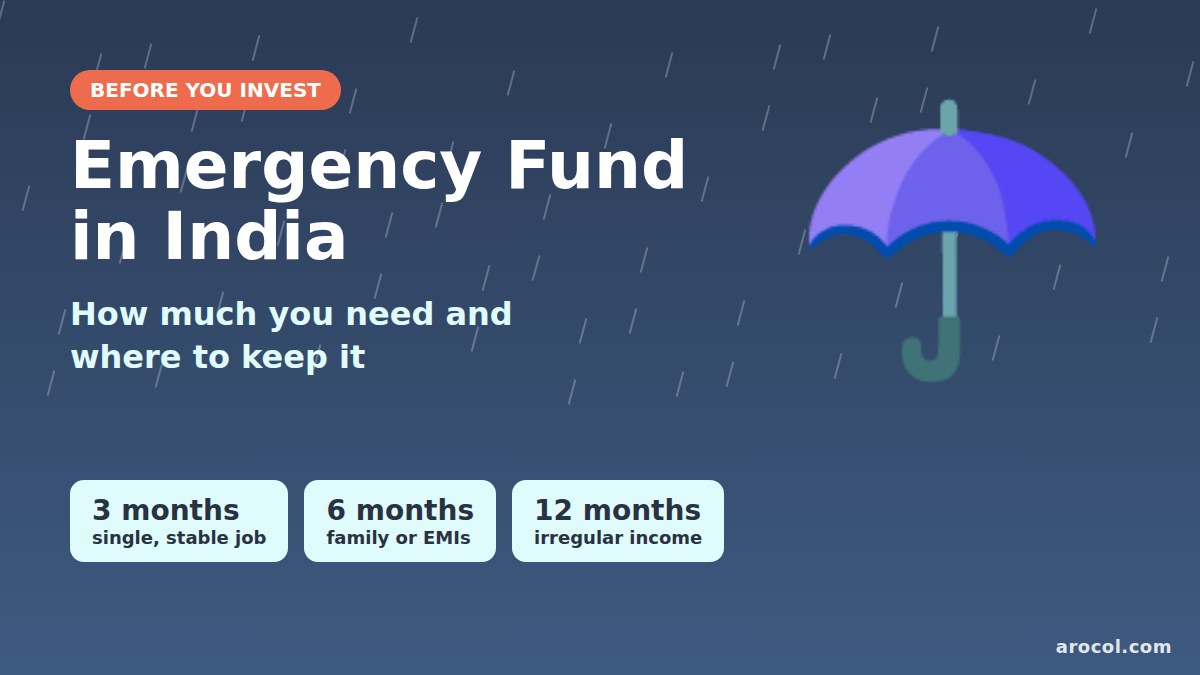
So the simple emergency fund formula is: essential monthly expenses × number of months. Your situation decides how many months you need. Use this as a rough guide:
| Your situation | Suggested cushion | At ₹30,000 a month |
|---|---|---|
| Single, steady salaried job, no dependants | 3 months | ₹90,000 |
| Married, kids or parents depending on one income | 6 months | ₹1.8 lakh |
| Freelancer, business owner or commission-based income | 9 to 12 months | ₹2.7 to 3.6 lakh |
If both partners earn and work in different industries, you can lean towards the lower end. If you work in a sector with frequent layoffs, lean higher.

Want a quick number? Paste this into ChatGPT, Gemini or Claude, fill the blanks, and let it do the adding for you:
I live in India. Help me work out my emergency fund target. Don’t ask for any personal or bank details.
My essential monthly costs: rent [ ], groceries [ ], bills [ ], transport [ ], EMIs [ ], insurance premiums [ ], school fees [ ], medicines [ ], money I send to family [ ].
Earners at home: [1/2]. Job type: [salaried/freelance/business]. Dependants: [ ].
1. Add up my essential monthly costs.
2. Tell me if I should aim for 3, 6 or more months, and why.
3. Split the total into savings account, sweep-in FD and liquid fund layers.
4. Give me first milestones I can reach in 3 to 6 months.
Don’t have the money yet? Start small
That’s normal. Most people don’t start with three months saved. They start with ₹10,000, then ₹25,000, then a little more.
This guide is about how much you need and where to keep it. The “how do I actually find the money” part has its own page: how to build an emergency fund when money is tight, with 12 practical ways, a starter target and how to automate it.
If you like working with numbers, a free AI chatbot can also go through your spending with you. See how to use AI to plan your monthly budget.
Don’t make your emergency fund too difficult to access
There is a temptation to think, “If I’m saving money, I should invest it so it grows.”
That thinking makes sense for long-term money. We explain the difference in detail in saving money vs investing money.
Emergency money is different.
Suppose you suddenly need ₹40,000 tomorrow. You don’t want to discover that your emergency savings are sitting in something that takes time to sell or withdraw from.
The main purpose of this money is not to produce impressive returns.
It is to be there when you need it.
For that reason, accessibility and safety are important when deciding where to keep it.
Where to keep your emergency fund in India
A simple way to balance access and a little return is to split the money into layers:
- Savings account, about one month of expenses. This is your instant money, available any time through UPI, a debit card or net banking.
- Sweep-in FD, about two months. Many banks offer an auto-sweep facility. Money above a set limit is moved into an FD and earns FD interest, but comes back to your account automatically when you need it.
- Liquid mutual fund, the rest. Liquid funds invest in very short-term debt. Redemptions are usually credited by the next working day, and many funds offer instant redemption of up to ₹50,000 a day. They are low risk, but not risk-free, and returns aren’t guaranteed. The AMFI investor corner explains how they work.
Bank deposits are insured by the DICGC, a subsidiary of the Reserve Bank of India, up to ₹5 lakh per depositor per bank. Keep your emergency fund in a large, well-known bank, and split it across two banks if it grows beyond ₹5 lakh.
Where you should not keep it: equity mutual funds, shares, gold, crypto, or long lock-in products like PPF, ELSS or a 5-year tax-saving FD. These may be fine investments, but they can fall in value or lock your money exactly when you need it. Want to see what an FD would earn? Try our FD calculator.

Is a credit card an emergency fund? No, and here’s why
Many people think, “I have a credit card with a ₹1 lakh limit, so I’m covered.”
A credit card can help in a pinch, and it’s handy to have one. But if you can’t pay the full bill by the due date, interest is usually around 3% to 3.75% a month. That’s roughly 36% to 45% a year, which is far more than any savings will ever earn. We show how quickly this grows in why paying only the minimum due is costly.
A personal loan is cheaper than card debt, but it still costs interest and needs a decent credit score. If your score is low when the emergency hits, you may not get one at all. Our guides on getting a personal loan at the lowest rate and improving your CIBIL score explain why.
Treat a credit card as a backup for a few days, not as the plan.
Emergency fund vs paying off debt: which comes first?
Short answer: a small starter cushion first, then high-interest debt, then the full fund.
Credit card dues can cost well over 30% a year, while savings earn a few percent, so clearing them fast usually wins. But with zero cash, the next surprise goes straight back on the card. I’ve explained the exact order step by step in building an emergency fund when money is tight.
Emergency fund vs health insurance: you need both
An emergency fund is built for the small and medium shocks. It isn’t meant to pay for a ₹5 lakh hospital stay or to replace your income for 20 years if something happens to you.
That’s what insurance is for:
- Health insurance covers big hospital bills. Your emergency fund covers what the policy doesn’t, like co-payments and room rent differences. See how to choose health insurance for your family.
- Term life insurance replaces your income for your family if you die early. See how to pick term insurance in India.
Without insurance, one big event can wipe out your emergency fund in a week. Without an emergency fund, even small events push you into debt. Together, they cover most of what life can throw at you.
When to use your emergency fund, and how to refill it
This is something people sometimes misunderstand.
Let’s say you’ve saved ₹1 lakh.
Then something genuinely unexpected happens and you need ₹30,000.
You use it.
That’s not failure.
That’s the reason you saved it in the first place.
Your emergency fund is now ₹70,000 instead of ₹1 lakh. Once the situation is over, you can slowly rebuild the ₹30,000.
Think of it as a financial cushion that gets used and refilled when necessary.
Emergency fund vs investments: keep them separate
Your investment portfolio and your emergency savings have different jobs.
Investments are generally intended for longer-term goals.
Emergency savings are there for the problems you didn’t plan for.
Keeping these two buckets separate can make your financial life easier to manage.
You don’t want to be forced to sell a long-term investment at an inconvenient time simply because your washing machine suddenly stopped working or you had an unexpected bill.
Once your emergency fund is in place, you’re ready to invest with a calm mind. Our guides to starting a SIP with just ₹500 and how to invest ₹10,000 a month are good next steps.
Common emergency fund mistakes to avoid
- Using it for wants. A sale, a new phone or a trip is not an emergency. Keep a separate “planned spending” savings for those.
- Keeping it in the same account you spend from. It quietly disappears. A separate account or a sweep FD keeps it out of sight.
- Never updating the target. When your rent goes up or a baby arrives, your monthly expenses change, and so should your fund.
- Not refilling it after use. Make rebuilding it the first thing you do once the emergency is over.
- Telling no one where it is. Make sure your spouse or a trusted family member knows where the money is and how to reach it.
The hidden benefit of an emergency fund: peace of mind
There’s also something about having emergency savings that doesn’t show up in a spreadsheet.
You worry less.
Not because you suddenly have enough money to handle everything, but because a relatively small problem doesn’t automatically become a financial crisis.
Having ₹50,000 sitting in an emergency account won’t make you wealthy.
But if an unexpected ₹30,000 expense appears, it can make a very big difference.
That breathing room is valuable. It also makes you a calmer investor. People with an emergency fund are far less likely to panic and sell their investments when markets fall.
Best tools to build and keep your emergency fund
- For the liquid fund layer: you can invest in liquid mutual funds through an investing app. Open a free account with Angel One and pick a liquid fund from a large fund house.
- A card as a short backup only: if you pay the full bill every month, a simple cashback card like the SBI Cashback Credit Card can bridge a few days until money moves from your liquid fund.
- Best book for Indian families: Let’s Talk Money by Monika Halan has a clear chapter on building an emergency fund.
- To build the saving habit: The Psychology of Money by Morgan Housel explains why “enough” and room for error matter so much.
- To track it on paper: a budget planner notebook makes your monthly saving visible.
Some links above are affiliate links. If you sign up or buy through them, Arocol may earn a small commission at no extra cost to you. Read our affiliate disclosure.
Emergency fund FAQs
Should I build an emergency fund before investing?
Yes, at least a starter fund of one to three months. Without it, the first surprise expense can force you to stop your SIP or sell investments at a bad time.
Can I keep my emergency fund in an FD?
Yes. A sweep-in FD or a few small FDs work well. Breaking an FD early usually costs a small penalty on interest, which is a fair price for safety.
Is a liquid fund safe for an emergency fund?
Liquid funds are low risk and usually pay out by the next working day, but they are not bank deposits and are not insured. Use them for the part of the fund you’re unlikely to need on day one.
Is gold a good emergency fund?
Not really. Gold prices can fall, and selling jewellery quickly often means a poor price. Keep gold as a long-term holding, not as your emergency money.
Is ₹1 lakh enough for an emergency fund?
It depends on your expenses. If your essential costs are around ₹30,000 a month, ₹1 lakh covers a little over three months, which is a good start for a single salaried person. A family on one income should aim higher.
What is a good emergency fund for a salaried person in India?
Most salaried people should aim for three to six months of essential expenses. If your job is in a sector with frequent layoffs, or you’re the only earner, go towards six months or more.
Should my emergency fund be 6 months of salary or 6 months of expenses?
Expenses, not salary. You only need to cover what you must pay to live, like rent, food, bills, EMIs and insurance premiums, not your full take-home pay.
Does an emergency fund earn interest?
Yes, a little. A savings account, sweep-in FD or liquid fund all earn some return, but the goal is safety and quick access, not high growth.
What if I live abroad and support family in India?
Keep an emergency fund where you live and a smaller one in India for your family. If you’re in the UAE, see our guide on sending money from UAE to India.
Start your emergency fund today, with whatever you can save
If you can put aside ₹10,000 a month, great.
If you can only manage ₹1,000, start with ₹1,000.
Waiting until you earn more can become an excuse that lasts for years.
The amount matters, but the habit matters too.
Build the first small cushion. Keep adding to it. Increase it when your financial situation improves.
You don’t need a perfect financial plan to begin.
You just need to make sure that when something unexpected happens, your first thought isn’t, “Where am I going to borrow this money from?”
Recommended reads
- Got ₹1 Lakh? How to Invest a Lump Sum in India
- How to Build an Emergency Fund When Money Is Tight: 12 Practical Ways
- Saving Money vs Investing Money: Why You Need to Understand Both
- Health Insurance for Your Family: What to Check Before You Buy
- FD Calculator: Find Your Fixed Deposit Maturity Value
- Where Does Your Salary Go Every Month? A Simple Budget Plan for Indians
Note: This article is for general educational purposes and is not personalized financial advice. The appropriate emergency-fund amount and where to keep it depend on your individual circumstances. Interest rates and product features mentioned are examples and can change.