Disclosure: This post contains an affiliate link. If you buy through it, Arocol may earn a small commission at no extra cost to you. As an Amazon Associate I earn from qualifying purchases. Read our affiliate disclosure.
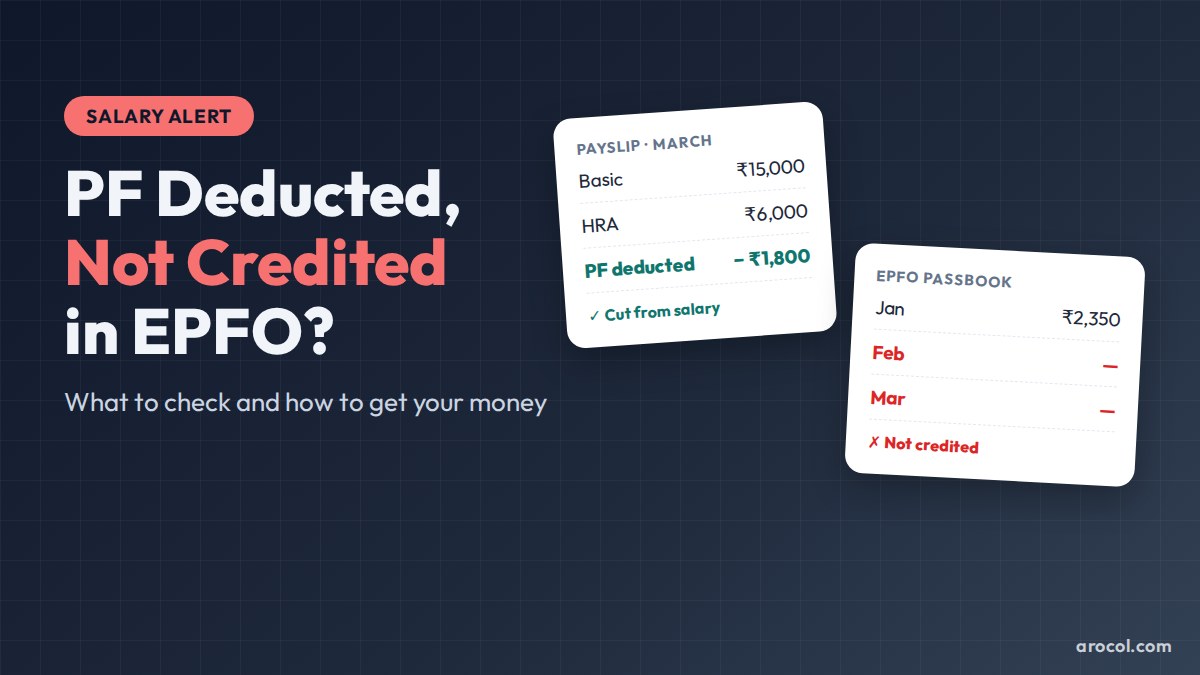
Your payslip says it clearly: “PF: ₹1,800”. The money is cut from your salary every month. But when you open your EPFO passbook, the last entry is from three months ago. Or six. Or there’s nothing at all.
It’s a worrying feeling, and you’re not imagining the problem. When PF is deducted but not credited, it can be a simple delay, a technical mix-up, or, in the worst case, an employer who is keeping money that legally belongs to you. The good news is that the law is firmly on your side, and EPFO gives you free, simple ways to complain and recover the money.
This guide explains, in plain language, how to check your PF properly, the common reasons your PF is not credited, what the employer must do by law, and a clear step-by-step plan to get your money into your account.
First, how PF is supposed to work
If you work at a company covered by EPF (usually one with 20 or more employees), two contributions go into your PF every month:
- Your share: 12% of your basic salary plus dearness allowance (DA). This is the amount you see deducted on your payslip.
- Your employer’s share: another 12%. Of this, 8.33% goes to the pension scheme (EPS), up to a limit, and the rest goes to your EPF account.
The employer cuts your share from your salary, adds its own share, and must pay the total to EPFO by the 15th of the next month. So PF cut from your March salary must be paid by 15 April. Along with the payment, the employer files a monthly return called the ECR (Electronic Challan cum Return), which tells EPFO how much belongs to which employee.
Once EPFO receives the money and the ECR, the amount shows in your passbook against your member ID. That’s the whole chain. When something breaks anywhere in it, your PF is not credited even though your salary shows the deduction.

If you’re new to reading your payslip, our guide on where your salary goes every month explains each deduction in simple words.
Step 1: Check your PF the right way
Before you assume the worst, make sure you’re looking at the right place and the right month. There are four easy ways to check:

- EPFO passbook website: log in at the EPFO passbook portal with your UAN and password. You’ll see every monthly credit, separated into employee share, employer share and pension.
- UMANG app: search for EPFO inside the app, then “View Passbook”. It shows the same details on your phone.
- Missed call: give a missed call to 9966044425 from the mobile number linked to your UAN. You’ll get an SMS with your latest balance.
- SMS: send EPFOHO UAN ENG to 7738299899 from your registered mobile.
When you look at the passbook, check these three things carefully:
- The wage month, not the date of credit. The passbook lists contributions by the salary month they belong to. March’s PF may appear in late April. If today is 10 May and April is missing, that’s normal, because the deadline for April is 15 May.
- The right member ID. Every job you’ve had creates a different member ID under the same UAN. If you changed jobs, make sure you’re looking at your current employer’s member ID, not the old one.
- Whether you have more than one UAN. Sometimes a new employer creates a fresh UAN instead of using your old one. Your PF may be going into a UAN you don’t even know about. Ask HR which UAN they’re using.
A quick tip: the EPFO website also has an Establishment Search option where you can look up your company by name or code and see the months for which it has filed PF payments. If the company hasn’t paid for a month for anyone, you’ll see the gap there too.
Common reasons PF is not credited

Not every gap means fraud. Here are the usual reasons, from the most harmless to the most serious:
1. It’s simply not due yet
As explained above, the employer has until the 15th of the following month. After payment, it can take a few more days for the passbook to update. A gap of one month is usually nothing to worry about.
2. Your PF is in a different UAN or member ID
This is very common after a job change. The money is safe; it’s just sitting under a different number. Once you find it, you can link or transfer it online through the member portal.
3. Your company runs its own PF trust
Some large companies are “exempted establishments”. They manage employees’ PF through their own private trust instead of depositing it with EPFO. In that case, your contributions won’t appear in the EPFO passbook at all. You check your balance on the trust’s portal or through HR. EPFO still supervises these trusts, and you can still complain to EPFO if the trust doesn’t credit your money.
4. Details don’t match
If your name, date of birth or Aadhaar details in the employer’s records don’t match EPFO’s records, the return can get stuck. The employer usually has to correct it and file again.
5. The employer is late or not paying at all
This is the serious one. Companies in cash trouble sometimes cut PF from salaries but use the money to pay other bills, hoping to “catch up later”. Sometimes they never do. If several months are missing and HR gives vague answers, treat this as a real problem and act quickly.
What the law says: this is your money
It helps to know where you stand before you talk to HR, because it changes the tone of the conversation:
- The employer must deposit both shares by the 15th of the next month. There’s no option to “hold” it for business needs.
- Late payment costs the employer. EPFO charges interest on late PF and can add penalty damages on top. The longer the delay, the more the employer pays.
- EPFO can recover the dues. It can hold an inquiry, work out how much the employer owes, and recover it, including by attaching the company’s bank accounts or property.
- Cutting your share and not depositing it is treated very seriously. Courts have treated it as criminal breach of trust, because the employer took money that belonged to you and didn’t pass it on. Directors and people responsible for the company can be held personally liable.
You don’t need to quote any of this aggressively. But knowing it helps you stay calm and firm.
Your step-by-step action plan

If your PF is not credited after the due date, follow these steps in order. Each step is free.
1. Collect your proof
Download your payslips for the months where PF was deducted but not credited, a screenshot of your passbook showing the gap, your UAN, your member ID and your offer letter or appointment letter. If your salary comes into your bank account, the bank statement helps too. Save everything in one folder.
2. Ask HR or payroll in writing
Send a short, polite email. Something like: “My payslips for January to March show PF deductions, but my EPFO passbook shows no credit for these months. Please share the ECR or challan details (TRRN) for these months, or let me know when the amount will be deposited.” Email is better than a phone call, because it creates a dated record.
A genuine employer will usually reply with a challan, a payment receipt or an honest explanation. If they share a TRRN number, you can ask them to check the payment status with EPFO.
3. Give them a short, clear deadline
If the reply is “it will be done soon”, ask for a specific date in writing. Seven to fifteen days is reasonable. If nothing happens by then, move to the next step. Don’t wait months. The longer the gap, the harder recovery becomes, especially if the company is struggling.
4. File a grievance on EPFiGMS
EPFO’s official complaint system is EPFiGMS. It’s free and online:
- Go to the website and choose “Register Grievance”.
- Select “PF Member” and enter your UAN. Verify with the OTP sent to your registered mobile.
- Pick the member ID for your current employer.
- Choose the grievance category for PF not credited, or contributions not deposited by the employer.
- Describe the problem in a few lines: which months are missing, that your payslips show the deduction, and that you’ve already asked HR. Attach your payslips and passbook screenshot.
- Submit and save the registration number. You’ll get updates by SMS and email.
The complaint goes to the regional PF office that handles your company. Many cases get sorted at this stage, because the PF office contacts the employer directly, and most employers don’t want an official inquiry.
5. Call or visit the regional PF office
If the grievance isn’t resolved in about 30 days, call the EPFO toll-free helpline (1800-118-005) or visit the regional office with your documents and grievance number. Ask to speak to the enforcement or compliance section. Many regional offices also hold a monthly public grievance meeting (“Nidhi Aapke Nikat”), where you can raise your case in person.
6. Escalate if needed
If you still don’t get a response, you can file a complaint on the central government’s public grievance portal, CPGRAMS, choosing the Ministry of Labour and Employment. For long, deliberate non-payment, many employees also file a police complaint for criminal breach of trust, or approach the labour department. It’s worth speaking to a labour lawyer before that step, especially if several colleagues are affected.
Is it better to complain together?
Yes, if colleagues have the same problem. When several employees file grievances about the same months, it’s clear the issue isn’t a one-person mix-up. The PF office tends to treat it as an employer-level default and can open a full inquiry into the company’s records. Each person should still file their own grievance with their own UAN, but you can mention in yours that other employees are affected too.
Talk to colleagues calmly and share facts, not rumours. Check passbooks together, list the missing months, and keep copies of every email you send to HR.
What if you’ve left the job, or the company shut down?
You can still complain. If your PF was deducted but not credited while you worked there, EPFiGMS works even after you’ve resigned, because the complaint is about the months you were employed. EPFO can recover dues from the employer for past periods as well.
If the company has closed, EPFO can still go after its assets and, in many cases, the people responsible for running it. It may take longer, but don’t give up on the money. File the grievance with your old payslips as proof.
If you’re planning to withdraw your PF or transfer it to a new employer, check your passbook first. A withdrawal pays out only what’s actually credited. If months are missing, raise the complaint before or alongside your claim, so the gap doesn’t get forgotten.
How to protect yourself from now on
- Check your passbook every month or two. A missed call takes ten seconds. Catching PF that is not credited after one month is far easier than after a year.
- Keep every payslip. Save the PDF each month in a folder on your phone or email. Payslips are your strongest proof.
- Complete your KYC on the member portal. Link Aadhaar, PAN and bank account to your UAN at the EPFO member portal, so contributions and claims don’t get stuck.
- Add an e-nominee. It takes five minutes and makes claims much easier for your family.
- Use one UAN for your whole career. Give your existing UAN to every new employer, and transfer old balances so everything stays in one place.
- Never share your UAN password or OTP. Fake “EPFO agents” call people offering to speed up claims. EPFO never asks for your password, OTP or bank PIN. Read our guide on protecting yourself from online fraud.
Why it’s worth the effort
It’s easy to think, “It’s only ₹1,800 a month, not worth a fight.” But both shares together, plus the interest, add up quickly. Say your basic salary is ₹15,000. Your share and your employer’s EPF share are worth around ₹2,350 a month, and a pension contribution of ₹1,250 sits on top. Six months of PF not credited is roughly ₹14,000 in your EPF alone, before any interest. Over a full career, money in EPF grows into one of the biggest parts of your retirement savings, earning a government-declared interest rate that has stayed above 8% for years.
EPF is the base of most salaried people’s retirement plan. If you’d like to see how it fits together with PPF and NPS, read our retirement planning guide.
A book that makes salary money simple
If you want to understand your salary, PF, insurance and investing as one simple system, Let’s Talk Money by Monika Halan is one of the clearest books written for Indian salaried readers.
Frequently asked questions
How long does it take for PF to show in the passbook?
The employer must pay by the 15th of the next month. After that, it usually shows within a few days. So March’s PF typically appears in the second half of April.
My payslip shows PF but my passbook is empty. Is my money lost?
Usually not. First check that you’re looking at the right UAN and member ID, and whether your company runs its own PF trust. If the money truly hasn’t been deposited, EPFO can recover it from the employer, with interest.
Can I complain to EPFO without telling my employer?
Yes. You can file an EPFiGMS grievance directly. It’s still a good idea to ask HR in writing first, because it often solves the problem faster and shows you tried.
Will I lose the interest for the months it was late?
The employer is supposed to pay interest and damages for late deposits. When EPFO recovers late dues, the amount credited to you should include the contributions that were due. If the numbers look short, raise it in your grievance.
Is the employer’s share shown on my payslip?
Often not. Most payslips show only your 12% share. The employer’s share is usually part of your CTC but not shown as a deduction. Your passbook shows both shares separately.
Where do I complain if PF is deducted but not credited?
Start with HR in writing. If that doesn’t work, file a grievance on EPFiGMS, EPFO’s official complaint website. If it’s still not solved, contact your regional PF office or the EPFO helpline, and then CPGRAMS.
What is a TRRN number?
It’s the reference number of the employer’s monthly PF return and payment. If HR gives you the TRRN for a month, it shows they at least created the return. Ask whether it was actually paid, because a return can be created and left unpaid.
Can I withdraw my PF if the employer hasn’t deposited it?
You can only withdraw what’s actually in your account. The missing months need to be recovered from the employer first through a grievance.
Your next step
Give a missed call to 9966044425 today and look at your latest balance. If months are missing beyond the 15th-of-next-month deadline, email HR tonight with your payslips attached. If there’s no clear answer within two weeks, file a grievance on EPFiGMS. It’s your money, the law is on your side, and the process is free.
Recommended reads
- Planning Your Retirement in India With EPF, PPF and NPS
- Where Does Your Salary Go Every Month?
- PPF Account in India: Interest, Rules and How to Open One
- Old vs New Tax Regime: Which One Saves You More?
- All our tax and salary guides
This article is for general information only and isn’t legal or financial advice. PF rules, interest rates and complaint processes are set by EPFO and the Government of India and can change. For serious or long-running non-payment, please speak to EPFO or a labour law professional.