Disclosure: This post has affiliate links. Arocol may earn a small commission at no extra cost to you. As an Amazon Associate I earn from qualifying purchases. Read our disclosure.
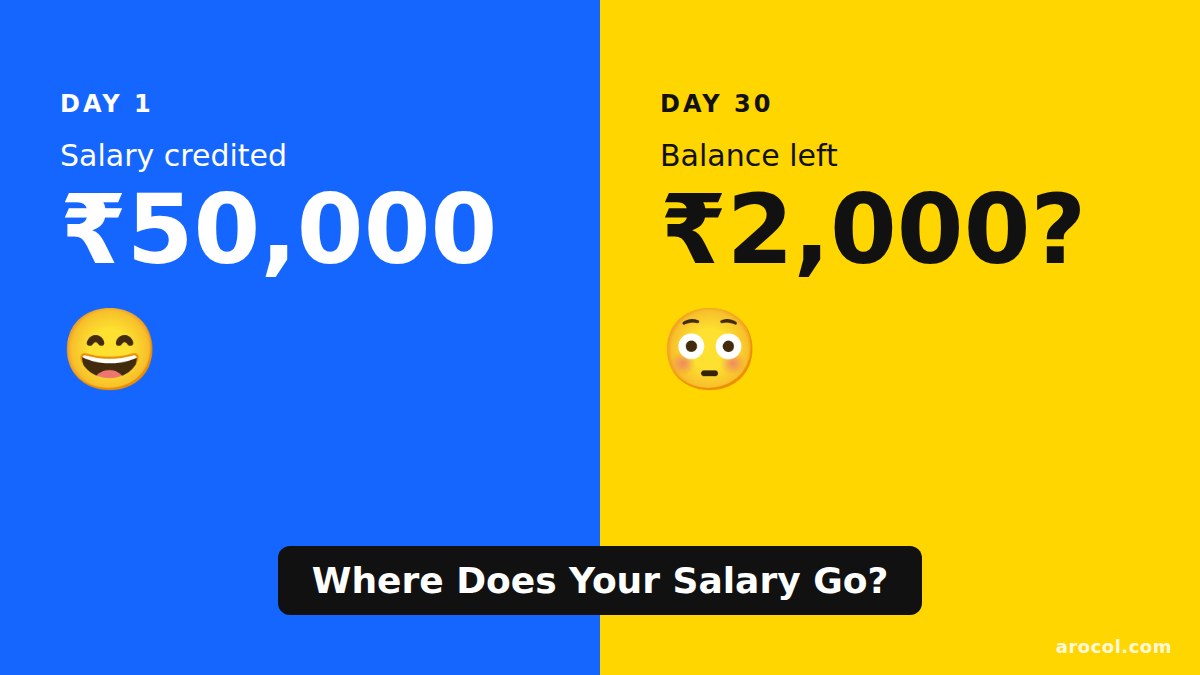
Have you ever checked your bank account a few days after getting your salary and thought:
“Wait… how did I spend this much already?”
I have a feeling a lot of people have had that moment.
You get paid. For a day or two, everything feels fine. You look at the balance and think, Okay, this month I’m going to save properly.
Then life starts happening.
You order food because you’re tired.
You buy something online because it is “on sale.”
You take a cab instead of the bus because you’re running late.
Then there’s the subscription you forgot about, the coffee you didn’t really plan to buy, and that random ₹800 purchase that seemed completely reasonable at the time.
Nothing feels expensive enough to be a problem.
And yet, somehow, the money keeps disappearing.
In this guide, we’ll look at where your salary actually goes every month, the hidden leaks most people miss, a simple monthly budget that works on an Indian salary, and how to save money from your salary without giving up everything you enjoy.
Where does your salary actually go? A typical breakdown
Every household is different, but for many salaried people in Indian cities, the money tends to split up roughly like this:
| Category | Typical share of take-home pay |
|---|---|
| Rent or home loan EMI | 25% to 35% |
| Groceries and household items | 10% to 15% |
| Transport, fuel and cabs | 5% to 10% |
| Phone, internet, electricity and other bills | 5% to 8% |
| Other EMIs and credit card bills | 0% to 20% |
| Food delivery, eating out and shopping | 10% to 20% |
| Supporting parents or family | 0% to 15% |
| Savings and investments | Often whatever is left, sometimes 0% |
Look at the last row. For many people, saving is whatever survives the month. That’s usually the root of the problem.
The funny thing about earning more: lifestyle inflation
You might think this problem disappears when your salary increases.
Sometimes it does.
But sometimes something rather strange happens.
You earn ₹40,000 a month and manage your expenses around it.
Then your salary becomes ₹60,000.
You celebrate, understandably.
Maybe you start thinking about getting a better phone. You eat out a little more. You stop worrying about small purchases. Perhaps you upgrade your internet plan or start taking cabs more often.
None of those decisions seems crazy.
That’s the problem.
A year later, you might be earning considerably more and still wondering why your savings account doesn’t look much different.
Your salary went up.
Your lifestyle quietly followed it.
This is commonly called lifestyle inflation.
And it can happen without you even noticing.
A simple fix: every time your salary rises, decide on day one that at least half of the increase goes to savings or investments. If you get a ₹10,000 raise, increase your SIP or savings by ₹5,000 before you get used to the extra money. You still enjoy the other half.

It’s usually the small things
Let’s say you spend an extra ₹500 every week.
That’s not a huge amount, right?
You probably wouldn’t lose sleep over it.
But ₹500 every week is ₹26,000 over a year.
And that’s just one habit.
Now imagine a few of them happening together.
Extra food deliveries.
More shopping.
More entertainment subscriptions.
More expensive weekends.
More frequent cab rides.
None of these expenses individually looks scary.
Together, they can make a surprisingly large dent in your finances.
Here’s another way to see it. If you redirected about ₹2,000 a month of those small spends into a SIP for 10 years, and it earned around 12% a year, it could grow to roughly ₹4.6 lakh. Returns aren’t guaranteed, but the point stands: small leaks become big money over time. You can try your own numbers with our SIP calculator.
That’s why looking only at your biggest expenses doesn’t always tell the whole story.
Sometimes your money is leaking through a hundred tiny holes.

The hidden money leaks most people miss
When people go through their statements carefully, these are the leaks that show up again and again:
- Forgotten subscriptions. OTT apps, music, cloud storage, gym memberships and app subscriptions that renew quietly every month.
- Tiny UPI payments. ₹40 here and ₹150 there feel like nothing, but dozens of them add up to thousands.
- Delivery and convenience fees. Platform fees, delivery charges and surge pricing can add 15% to 30% to a small order.
- Buy Now, Pay Later and small EMIs. A phone, a watch and a sofa on EMI can quietly lock up a big chunk of next year’s salary. Our guide on EMI vs total interest shows how this adds up.
- Credit card interest. Paying only the minimum due turns last month’s shopping into a long, expensive debt. See what happens when you pay only the minimum.
- Bank charges. Minimum balance penalties, card fees and late fees are easy to miss but simple to avoid.
Fixing even two or three of these can free up a few thousand rupees a month without changing how you live.
How to track your expenses (without a complicated spreadsheet)
Don’t make a complicated spreadsheet if you know you’re never going to use it.
Just sit down for ten minutes.
Look at your last month’s bank transactions.
And ask yourself:
Where did my money actually go?
Not where you think it went.
Where did it actually go?
Here are a few easy ways to find out:
- Your UPI app history. Most UPI apps show your spending by month and sometimes by category.
- Your bank and credit card statements. Download last month’s statement and highlight anything that wasn’t a real need.
- A free AI chatbot. Paste in your expenses and ask it to group them into categories and suggest where to cut. We show exactly how in how to use AI to plan your monthly budget.
- A small notebook. Writing down every spend for just one month makes you far more aware of where money goes.
You may find something surprising.
Maybe you’re spending far more on food than you realized.
Maybe several subscriptions are sitting there untouched.
Maybe online shopping is eating up a bigger part of your income than you expected.
Or maybe you’ll discover that you’re actually doing pretty well.
Either way, now you know. And you can’t really fix a money problem that you haven’t noticed yet.
“I’ll save what’s left” doesn’t work very well
This is one of those things that sounds logical.
You get your salary.
You pay your bills.
You buy what you need.
You enjoy yourself.
And at the end of the month, whatever remains goes into savings.
The problem?
There may be nothing left.
Or maybe there’s ₹1,000 left when you were hoping to save ₹10,000.
A simpler approach is to decide on your savings before you start spending. This is often called “pay yourself first”. Set up an automatic transfer or SIP for the day after your salary arrives, so the money moves before you can spend it.
You don’t have to follow some perfect percentage from an internet guru.
Start with an amount that is realistic for you.
If you can comfortably save ₹5,000, start there.
If later you can increase it, great.
The important thing is creating the habit.
A simple monthly budget for an Indian salary: the 50/30/20 rule
If you’d like a starting point, the 50/30/20 rule is easy to remember:
- 50% for needs: rent, groceries, bills, transport, EMIs and insurance premiums.
- 30% for wants: eating out, shopping, entertainment and trips.
- 20% for savings: emergency fund, SIPs and other goals.
Here’s what it looks like at different take-home salaries:
| Take-home salary | Needs (50%) | Wants (30%) | Savings (20%) |
|---|---|---|---|
| ₹30,000 | ₹15,000 | ₹9,000 | ₹6,000 |
| ₹50,000 | ₹25,000 | ₹15,000 | ₹10,000 |
| ₹1,00,000 | ₹50,000 | ₹30,000 | ₹20,000 |
In big cities, rent alone can take more than half your salary. That’s okay. Treat the rule as a guide, not a law. If needs take 60%, cut wants to 25% and aim to save at least 15%. As your salary grows, push savings towards 25% or 30%.

But saving everything isn’t the answer either
There’s another extreme.
Someone becomes serious about saving money and suddenly feels guilty about buying anything.
Dinner with friends? Too expensive.
A holiday? Waste of money.
A new pair of shoes? Absolutely not.
That isn’t necessarily financial freedom either.
Money is supposed to be useful.
If something genuinely makes your life better and you’ve planned for it, spending money on it isn’t automatically irresponsible.
The trick is knowing the difference between “I really want this” and “I bought this because I happened to see it.”
Those two things can look very similar on a shopping app. A simple test: for anything above ₹2,000 that isn’t a need, wait 48 hours before buying. If you still want it after two days, buy it without guilt.
Then there’s the emergency nobody plans for
Imagine everything is going perfectly.
You have a job.
Your salary arrives every month.
Your bills are under control.
Then your washing machine stops working.
Or your car needs an expensive repair.
Or you suddenly have a large medical or family expense.
That’s when an emergency fund stops being a boring savings account and starts feeling like a lifesaver.
The exact amount you need depends on your own situation, expenses and income. Our guide on how much emergency fund you need in India walks through it, and if money is already tight, read how to build an emergency fund when money is tight.
You don’t build an emergency fund because you expect something terrible to happen.
You build one because life has a habit of ignoring our plans. And alongside it, make sure your family has health insurance, so one hospital bill doesn’t wipe out years of saving.
What about investing?
Once you’ve got your everyday finances under control, you may start thinking about investing.
And this is where people sometimes make things unnecessarily complicated.
You hear about stocks.
Then mutual funds.
Then cryptocurrency.
Then someone tells you about a “secret” investment that supposedly doubles your money.
Suddenly you’re wondering whether you need to become a financial expert just to make your money grow.
You don’t.
But you do need to understand what you’re putting your money into. Our guide on saving vs investing explains the difference, and starting a SIP with just ₹500 is a gentle first step.
Investing isn’t the same as keeping emergency savings.
Investments can go up and down, sometimes significantly. The right choice depends on your goals, time horizon and ability to handle risk.
And if someone promises you guaranteed high returns with little or no risk, that’s a very good reason to slow down and investigate before handing over your money. Many of these offers are scams; read how to spot and avoid online money fraud.
Stop comparing your bank account with someone’s Instagram
This one is difficult.
You see someone buying a new car.
Someone else is travelling to another country.
Another person has a beautiful apartment and seems to eat at expensive restaurants every weekend.
And you start wondering:
“What am I doing wrong?”
Maybe nothing.
You are seeing their spending.
You aren’t seeing their entire financial situation.
That expensive car might be financed.
That holiday might have gone on a credit card.
That beautiful apartment might come with a huge monthly payment.
We simply don’t know.
Social media is very good at showing us what people buy.
It isn’t nearly as good at showing us what they owe.
Not sure how much tax comes out of your salary? Try the Income Tax calculator. And check that the PF cut from your salary really reaches your account on the EPF passbook.
A 5-step salary day routine
If you only remember one thing from this article, make it this routine for the day your salary arrives:
- Move your savings first. Transfer your fixed savings amount, or let your SIP auto-debit, on the same day.
- Pay the fixed bills. Rent, EMIs, insurance premiums and the full credit card bill, not the minimum.
- Set aside money for planned spends coming up this month, like a birthday or a trip.
- Split what’s left by week. If you have ₹12,000 for daily spending, think of it as ₹3,000 a week. It’s much easier to stay on track.
- Do a 10-minute review at month end. Look at what went where and adjust next month’s plan.
More money isn’t always the solution
Of course, earning more can help.
A higher income can make saving easier and give you more financial choices.
But if your spending automatically rises every time your income rises, you’ll keep feeling like you’re chasing the same number.
That’s why personal finance isn’t only about making more money.
It’s also about deciding what you want your money to do.
Maybe you want an emergency fund.
Maybe you’re saving for a house.
Maybe you want to travel.
Maybe you simply want the peace of knowing that one unexpected expense won’t completely destroy your month.
Those goals are different.
And that’s okay. There isn’t one perfect way to manage money. When you’re ready to grow your savings, see how to invest ₹10,000 a month.
Helpful tools and reads
- Track your spending on paper: a budget planner notebook makes every rupee visible for a month.
- Understand your money habits: The Psychology of Money by Morgan Housel explains why we spend the way we do.
- A clear plan for Indian families: Let’s Talk Money by Monika Halan has a simple system for salary, savings and insurance.
- Start your first SIP: open a free demat account with Angel One and set it to auto-debit on salary day.
- Earn back on spends you’d make anyway: if you always pay your card in full, a cashback card like the HDFC Millennia Credit Card returns a little on everyday shopping. Our credit card guide explains how to choose.
Salary and budgeting FAQs
How much of my salary should I save?
Aim for at least 20% of your take-home pay. If that’s hard, start with 10% and raise it by 1% to 2% every time your salary goes up.
What is the 50/30/20 rule?
It’s a simple budget: 50% of take-home pay for needs, 30% for wants and 20% for savings and investments. Adjust it if your rent is high.
Why do I have no money left at the end of the month?
Usually because savings come last, small daily spends add up, and lifestyle grows with salary. Saving first and tracking for one month usually shows the fix.
How can I track my expenses easily?
Use your UPI app’s spending history, your bank statement, a free AI chatbot or a simple notebook. Do it for one full month.
How can I save money on a ₹30,000 salary?
Start small. Save ₹2,000 to ₹3,000 on salary day, cut one or two leaks like unused subscriptions, and build a small emergency fund before investing.
The goal is actually quite simple
You don’t need to become obsessed with every rupee.
You don’t need to stop enjoying life.
And you certainly don’t need to feel bad every time you buy something you like.
Just try to make sure your money isn’t making all the decisions for you.
Know what comes in.
Know what goes out.
Save something before the month disappears.
Keep a cushion for emergencies.
Be careful with debt.
And when you invest, understand what you’re buying instead of following whatever happens to be trending this week.
It sounds almost too simple.
But sometimes simple is exactly what works.
Because at the end of the month, the goal isn’t to look at your bank account and wonder where your salary went.
The goal is to look at it and know exactly where it went, and why.
Recommended reads
- How to Use AI to Plan Your Monthly Budget in India (Free Tools + Prompts)
- How to Build an Emergency Fund When Money Is Tight: 12 Practical Ways
- How to Invest ₹10,000 a Month in India: A Simple Plan for Beginners
- How to Use a Credit Card Without Ever Paying Interest
- Old vs New Tax Regime: Which One Saves You More Tax in 2026-27?
Disclaimer: This article is for general educational purposes and is not personalized financial advice. Budget percentages and investment figures are examples only. Investment returns are not guaranteed.