Disclosure: This post has affiliate links. Arocol may earn a small commission at no extra cost to you. As an Amazon Associate I earn from qualifying purchases. Read our disclosure.
SIP Calculator
See how your monthly SIP could grow over time.
| Year | Monthly SIP | Invested so far | Value |
|---|
This is an estimate assuming a steady return every year, with monthly investing and compounding. Real mutual fund returns go up and down and are not guaranteed.
Want to know what your monthly SIP could turn into? Move the sliders below, or type your own numbers. The calculator instantly shows how much you’d invest, how much your money could earn, and the total value at the end.
New to SIPs? Start with our SIP guide for beginners, which explains how SIPs work, which funds to pick and how they’re taxed.
How to use this SIP calculator
Monthly investment: the amount you plan to put in every month. Many funds let you start with ₹500, and some with as little as ₹100.
Expected return: the yearly return you expect. Equity mutual funds have historically done better than FDs over long periods, but returns go up and down, and nothing is guaranteed. Many people use something between 10% and 12% for long-term equity estimates, and lower for debt or hybrid funds.
Time period: how many years you’ll keep investing. This is the setting that makes the biggest difference, as you’ll see when you move it.
Yearly step-up: if you plan to increase your SIP every year when your salary goes up, enter the percentage here. Even a 10% step-up can make a big difference to the final amount.
Not sure which fund to put the SIP in? For most beginners, a simple index fund is enough. You’ll need an investing account; Angel One is one option. All mutual funds in India are regulated by SEBI.
How the SIP calculation works
The calculator assumes you invest at the start of every month and that returns are added (compounded) monthly. Each month’s investment starts earning returns, and those returns start earning returns of their own. That snowball effect is called compounding.
For a fixed SIP, the standard formula is:
Future value = P × [((1 + i)n − 1) ÷ i] × (1 + i)
Where P is your monthly investment, i is the monthly return rate (yearly rate ÷ 12 ÷ 100), and n is the number of months. When you add a step-up, the calculator simply raises your monthly amount every 12 months and keeps compounding.
A few examples
Here’s roughly what different SIPs could grow to at an assumed 12% a year:
- ₹2,000 a month for 15 years: you invest ₹3.6 lakh, and it could grow to about ₹10 lakh.
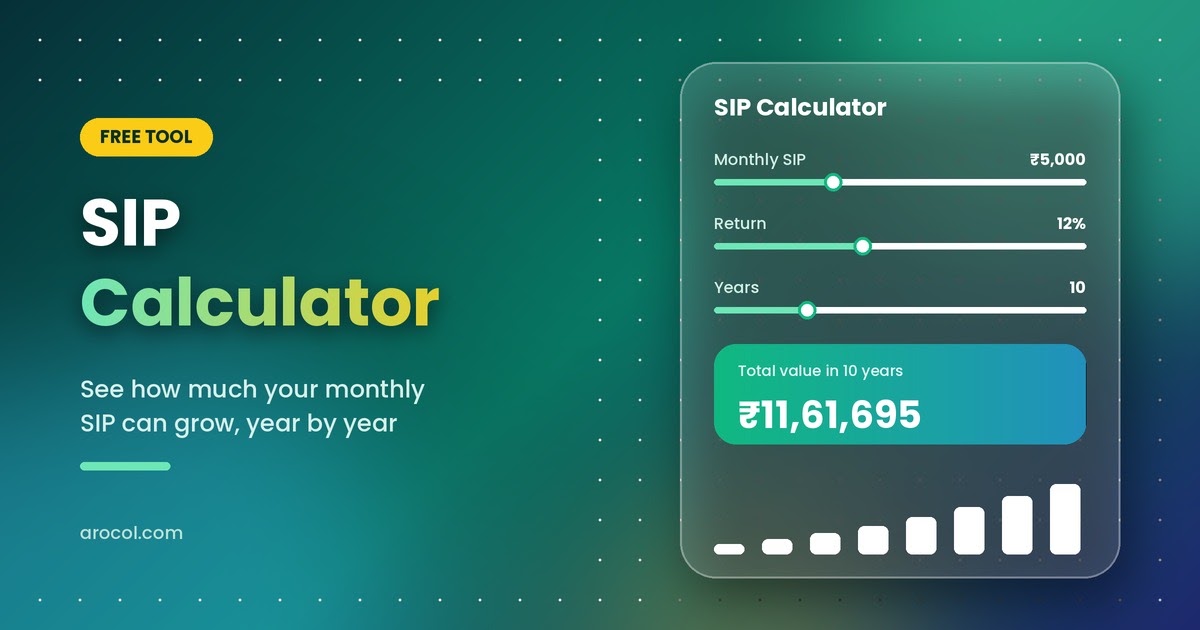
- ₹5,000 a month for 10 years: you invest ₹6 lakh, and it could grow to about ₹11.6 lakh.
- ₹10,000 a month for 20 years: you invest ₹24 lakh, and it could grow to about ₹1 crore.
Notice how the time period matters more than the amount. That’s why starting early, even with a small SIP, is one of the best money decisions you can make. If you’re trying to decide how to split a fixed monthly amount, read how to invest ₹10,000 a month.
Saving for a child? See my child education fund plan. Got a bigger amount? Read how to invest ₹1 lakh, or how to invest ₹20,000 a month.
Things to keep in mind
Returns aren’t fixed. The calculator uses a steady yearly return to keep things simple. Real returns can be negative in some years and much higher in others. Treat the result as a rough guide, not a promise.
Tax isn’t included. Gains on equity mutual funds are taxed when you sell. Long-term gains above ₹1.25 lakh a year are taxed at 12.5%, and short-term gains at 20%.
Build your safety net first. Before starting a SIP, make sure you have an emergency fund and health insurance. That way you won’t have to stop your SIP or sell at a bad time when something unexpected happens. Our guide on why you need an emergency fund before investing heavily explains why.
Check all your mutual funds in one statement (CAS) through CDSL. Compare your SIP with your PF on the EPF passbook and with NPS on PFRDA. Gains above the limit are taxed; the Income Tax calculator shows your total tax.
Common questions
Is the SIP calculator result guaranteed?
No. It’s an estimate based on the return you enter. Mutual fund returns depend on the market and can be higher or lower.
What return should I enter?
For long-term equity funds, many people use 10% to 12% as a rough planning figure. For safer debt funds, something closer to 6% to 7% is more realistic. If you’re unsure, try a lower number so you don’t overestimate.
Can I use this for retirement planning?
Yes. Enter your years until retirement to see what your SIP could grow to. For a full plan, including EPF, PPF and NPS, read our retirement planning guide.
What is a step-up SIP?
It’s a SIP where you increase your monthly amount by a fixed percentage every year. Most fund platforms let you set this up automatically, and you can test the effect in the SIP calculator above.
Three books that make SIPs easier to stick with: The Psychology of Money, Let’s Talk Money by Monika Halan, and The Little Book of Common Sense Investing.
How do you read your SIP calculator result?
The calculator shows two numbers that matter: how much you put in and what it could grow to. The gap between them is the estimated gain. That gain isn’t promised. It depends on how the market behaves over your years.
Take one example. ₹5,000 a month for 10 years means you invest ₹6,00,000. At 12% a year, the estimate comes to about ₹11.6 lakh. At 10%, it’s about ₹10.3 lakh. Same effort, ₹1.3 lakh difference, just from two percentage points. That’s why it’s worth trying a few different return rates instead of trusting one number.
What will your SIP money be worth after inflation?
₹11.6 lakh ten years from now won’t buy what ₹11.6 lakh buys today. If prices rise about 6% a year, that amount is worth roughly ₹6.5 lakh in today’s money.
That doesn’t mean the SIP is bad. It’s still far better than leaving the money in a savings account. It just means you should plan your goal in future rupees, not today’s.
How much SIP do you need for a goal?
Most people use the calculator the wrong way round. They type in a random amount and see what comes out. Try this instead:
- Write down the goal and the year you need it. For example, ₹10 lakh in 15 years.
- Try different monthly amounts in the calculator until the result reaches your goal at a careful return, like 10%.
- If the amount is too high for your budget, add years, or plan to raise your SIP a little every year.
When I first did this, I realised my “big” SIP was nowhere near my goal. Raising it by ₹500 every year closed most of the gap without hurting my monthly budget.
Can you check your SIP maths with AI safely?
You can ask a free AI tool to double-check your numbers. Here’s a prompt you can copy:
I invest ₹5,000 every month in a SIP for 10 years. Show me the estimated value at 8%, 10% and 12% yearly returns, and also tell me what the 12% result is worth in today’s money if prices rise 6% a year. Explain it simply.
Don’t share your folio number, PAN or bank details with any AI tool. If the AI’s answer is very different from this calculator, check which return rate and compounding it used.
What if the market falls right after I start?
That’s actually not a disaster for a SIP. When prices fall, the same monthly amount buys more units. People who keep going through the falls usually do better than people who stop. Read what to do in a market crash before you panic.
Recommended reads
- New to SIPs? Here’s How to Start With Just ₹500
- FD Calculator: Find Your Fixed Deposit Maturity Value
- How to Invest ₹10,000 a Month in India: Beginner Plan
- Share Market vs Mutual Funds: Which Is Better for Beginners?
- How to Invest ₹5,000 a Month in India: A Beginner’s Plan
Disclaimer: This calculator and article are for general information only and aren’t investment advice. Mutual fund investments are subject to market risks. Read all scheme documents carefully and consider speaking to a SEBI-registered investment adviser.