Disclosure: This post has affiliate links. Arocol may earn a small commission at no extra cost to you. As an Amazon Associate I earn from qualifying purchases. Read our disclosure.
Once you decide to put some money into equity, a very practical question comes up. Should you buy shares yourself in the share market, or should you invest through mutual funds and let a professional (or an index) do the picking?
Friends will give you strong opinions on both sides. One cousin swears by “direct stocks, no middleman”. A colleague says “just do SIPs, don’t think too much”. Both can be right, for different people. This guide lays out the real differences in risk, cost, time, tax and effort, so you can choose what actually suits your life, not someone else’s.
If you’re completely new, it may help to first read our simple guide on how the stock market works. This post picks up from there.
First, they’re not really opposites
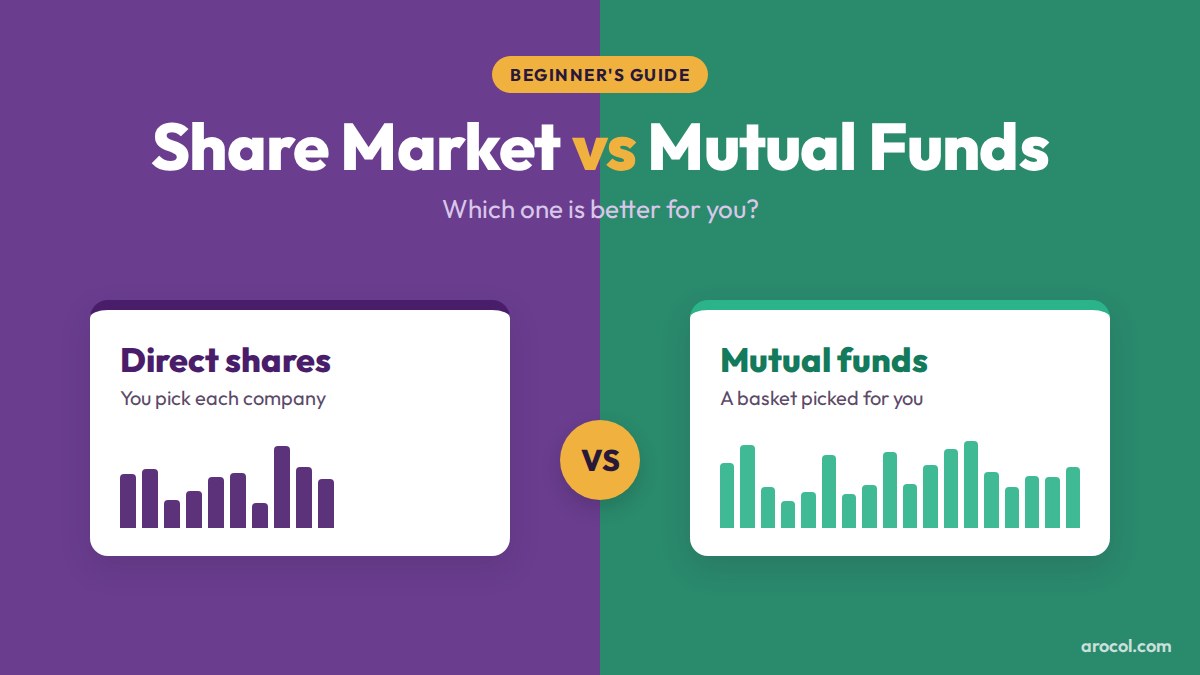
Here’s something that clears up a lot of confusion: an equity mutual fund also invests in the share market. When you buy units of an equity fund, the fund uses your money (pooled with thousands of other investors) to buy shares of many companies.
So the real question isn’t “share market or mutual funds”. It’s this:
- Do you want to choose individual companies yourself (direct shares)?
- Or do you want someone else to choose and manage a basket of companies for you (a mutual fund)?
Both put your money into the same share market. What changes is who makes the decisions, how spread out your money is, and how much time and skill it takes from you.
How buying shares directly works
When you invest directly in the share market, you open a demat and trading account with a broker, search for a company, and buy its shares. You decide what to buy, how much, and when to sell. Your shares sit in your demat account in your name.
The upside of investing in the share market directly is full control. If you pick a great company early and hold it for years, the returns can be excellent, and there’s no fund manager fee. The downside is that every decision, and every mistake, is yours. If one company you own runs into trouble, a big chunk of your money can be hit.
Our guide on how to open a demat account covers the setup step by step.
How a mutual fund works

A mutual fund collects money from many investors and invests it according to a stated plan. An equity fund buys shares; a debt fund lends to the government and companies; a hybrid fund does both. You don’t own the shares directly. You own units of the fund, and the value of each unit (the NAV) goes up or down with the value of everything the fund holds.
There are two main styles:
- Actively managed funds: a fund manager and research team pick shares, trying to beat the market.
- Index funds and ETFs: no picking at all. The fund simply copies an index like the Nifty 50, so you own all 50 companies in the same proportions. Costs are much lower.
Mutual funds in India are regulated by SEBI, and fund houses must follow strict rules on disclosure and how your money is held. You can start with as little as ₹100 to ₹500 a month through a SIP. Our SIP guide for beginners explains how to begin.
Share market vs mutual funds: side by side

| Point | Direct shares | Equity mutual funds |
|---|---|---|
| Who picks the companies | You | Fund manager, or the index |
| Diversification | Only as much as you build yourself | Built in: usually 30 to 100+ companies |
| Time needed | A lot: research, results, news | Very little after setup |
| Skill needed | Reading accounts, valuing businesses | Choosing a sensible fund and staying patient |
| Ongoing cost | No yearly fee, but charges on every buy and sell | Expense ratio every year (low for index funds) |
| Minimum amount | Price of one share | Often ₹100 to ₹500 via SIP |
| Automatic investing | Possible but less common | Easy with a SIP |
| Emotional pressure | High: you see each stock move | Lower: you see one combined value |
Risk: the biggest difference
With direct shares, your risk depends heavily on how many companies you own. If you hold just three or four shares, one bad news story can wipe out 30% or 40% of your portfolio. Even well-known companies have gone through frauds, debt problems or long slumps.
A diversified equity fund spreads your money across dozens of companies. If one company collapses, it might be 2% or 3% of the fund, painful but not a disaster. The market as a whole can still fall, sometimes 20% to 30% in a bad year, so funds aren’t risk-free. But you’re protected from the “one company” risk that hurts many first-time share market investors.
You can build diversification yourself with direct shares, but doing it properly usually means owning 15 to 25 companies across different sectors, and tracking all of them. That’s a lot of work for a salaried person with a family.
Returns: can you beat a fund?
This is the exciting part of the share market, and also where most people overestimate themselves.
Yes, a skilled stock picker can beat a mutual fund over time. But consider this: even professional fund managers, with full-time research teams, often struggle to beat a simple index. S&P’s SPIVA reports have repeatedly found that most actively managed large-cap funds in India trail their benchmark index over long periods. If professionals find it this hard, an individual investing in the evenings after work is starting with a real disadvantage.
That doesn’t mean you shouldn’t try. It means you should be honest about why you’re doing it. If you enjoy studying businesses, direct shares can be rewarding. If you mainly want good long-term returns with little effort, a low-cost index fund will very likely do as well as, or better than, most people’s own picks.
A simple example
Imagine two friends with ₹3 lakh each. Neha puts hers into a Nifty 50 index fund. Karan buys five shares he heard about from colleagues. In a good year, one of Karan’s picks might double while another falls 40%. His result depends on luck and timing as much as skill. Neha’s result will simply follow the 50 biggest companies in India, without big surprises either way. Over ten years, it’s quite possible that Neha ends up with a similar or better amount, with far less stress. (Neha and Karan are made-up names to explain the idea, not real people.)
Want to see what steady monthly investing can grow to? Try our SIP calculator.
Costs: what you really pay
With direct shares, there’s no yearly fee on what you own, but there are charges on every trade: brokerage (zero or very low for delivery at many discount brokers), Securities Transaction Tax, exchange and SEBI charges, stamp duty, GST, and a depository (DP) charge each time you sell a stock. Your demat account may also have a yearly maintenance charge. If you buy and hold for years, these costs stay small. If you trade often, they add up fast.
With mutual funds, you pay an expense ratio: a small percentage of your investment, taken every year inside the NAV. For index funds and ETFs, it’s often well under 0.5% a year. Actively managed funds charge more, and Regular plans (bought through a distributor) cost more than Direct plans. Over 20 years, even a 1% difference in yearly cost can add up to a big amount, so choose Direct plans when you invest on your own.
Tax: mostly the same, with one hidden advantage for funds
For listed shares and equity mutual funds, the basic rules are exactly the same: the same 12-month line between short-term and long-term, the same rates, and dividends taxed at your slab rate. I’ve listed the numbers in our stock market guide for beginners, so I won’t repeat them here. What’s really different is how often you trigger tax.
The hidden advantage of funds: when a fund manager sells one share and buys another inside the fund, you don’t pay tax on that. You pay tax only when you sell your own fund units. With direct shares, every time you switch from one company to another, it’s a sale, and tax may apply. If you like to rebalance or change holdings often, a fund is more tax-efficient.
Here’s what that looks like. Say you put ₹1 lakh into one company’s shares, and after 8 months it’s worth ₹1.2 lakh. You lose faith in it and switch to another company. That switch is a sale, so the ₹20,000 gain is short-term and you pay about ₹4,000 in tax right away. You now have ₹1.16 lakh working for you, not ₹1.2 lakh. If a fund manager makes the same switch inside a fund, you pay nothing that day, and the full ₹1.2 lakh keeps growing.
There’s also ELSS, a type of equity mutual fund with a 3-year lock-in that gives you a deduction under Section 80C, but only if you choose the old tax regime. Our old vs new tax regime guide helps you check whether that matters for you. Tax rules can change with each Budget, so check the latest before you file.
If you choose funds, the simplest start is a low-cost index fund.
Time and temperament
This is the part people skip, and it matters more than returns. The share market tests your patience far more than your intelligence.
Investing in the share market directly means reading quarterly results, following company news, and deciding what to do when a share falls 25% in a week. Many beginners discover that they don’t enjoy this, or that it makes them anxious and checking their phone all day. That anxiety often leads to buying high in excitement and selling low in panic.
A mutual fund SIP runs quietly in the background. You check it once a month, or even less. For most people with a full-time job, family responsibilities and limited free time, that simplicity is worth a lot.
Before you pick shares, look at the companies on the BSE website: you can see their results and announcements for free. And if you lean towards funds, The Little Book of Common Sense Investing explains why low-cost index funds beat most experts.
Which one suits you?

Mutual funds are usually the better choice if you:
- Are just starting out with equity.
- Have a busy job and don’t want to track companies.
- Want to invest a fixed amount every month automatically.
- Get stressed seeing big ups and downs.
- Are investing for long-term goals like retirement or a child’s education.
Direct shares can make sense if you:
- Genuinely enjoy reading about businesses and annual reports.
- Can spend a few hours every week on research.
- Already have a solid base in funds and an emergency fund.
- Can stay calm when one of your shares falls sharply, which happens often in the share market.
- Are fine with the possibility of doing worse than an index fund.
The smart middle path: core and satellite

You don’t have to pick only one. Many sensible investors use a core and satellite approach:
- Core (80% to 90% of your equity money): one or two low-cost mutual funds, like a Nifty 50 index fund and maybe a flexi-cap fund, running through monthly SIPs.
- Satellite (10% to 20%): a few direct shares of companies you understand well, bought slowly and held for years.
This way, your important goals are protected by the diversified core, and you still get to learn the share market with money that won’t hurt your future if a pick goes wrong. As you gain experience and confidence, you can adjust the split.
Not sure how much to put where? Our sample plans for investing ₹5,000 a month and ₹10,000 a month show simple mixes, and our guide on investing a ₹1 lakh lump sum helps if you have a bigger amount ready.
How to get started with either
- Check your base. Emergency fund, health insurance and no high-interest debt come first.
- For mutual funds: pick a Direct plan of a Nifty 50 index fund and start a monthly SIP through a fund house website, a registrar like MF Central, or an investing app.
- For direct shares: open a demat and trading account with a SEBI-registered broker. If you’d like a large broker whose app also lets you invest in mutual funds, you can open an account with Angel One; compare charges with other brokers before you sign up.
- Start small and increase slowly as you understand how it feels when markets move.
- Ignore share market tips from Telegram, WhatsApp and “guaranteed return” groups. Real investing is boring, and that’s a good thing.
Books that make this easier
- Let’s Talk Money by Monika Halan: written for Indians, with a clear take on mutual funds, insurance and planning.
- The Psychology of Money by Morgan Housel: why patience and behaviour matter more than picking the “best” share.
Frequently asked questions
Are mutual funds safer than shares?
A diversified equity fund is usually less risky than holding a few individual shares, because your money is spread across many companies. But equity funds still go up and down with the market. They’re “safer” against one company failing, not against the whole market falling.
Do mutual funds give lower returns than the share market?
Not necessarily. A good index fund gives you roughly the market’s return. Some individual shares do much better, many do worse. On average, most individual investors don’t beat a simple index fund over long periods.
Can I invest in mutual funds without a demat account?
Yes. You can invest in mutual funds directly with a fund house or through an app without a demat account. You need a demat account to buy shares and ETFs.
Is it okay to do both?
Yes, and for many people it’s the best approach. Keep most of your money in funds and a small part in shares you understand.
How much money do I need to start in the share market?
Only the price of one share plus small charges. But it’s wise to start with a small amount you can afford to see fall, while you learn.
What’s better for a 5-year goal?
For goals within 5 years, neither direct shares nor a pure equity fund is ideal, because the market can be down when you need the money. A hybrid fund, debt fund or FD may be more suitable for short goals.
The bottom line
The share market and mutual funds aren’t rivals. They’re two ways of owning the same businesses. For most beginners, mutual funds, especially low-cost index funds, are the simpler and steadier way to start. Direct shares are worth exploring later, with a small part of your money, once you have the time, the interest and a calm mind for the ups and downs. Start with what you’ll actually stick with for years. That decision matters more than any single share or fund.
Recommended reads
- Stock Market for Beginners in India: How It Really Works
- New to SIPs? How to Start With Just ₹500
- How to Open a Demat Account in India: A Beginner’s Guide
- How to Invest ₹10,000 a Month in India
- Saving vs Investing: The Difference and Why You Need Both
This article is for general information and education only and isn’t investment advice. Mutual fund investments are subject to market risks; read all scheme-related documents carefully. Investing in shares involves risk, including the loss of capital. Please do your own research or speak to a SEBI-registered adviser before investing.