Disclosure: This post has affiliate links. Arocol may earn a small commission at no extra cost to you. As an Amazon Associate I earn from qualifying purchases. Read our disclosure.
Ever wondered how to read salary slip numbers that never seem to match your offer letter? My cousin Rohan found out the hard way last month.
It was his first job. Offer letter said ₹6 lakh a year. He did the maths in his head a hundred times: ₹50,000 a month.
Salary day came. His phone buzzed. ₹43,433.
He called me that night. “Didi, they’ve cut almost ₹6,600. Is this a scam company?”
It wasn’t a scam. Most of that money had a perfectly normal reason. But one line on his payslip was plain wrong, and he would never have caught it if we hadn’t gone through the slip together.
I’ll tell you what that line was at the end. First, let’s open your own slip.
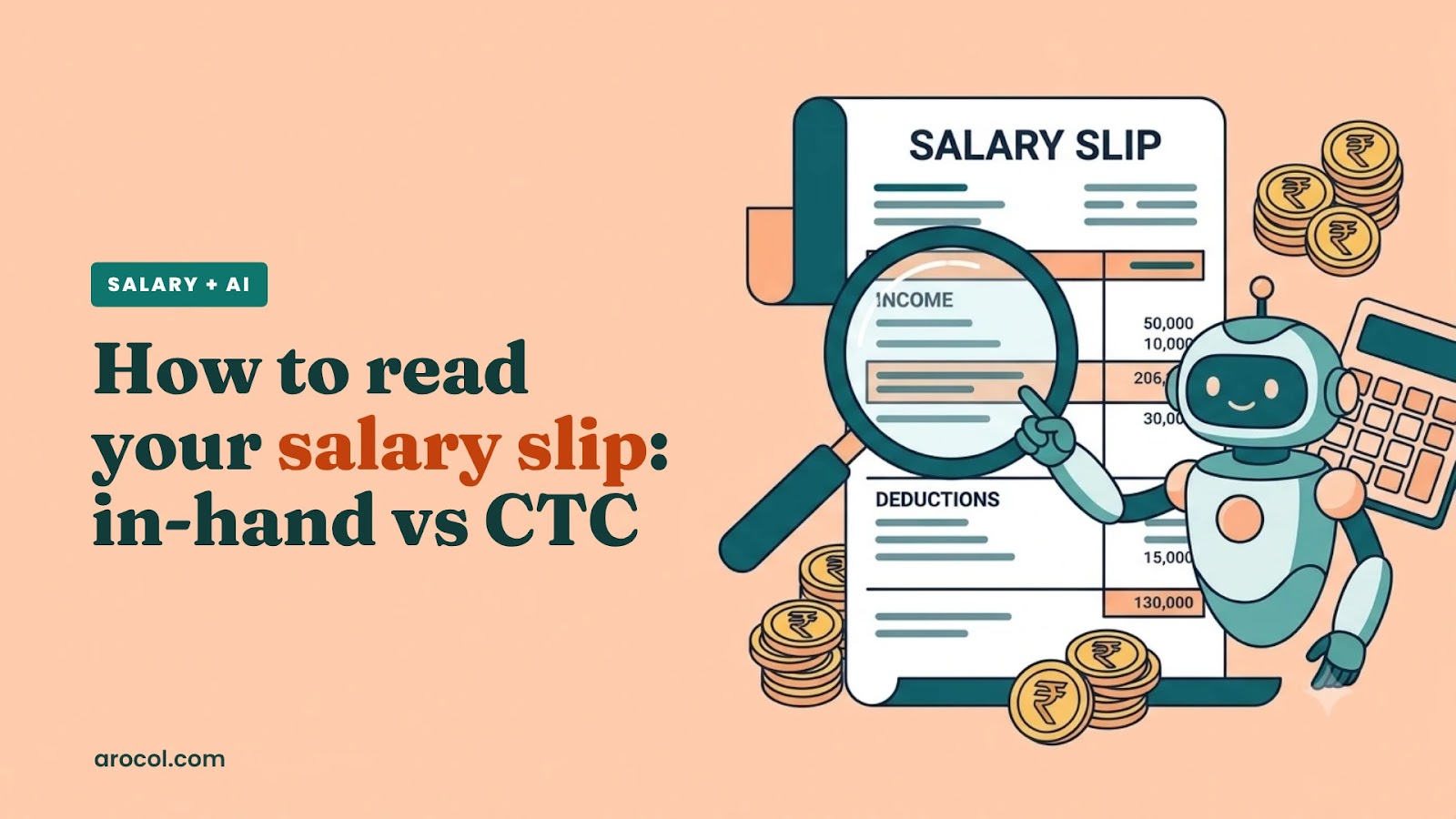
Below: how to read salary slip lines one by one, why in-hand pay is less than CTC, how HRA and TDS work, and how to use AI to explain your payslip without giving away private details.
How to read salary slip basics: what’s actually on it?
Short answer: two lists and one final number.
Every salary slip in India, whatever the company or payroll software, follows the same idea:
- Top part: your name, employee ID, month, days paid, PAN (often masked), UAN and bank account (last digits)
- Earnings: money the company pays you this month
- Deductions: money taken out before it reaches your bank
- Net pay: earnings minus deductions. This is your in-hand salary.
That’s it. Once you learn how to read salary slip pages this way, they stop looking like a maths exam.
Here’s Rohan’s slip, rebuilt with the same numbers. Names and IDs are removed, and it’s marked as an example.

The first time I got a payslip, I only looked at net pay and closed the PDF. For months. I thought the rest was for HR. Big mistake, because the rest is where mistakes hide.
What is basic salary in a salary slip, and why does it matter so much?
Basic salary is the fixed core of your pay. Almost everything else is calculated from it.
Your PF is a percentage of basic. HRA is usually a percentage of basic. Gratuity is calculated on basic. So a small change in basic moves five other lines.
And there’s a newer reason to look at it. The new labour codes, which the Ministry of Labour and Employment brought into force from 21 November 2025, say “wages” must be at least half of your total pay. Basic plus DA usually forms that wage part.
What does that mean for you? Many companies are reworking salary structures so basic goes up. A higher basic means a higher PF cut, so take-home pay can drop a little even when your CTC stays the same.
Your PF isn’t lost money, though. It’s your savings, with interest, just locked for later.
Rohan’s basic is ₹23,500, exactly half of his monthly gross of ₹47,000. So his company has already followed the 50% rule.
If your basic suddenly jumped this year and your in-hand fell, this is probably why. Ask HR for the new structure in writing. Rules can also differ slightly by state, so their note is the best source for your case.
Why is my in-hand salary less than CTC?
This is the question everyone asks in their first month. Rohan asked it three times on one call.
CTC means cost to company. It’s what the company spends on you in a year, not what you receive. Some parts of CTC never even touch your salary slip.
Here’s how Rohan’s ₹50,000 a month CTC breaks down:
- Employer’s PF: ₹1,800. Paid straight to your PF account, not to you.
- Gratuity: about ₹1,200 a month set aside. You get it only after 5 years with the company (rules apply).
- Gross salary: ₹47,000. This is what shows under Earnings.
Then from that ₹47,000, his own deductions come out: his PF, professional tax, and in his case, something else.

So the gap between CTC and in-hand salary isn’t one mystery cut. It’s a few small, normal pieces stacked together. Insurance premiums, food coupons, meal cards and bonuses that are “part of CTC” but paid once a year make the gap even bigger in some companies.
My colleague Meena joined with a big CTC that included a performance bonus. She planned her rent on CTC divided by 12. Bad idea. The bonus came once, in April, and only 70% of it. Now she budgets on net pay only, and so should you. My post on a simple monthly budget for Indians shows how.
How to read your salary slip earnings: what does each line mean?
Company names for these lines change, but here are the usual ones:
- Basic: fixed core pay (see above)
- HRA (House Rent Allowance): part of your pay meant for rent
- Special allowance / Flexi pay: the balance. Fully taxable.
- Conveyance / LTA / Telephone: some companies still split these out
- Bonus / Incentive / Arrears: one-time or delayed amounts for a month
- Overtime / Shift allowance: extra hours or night shifts
Arrears confuse people the most. If your appraisal came in July but was effective from April, you’ll see “Arrears” in July with three months of the difference. Nice surprise, but TDS that month may also jump.
Now the deductions. This is where most of the questions live.
Why is PF deducted from my salary, and how do I check it?
PF (Provident Fund) is a retirement savings scheme run by EPFO. You put in 12% of your basic (plus DA). Your employer adds 12% too, part of which goes to your pension (EPS).
Many companies cap PF at a wage of ₹15,000, which makes the cut ₹1,800 a month. That’s what Rohan’s company does. Others take 12% of the full basic. For Rohan, that would be ₹2,820. Both are allowed, so check which one your company follows.
Here’s the part nobody tells freshers: your slip showing PF doesn’t prove PF reached your account.
I learned this myself. My slips showed PF every month, but my passbook didn’t. I’ve written the full story in PF deducted but not credited in EPFO.
So once every two or three months, open the EPFO member passbook with your UAN and match the amounts with your slips. If the employer side is missing for months, read what to do when your employer isn’t crediting PF.
Some slips also show VPF (Voluntary PF, extra savings you chose) or NPS (if your company offers the National Pension System, regulated by PFRDA). If you see NPS and never signed up, ask HR why.
What is professional tax in a salary slip?
Professional tax is a small state tax on people who earn from a job or profession. Your employer cuts it and pays it to the state.
The total can’t be more than ₹2,500 a year in any state. Many states take ₹200 a month and ₹300 in one month to reach that. Some states, like Delhi, don’t charge it at all.
Rohan works in Pune, so ₹200 goes every month. In Maharashtra, it’s handled by the state tax department (Maharashtra GST Department).
Two quick checks for professional tax on your salary slip:
- It should not be cut twice in one month (it happens with payroll changes).
- If you moved cities, it should follow the new state’s slab from the move.
It’s a small amount. But a mistake here is a hint that someone in payroll copied things in a hurry. Look closer at the rest.
What is ESI on a salary slip?
ESI is health insurance for lower-paid workers, run by ESIC. If your gross pay is ₹21,000 a month or less, you’ll usually see a 0.75% ESI cut, and your employer pays 3.25%.
In return, you and your family get medical care at ESI hospitals and dispensaries. It’s genuinely useful, so make sure you get your ESI card (e-Pehchan) from HR.
Rohan earns more than ₹21,000, so there’s no ESI line on his slip.
Why is TDS deducted from my salary?
TDS means tax deducted at source. Your employer estimates your full-year income tax and cuts a part of it every month.
The estimate depends on the tax regime you chose at the start of the year:
- New regime (default): standard deduction of ₹75,000. Salary income up to about ₹12.75 lakh a year usually ends up with zero tax because of the rebate.
- Old regime: lower deductions, but you can claim HRA, 80C investments, health insurance and so on. You must submit proofs.
Rohan’s yearly gross is ₹5.64 lakh. Under the new regime, no tax. So his TDS line shows zero, which surprised him. “Don’t I have to pay tax?” Not at this income.
Not sure which regime suits you? My comparison of the old vs new tax regime works through real salary examples.
One more thing: from 1 April 2026, the new Income-tax Act, 2025 replaced the old 1961 Act. Section numbers changed, but for most salaried people, slabs and the standard deduction stayed the same. The Union Budget website and the Income Tax Department portal have the official details.
At the year end, your employer gives you Form 16. It should match the TDS on your slips. You can cross-check the TDS your employer deposited in your Form 26AS through the income tax portal, or ask HR for the details from TRACES.
My neighbour uncle found ₹4,000 of TDS on his slips that never showed up in 26AS. The employer had deposited it late. He caught it in time to fix before filing. Most people only notice after the refund gets stuck.
How is HRA calculated in a salary slip?
HRA itself is just an allowance. The question is how much of it is tax-free, and that only matters in the old regime.
In the old regime, the exempt part is the lowest of these three:
- Actual HRA you received
- Rent paid minus 10% of basic
- 50% of basic in a metro city, or 40% in a non-metro city
Say Meena’s basic is ₹30,000 a month, her HRA is ₹15,000, and she pays ₹14,000 rent in a non-metro city.
- Actual HRA: ₹15,000
- Rent minus 10% of basic: ₹14,000 minus ₹3,000 = ₹11,000
- 40% of basic: ₹12,000
Lowest is ₹11,000. So ₹11,000 a month is tax-free and ₹4,000 is taxed.

Which cities count as metros has been changing, so check your HR’s tax note. And keep rent receipts and the rent agreement. If your rent is above ₹1 lakh a year, you’ll also need your landlord’s PAN.
Under the new regime, HRA is fully taxable. So if you’ve chosen the new regime, the HRA line is just part of your pay, nothing to calculate.
How to read salary slip lines that often go wrong
Here’s a quick table I made for Rohan, and now for you. Keep it open next to your payslip.
| Payslip line | What it is | What to check every month |
|---|---|---|
| Days paid / LOP | Days you’re paid for; loss of pay days | Approved leave must not show as LOP |
| Basic | Fixed core pay | Same as your offer or revision letter |
| HRA | Rent allowance | Old regime: rent proofs submitted on time |
| PF (employee) | 12% of basic (or of ₹15,000) | Same amount shows in EPFO passbook |
| Professional tax | State tax, max ₹2,500 a year | Not cut twice; right state |
| TDS | Monthly income tax | Right regime; matches Form 16 and 26AS |
| Other deductions | Loans, advances, canteen, insurance | You agreed to each one |
Days paid is the line people skip. Don’t. It’s the one that bit Rohan.
How to check your salary slip with ChatGPT (safely)
If you’re still learning how to read your salary slip, this is where AI is honestly useful. It’s patient, it explains in simple words, and it does the subtraction for you at 11 pm when HR is asleep.
But a salary slip has a lot of private stuff on it. So before you paste anything into ChatGPT, Gemini or Claude, remove:
- Your name, employee ID and company name
- PAN, UAN, Aadhaar and bank account number
- Address and phone number
Only type the line names and amounts. AI doesn’t need to know who you are to explain “Special Allowance”.
Here’s the exact prompt I gave Rohan. Copy it and fill in your numbers:
I’m a salaried employee in India. Please explain my salary slip in simple English. I’ve removed all personal details.
Month: [month]. Days in month: [30]. Days paid: [29]. LOP days: [1]. Tax regime: [new/old]. State: [state].
Earnings: Basic [ ], HRA [ ], Special allowance [ ], Others [ ].
Deductions: PF [ ], Professional tax [ ], TDS [ ], LOP deduction [ ], Others [ ].
Net pay: [ ]. My yearly CTC: [ ].
1. Explain each line in one or two sentences.
2. Check the maths: do earnings minus deductions equal net pay?
3. Show the gap between my monthly CTC and net pay, line by line.
4. Point out anything that looks unusual and list questions I should ask HR.
Don’t guess numbers you don’t have. Say if something needs my company’s policy.

When Rohan ran this, the AI did three things in under a minute: explained every line, confirmed the maths added up, and flagged one line as “worth asking HR about”.
A few honest limits, though:
- AI doesn’t know your company’s policy, leave balance or attendance. It can only say “this looks odd”.
- It can get tax rules wrong, especially recent changes. Always confirm tax with HR or the official portal.
- It’s not proof. If something’s wrong, your evidence is the slip, your leave approval email and your passbook.
I use the same idea for my monthly budget. If you liked this, try my AI budget planning prompts next.
What should you do with your salary slips?
Keep them. All of them.
Banks ask for the last three months of slips for a loan or a credit card. Visa offices ask for them. Your next company may ask for your last slip before they make an offer. And if there’s ever a PF or salary dispute, your slips are your proof.
Here’s my simple system:
- A folder on my phone and one on email called “Payslips”, one PDF per month, named like 2026-10.pdf
- Printed copies of the last 6 months and Form 16 in a plain A4 document folder, because portals and inboxes don’t last forever
- A 10-minute check on salary day: days paid, PF, TDS, net pay
Then, once you know what really lands in your account, give that money a job. I note salary, rent and savings in a small expense tracker notebook on salary day. Old school, but it works for me.
Build a small emergency fund first. Then start a small SIP, even ₹500 (my SIP guide for beginners explains how). If you’d like to invest yourself, you’ll need a demat account; I use Angel One, but compare a few before you pick.
And if you want one book that explains salary, tax, PF and saving the Indian way, Let’s Talk Money by Monika Halan is the one I give every fresher in the family. Rohan got a copy too.
Your PF on the slip is also your first retirement step. My guide to retirement planning with EPF, PPF and NPS shows how it adds up over the years.
So what was the wrong line on Rohan’s salary slip?
Remember the ₹6,600 gap?
₹3,000 of it was employer PF and gratuity, which were never going to come to his bank. ₹1,800 was his own PF. ₹200 was professional tax.
That left ₹1,567. On his slip it said “LOP: 1 day”.
Rohan had taken one day off for his sister’s college function. He’d applied for it, and his manager had approved it on the leave portal. But the approval came after the payroll cut-off date, so the system marked him absent.
He emailed HR the next morning with a screenshot of the approval. They replied the same day: the ₹1,567 would come back as arrears in next month’s salary. It did.
“So I wasn’t being scammed,” he said. “I just didn’t know how to read salary slip numbers.”
Exactly. Now you do too. Open your latest payslip tonight, check the days paid, the PF and the TDS, and run the AI prompt. Ten minutes, once a month.
Found a line on your slip that doesn’t make sense? Tell me in the comments, without any personal details, and let’s decode it together.
Recommended reads
- PF Deducted but Not Credited in EPFO? Here’s What to Do
- Old vs New Tax Regime: Which One Saves You More Tax in 2026-27?
- Where Does Your Salary Go? A Simple Budget for Indians
- Salary Gone by the 20th? 15 Ways to Save Money Every Month
- Diwali Bonus 2026: How to Use It Smartly, Not Waste It
Disclaimer: This article is for general information only and isn’t tax, legal or financial advice. Salary structures, PF, professional tax and income tax rules differ by company and state and can change. Example numbers are for illustration. Check your company’s HR policy, your EPFO passbook and the Income Tax Department’s official website before you act. Never share your PAN, UAN, Aadhaar, bank details or OTP with anyone, including AI tools.