Disclosure: This post has affiliate links. Arocol may earn a small commission at no extra cost to you. As an Amazon Associate I earn from qualifying purchases. Read our disclosure.
“Should I buy gold now, or will it fall more?”
My colleague Anjali asked me this at lunch, holding her phone like it had bad news on it. It did.
Her wedding is in February. Back in January, her mother had bought a heavy necklace set for it. Right at the top, as it turned out.
Now the gold price had fallen almost a quarter. Her mother wanted to buy the rest of the jewellery on Dhanteras. Her uncle wanted to sell. Her cousin said “just ask ChatGPT”.
So she did. And the answer she got made things worse, not better.
What did the AI say? And what did Anjali’s family finally do? I’ll tell you at the end. But first, let’s answer the question you’re probably asking too.
How much has the gold price really fallen?
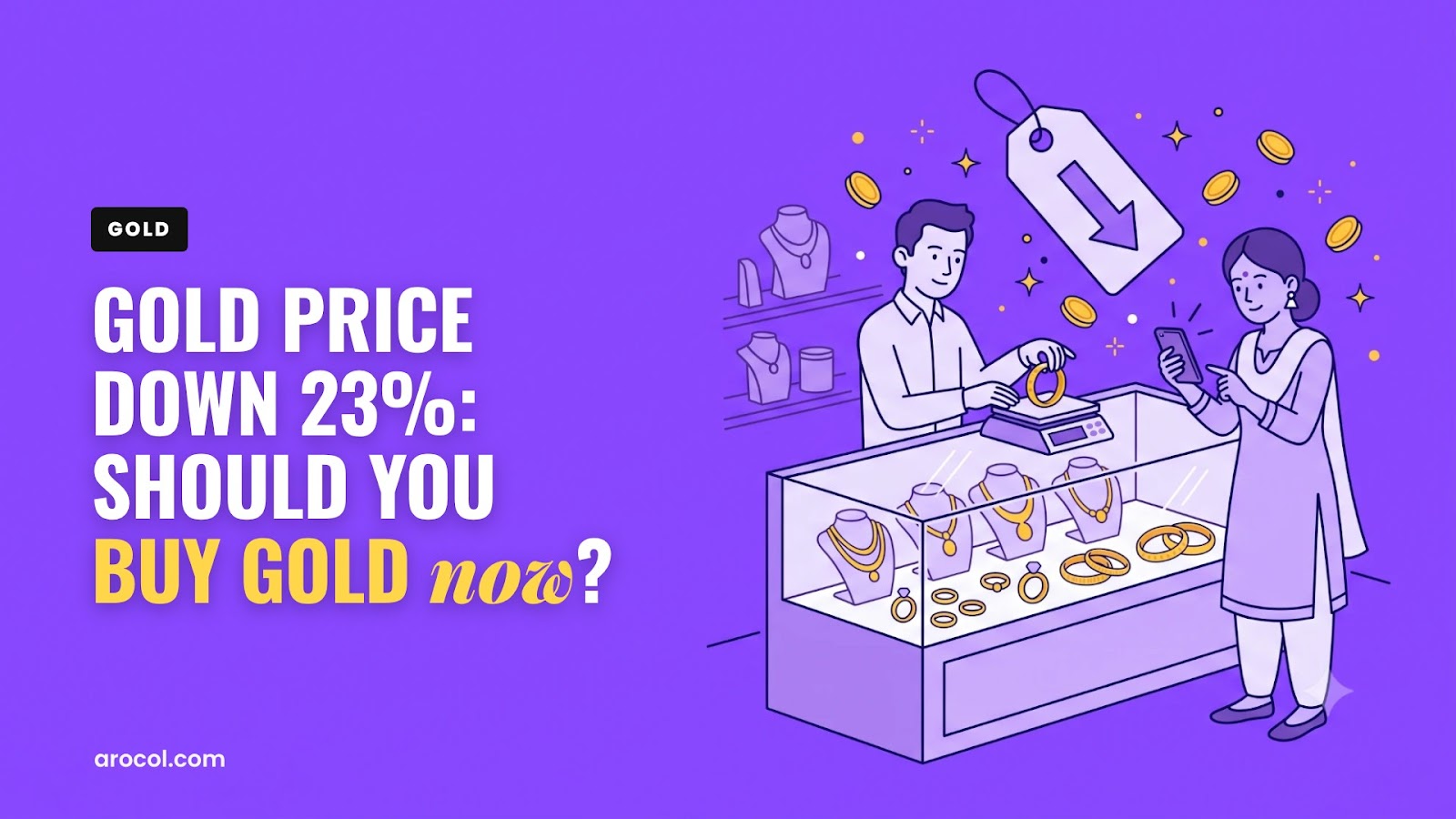
Short answer: about 23% from its peak in January 2026.
International gold touched about $5,419 an ounce on 28 January. By 12 October, it was just above $4,170.
In India, 24 carat gold was around ₹1.48 lakh for 10 grams in Mumbai on 12 October. Prices change every day and differ a little by city, so check your local rate before you buy.
Now here’s the strange part.
While prices were falling, Indians were buying more. Gold ETFs got about ₹4,450 crore of new money in September 2026 alone, as per AMFI data. From January to September, they got more money than in the whole of 2025.
So some people see a fall and run. Others see a fall and rush to buy gold.
Who’s right? Honestly, nobody knows for sure. And that’s the first thing you need to accept.
Should you buy gold now or wait for it to fall more?
Short answer: don’t try to guess the bottom. Buy gold in small parts if you need it, and keep it a small part of your savings.
Think about it. If experts could predict the gold price, they’d all be billionaires sitting on a beach.
The price moves because of things none of us control. Wars. US interest rates. The dollar. Central banks buying tonnes of it. Even one speech can move it.
Even experts get it wrong. When gold was at its peak in January, lots of people were sure it would only go up. Then it fell almost a quarter. If the people paid to watch gold all day can miss that, you and I shouldn’t plan our wedding shopping around a guess.
So the real question isn’t “will gold fall more?”
The real question is: why do you want to buy gold?
- For a wedding or a festival? You need the jewellery anyway. Buy it in 2 or 3 parts over a few months, so you don’t bet everything on one day’s price.
- As an investment? Then you don’t need jewellery at all. A gold ETF or gold fund is cheaper and easier.
- Because everyone’s talking about it? That’s the worst reason. Wait a week and read more first.
When I started earning a little from Arocol, I had the same itch. Gold was on every news channel. I wanted to put all of it into gold “before it goes up”. I didn’t. I put a small part, and I’m glad, because the price fell soon after.

What does buying gold in parts actually do?
Short answer: it stops you from getting the worst price. It also stops you from getting the best one. That’s the deal.
Let’s use Anjali’s 40 grams. Say 22 carat gold is ₹13,600 a gram today (gold value only, before making charges and GST). Here’s what happens to the gold bill in two different futures:
| How she buys | If price falls 10% by January | If price rises 10% by January |
|---|---|---|
| All 40 g on Dhanteras | ₹5,44,000 | ₹5,44,000 |
| All 40 g in January | ₹4,89,600 | ₹5,98,400 |
| 3 parts (14 g Nov, 13 g Dec, 13 g Jan) | ₹5,17,480 | ₹5,70,520 |
(For the 3 parts, I assumed the price moves halfway by December and the full 10% by January.)
Look at the last row. It’s never the cheapest and never the most expensive. Waiting for January wins big if gold falls and loses big if it rises. Buying in parts sits in the middle either way, and it’s only about ₹27,000 to ₹28,000 away from the best case on a ₹5 lakh purchase.
That’s the point. You give up the dream of the perfect day, and in return you can’t be badly wrong. For a wedding, where you need the gold no matter what, that’s a good trade.
Can ChatGPT tell you if the gold price will go up?
No. And this is where Anjali’s story got interesting.
She typed: “Will gold price go up before February 2027?”
The AI wrote three paragraphs. It talked about “strong central bank demand” and “safe-haven buying”. It sounded so sure. It even gave a price range.
Then she asked the same question in a new chat. This time it was more careful, and the range was different.
Same AI. Same question. Two different answers.
That’s the problem. AI tools write in a confident voice even when they’re guessing. They also may not know today’s price unless they search the web, and even then they can pick up old numbers.
Here’s what AI can’t do:
- Predict the gold price. Nobody can.
- Know your family’s needs, your loans or your other savings.
- Take responsibility if the guess goes wrong.
And here’s what it can do well. It can explain things, do maths, and help you make a plan. I wrote about using AI this way in my guide on using AI to plan your monthly budget. Same idea works for gold.
How can AI help you buy gold the smart way?
Use AI as a calculator, not a fortune teller.
Here’s the prompt I gave Anjali. You can copy it into ChatGPT, Gemini or any AI app:
I need about 40 grams of 22 carat gold jewellery for a wedding in February. Today’s 22K price is about ₹1,36,000 per 10 grams. Making charges are about 12% and GST is 3% on gold and 5% on making charges. Help me plan buying it in 3 parts: early November, December and January. Show the total cost for each part in a simple table. Don’t predict the gold price. Just show what happens to my total if the price goes 10% up or 10% down.
See the last line? You’re asking AI to show you different situations, not to guess the future.
And notice what’s not in the prompt. No PAN, no bank details, no address. Never put those into any AI app.
When Anjali ran this, she saw something new. Making charges were adding more to her bill than the whole price fall had saved her. That changed her plan. (More on that at the end.)
What is the cheapest way to buy gold as an investment?
Short answer: gold ETFs or gold mutual funds. No making charges, no locker, no purity worry.
Jewellery, coins, bars, ETFs, gold funds, digital gold and old Sovereign Gold Bonds all have their own costs and risks. I’ve compared all of them side by side in my Dhanteras gold guide, so here I’ll stick to what matters after a price fall.
Gold ETFs trade on the stock exchange like shares, on BSE and NSE. They’re regulated by SEBI, and you can read how these funds work on the AMFI website.
To buy a gold ETF, you need a demat account. If you’ve never opened one, my guide on how to open a demat account walks you through it. Or you can open one with Angel One in a few minutes.
My cousin Ritu does a ₹1,000 monthly SIP in a gold fund. She doesn’t check the gold price at all. When it falls, her ₹1,000 just buys a little more. That’s the whole trick.
If you’re new to SIPs, read how to start a SIP with just ₹500 first.

Is digital gold safe to buy?
It’s not regulated by SEBI. So if something goes wrong, you have fewer protections.
Many apps let you buy gold for ₹10 or ₹100. It feels easy and fun.
But in November 2025, SEBI put out a public caution about digital gold. It said these products are outside its rules, so the usual investor protections don’t apply.
That doesn’t mean every app is a scam. It means you’re trusting the company, not a regulator. If the company shuts down or messes up storage, getting your gold back can be hard.
If you want small amounts of gold online, a gold ETF or gold mutual fund does the same job with SEBI rules behind it.
Gold ETF or jewellery: which is better when you buy gold to save?
If it’s purely to save or invest, a gold ETF wins almost every time. If you’ll wear it, buy jewellery, but know the real cost.
Let’s do simple maths. Say you buy gold jewellery worth ₹1 lakh, plus 15% making charges and GST. You pay close to ₹1.2 lakh.
Next year you sell it back. The jeweller pays only for the gold, and may cut a little more for “melting loss”. So the gold price has to rise around 20% just for you to break even.
With a gold ETF, there are no making charges. There’s a small yearly expense (usually well under 1%) and a tiny brokerage when you buy or sell. That’s it.
I learnt this from my own mother’s earrings. She bought them years ago for “saving”. When she wanted to exchange them for a new design, the shop cut so much that she said, “Then what did I save?”
She still loves wearing them, and that’s fine. Jewellery has a value beyond money. Just don’t call it your investment plan.
If you want to buy gold only to grow your money, an ETF or gold fund is the cleaner way. And if you have a bigger amount, like a bonus, my guide on how to invest a lump sum shows how to split it across gold, debt and equity.
If you’re nervous because the share market is also shaky right now, read what to do when the stock market crashes. The same calm rules apply to gold.
For a simple, Indian take on all of this, Let’s Talk Money by Monika Halan has a clear chapter on where gold fits in a family’s money plan.
What happens to your gold loan when the gold price falls?
This is the part nobody talks about. And it hit Anjali’s uncle.
Mohan mama had taken a ₹4 lakh gold loan in March, with one-time repayment at the end (a “bullet” loan). His gold was valued at about ₹5.3 lakh then. So his loan was about 75% of the gold’s value.
When the gold price fell, the same gold was worth much less. Suddenly his loan was more than 85% of the gold’s value.
Here’s why that matters. Under RBI rules (announced in June 2025, see RBI press releases), a gold loan can be at most:
- 85% of the gold’s value for loans up to ₹2.5 lakh
- 80% for loans between ₹2.5 lakh and ₹5 lakh
- 75% for loans above ₹5 lakh
For bullet loans, the interest due at the end also counts. So his lender called. Pay part of the loan, or bring more gold.
He paid ₹50,000 from his savings. Annoying, but he kept his gold.
If you have a gold loan, check its value today. An EMI loan is safer here, because the amount you owe goes down every month. And if you’re thinking of a new loan, read my guide on getting a loan at the lowest interest to compare options.

How much of your savings should be in gold?
A common rule of thumb is 5% to 15%. Not more.
In bad years for shares, gold often holds up. That’s its job. But over long periods, good businesses (shares) have usually grown your money more. If you want to understand why, my guide on index funds for beginners explains it simply.
Many Indian families already have way more than 15% in gold, without knowing it. All that jewellery in the cupboard counts.
My neighbour’s grandmother has about 200 grams of jewellery. That’s close to ₹30 lakh at today’s prices. Her bank savings? About ₹2 lakh. Almost all her wealth is in one metal. That’s not safety. That’s a big bet.
And remember, gold is not an emergency fund. You can sell it, but you’ll lose time and money doing it. Keep an emergency fund in the right place first, then think about gold.
Should you exchange old gold now that the price has fallen?
Anjali’s mother had another idea. “Gold is cheaper now. Let’s exchange my old bangles for a new design.” Is that a bad time to do it?
Short answer: the price fall itself doesn’t hurt an exchange much. The deductions and the new making charges do.
Here’s why. When you exchange, the jeweller values your old gold at today’s lower rate. But the new piece is also priced at today’s lower rate. Both sides fall together, so the fall mostly cancels out.
What doesn’t cancel out:
- Purity and melting deductions. Many jewellers cut 2% to 10% from old gold, more if it isn’t hallmarked. Ask them to test it in front of you (most shops have a purity testing machine) and write down the weight and purity they found.
- New making charges. You paid making charges on the old bangles years ago, and you lose them. Now you pay them again on the new design, often 8% to 25%.
- GST on the new piece. 3% on gold and 5% on making charges, on the full new bill.
- Tax on the old piece. An exchange counts as a sale, so if the old gold has gone up a lot since you bought it, there can be capital gains tax.
So if you love the new design, an exchange can make sense at any price. But don’t do it because “gold is cheap now”. It’s cheap on both sides of the counter.
Whatever you buy, ask for a bill that shows the old gold’s weight, purity and value separately from the new piece. And at home, keep heavier pieces in a small jewellery locker box or a bank locker. For the full Dhanteras checklist (hallmark, HUID, making charges, buyback), see my Dhanteras gold guide. And if a Diwali bonus is coming, see how to use your Diwali bonus smartly before it all goes into one thing.
Is tax charged when you sell gold?
Yes. Profit on gold is taxed, and the rate depends on how long you held it and whether it’s jewellery, an ETF or a gold fund. The holding periods and rates for each type are in the tax section of my Dhanteras gold guide. Tax rules can change in every Budget, so check the income tax portal or a CA before a big sale. If you’re new to investing in general, SEBI’s investor education site is a free, honest place to learn.
One more thing. Selling gold because the price fell is often the worst move. You lock in the loss. If you didn’t need the money, it’s usually better to just leave it.
If you’d like to understand why our brains panic at times like this, The Psychology of Money by Morgan Housel is the book I recommend most. It’s short and easy to read.

So what did Anjali’s family do?
Remember the lunch, and the two different AI answers?
Anjali showed both answers to her mother. Her mother laughed. “Even the computer doesn’t know. Then why are we fighting?”
That’s when they stopped trying to guess the price and made a plan instead.
The necklace from January stayed. Nobody sold anything. It’s for the wedding, not for trading.
For the remaining 40 grams, they’re buying in three parts: a little on Dhanteras, a little in December, the rest in January. The AI table showed them that picking a shop with lower making charges would save more than any price guessing ever could. So they compared three jewellers and picked the one charging 9% instead of 18%.
Mohan mama paid down his gold loan and switched to an EMI loan.
And Anjali? She started a ₹2,000 monthly SIP in a gold fund for herself. Small. Boring. No more checking the gold price every hour.
Last week she sent me a message: “Price went down again today. I didn’t even feel bad.”
That’s the real answer to “should you buy gold now”. The gold price will keep moving, and nobody can tell you where. Buy gold for a clear reason, in small parts, and keep it to a small share of your money. Then a 23% fall stops being scary news. It’s just the price of gold that day.
Are you buying gold this Dhanteras? Jewellery, coin or ETF? Tell me in the comments.
Recommended reads
- Dhanteras Gold Guide: Jewellery vs Coins vs ETF vs Digital
- FD Insurance: Is Your ₹10 Lakh Really Safe in One Bank?
- Index Funds in India: A Simple Guide for Beginners
- Diwali Bonus 2026: How to Use It Smartly, Not Waste It
- How to Use AI to Plan Your Monthly Budget in India (Free Tools + Prompts)
This article is for general information only and isn’t investment, tax or financial advice. Gold prices change daily and nobody can predict them, including AI tools. Prices and data mentioned are as of 12 October 2026. Anjali’s story is an illustrative example based on common situations, with names and details changed.