Disclosure: This post contains affiliate links. If you sign up or buy through them, Arocol may earn a small commission at no extra cost to you. We only recommend products we think are useful. As an Amazon Associate I earn from qualifying purchases. Read our affiliate disclosure.
When people compare loans, one number usually gets the most attention: the monthly EMI.
A loan with a ₹11,000 EMI may look much easier to manage than one with a ₹16,000 payment. But the monthly payment doesn’t tell you how much the loan will actually cost over its full repayment period.
The interest rate, loan tenure, processing charges and total amount repaid all matter.
That is why looking only at the monthly figure can sometimes lead to an expensive decision. In this guide, we’ll look at how loan tenure changes the real cost of a home loan or personal loan, and simple ways to reduce the interest you pay.
What is an EMI and how is it calculated?
EMI stands for Equated Monthly Instalment. It is the amount a borrower normally pays every month until the loan is fully repaid.
Each instalment generally contains two parts:
- Principal: The amount borrowed from the lender.
- Interest: The cost charged for borrowing that money.
Banks use a standard formula based on three things: the loan amount, the interest rate and the number of months. Change any one of them and the monthly payment changes. You don’t need to do the maths yourself. Every bank’s website has a free EMI calculator, but it helps to know what the numbers mean.
At the beginning of many loans, a larger portion of each payment goes toward interest. As the outstanding principal falls, the interest component gradually decreases.
That’s why, in the first few years of a 20-year home loan, you may feel you’ve barely reduced what you owe. Most of your early payments go to interest, not principal.
Why a lower EMI isn’t always a cheaper loan
Consider a simple example. Suppose someone takes a ₹5 lakh personal loan at 12% interest.
If the loan is repaid over a shorter period, the monthly payment is higher, but the borrower gets rid of the debt sooner.
If the same amount is stretched over a much longer period, the instalment becomes easier to handle. However, interest continues to accumulate for more years.
| Loan amount | Tenure | EMI | Total interest | Total repayment |
|---|---|---|---|---|
| ₹5 lakh | 3 years | ₹16,607 | ₹97,858 | ₹5.98 lakh |
| ₹5 lakh | 5 years | ₹11,122 | ₹1.67 lakh | ₹6.67 lakh |
| ₹5 lakh | 7 years | ₹8,826 | ₹2.41 lakh | ₹7.41 lakh |
Example at 12% a year. Actual EMI and total repayment depend on the interest rate, fees and lender.
The 5-year option feels about ₹5,500 a month lighter than the 3-year option. But it costs almost ₹70,000 more in interest. The 7-year loan costs more than double the interest of the 3-year loan.
The key question should therefore be:
“How much will I pay in total?”
Not simply:
“How much is the EMI?”
Home loan tenure: how 20 vs 30 years changes total interest
The effect is much bigger on large, long loans like a home loan. Take a ₹40 lakh home loan at 8.5%:
| Tenure | EMI | Total interest |
|---|---|---|
| 15 years | ₹39,390 | ₹30.9 lakh |
| 20 years | ₹34,713 | ₹43.3 lakh |
| 25 years | ₹32,209 | ₹56.6 lakh |
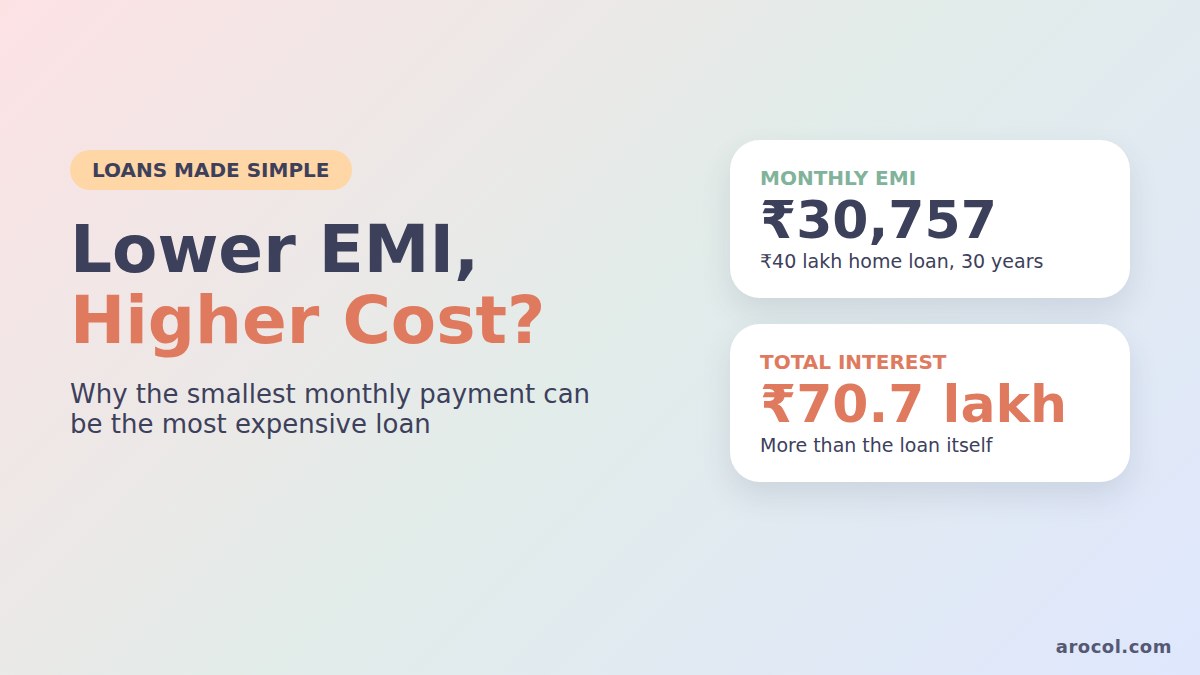
| 30 years | ₹30,757 | ₹70.7 lakh |
Look at the jump from 20 to 30 years. The EMI falls by only about ₹4,000 a month, but you pay roughly ₹27 lakh more in interest. On a 30-year loan, you repay the bank about ₹1.1 crore for a ₹40 lakh loan.
Banks often offer the longest tenure because it makes a bigger loan look affordable. That’s useful if your income is tight today, but go in with your eyes open, and plan to prepay when you can. Our first home loan guide explains how much you can safely borrow.

Car loan EMI: the same rule applies
Car loans follow exactly the same pattern, and car dealers often push the longest tenure to make a bigger car look affordable. Here’s an ₹8 lakh car loan at 9.5%:
| Tenure | EMI | Total interest |
|---|---|---|
| 3 years | ₹25,626 | ₹1.23 lakh |
| 5 years | ₹16,801 | ₹2.08 lakh |
| 7 years | ₹13,075 | ₹2.98 lakh |
The 7-year loan costs about ₹1.75 lakh more in interest than the 3-year loan. And unlike a house, a car loses value every year. By year seven you could still be paying for a car worth less than half of what you paid.
A simple rule many people follow for cars: make a down payment of at least 20%, keep the loan to four years or less, and keep the payment under about 10% to 15% of your take-home pay.
The same thinking applies to phones, laptops and appliances bought on EMI. If you can’t buy it in a few months of saving, it may be more than you can comfortably afford right now.
Short vs long loan tenure: which is better?
Tenure is the length of time you take to repay the loan.
A longer tenure spreads the repayment over more months. This reduces the monthly burden, but it can increase the total interest paid.
A shorter tenure generally works in the opposite direction: higher monthly payments but less time for interest to accumulate.
This creates a trade-off.
If your income comfortably supports a higher payment, a shorter tenure may reduce the overall cost. If your monthly budget is already tight, choosing an aggressive repayment just to finish the loan quickly may create financial stress.
The right tenure depends on your cash flow, not just the desire to pay the least possible interest. A common rule of thumb is to keep all your EMIs together under about 35% to 40% of your take-home pay. Not sure what that number is? Start with where your salary goes every month.
Don’t forget processing fees and other loan charges
Interest isn’t always the only cost associated with borrowing.
Depending on the loan and lender, there may be charges such as:
- Processing fees, often 0.5% to 3% of the loan
- Documentation charges
- Loan insurance bundled with the loan
- Late-payment charges
- Prepayment or foreclosure charges, where applicable
- GST and other applicable service fees
These costs can change the actual expense of a loan. A loan at 11.5% with a 3% processing fee can cost more than one at 12% with no fee, especially on a short tenure.
For that reason, compare the complete cost rather than comparing advertised interest rates alone. Every lender must give you a Key Fact Statement (KFS) showing the Annual Percentage Rate (APR), which includes fees as well as interest. The Reserve Bank of India requires this for retail loans, so ask for it and compare APRs side by side.
How to compare two loans: 5 numbers that matter
Before accepting a loan, write down these five numbers:
1. Loan amount
How much money are you actually borrowing, after fees are deducted?
2. Interest rate
What rate is being charged, and is it fixed or floating?
3. Tenure
How many months or years will you be making payments?
4. EMI
What will leave your bank account every month?
5. Total repayment
How much money will you pay the lender by the end, including all fees?
Then compare the offers side by side.
A loan with a slightly higher monthly payment can sometimes be cheaper overall if it allows you to repay the principal faster. For personal loans specifically, our guide on how to get a personal loan at the lowest rate walks through this step by step.

Fixed vs floating interest rate: how it affects your EMI
Most home loans in India have a floating rate linked to an external benchmark like the RBI repo rate. When rates go up, your bank usually increases your tenure first, not your EMI.
That sounds kind, but it quietly adds years of interest. Many borrowers only discover it when they check their loan statement and see the end date has moved by five or more years.
Check your statement once a year. If the tenure has grown, ask the bank to increase the EMI instead, or prepay a little to bring it back on track. Under RBI’s rules, lenders should tell you about rate changes and give you the option to choose between a higher EMI, a longer tenure or a mix of both.
How much EMI can I afford on my salary?
Saving interest is useful, but it should not come at the cost of having no financial breathing room.
Before taking a loan, consider your regular expenses, emergency savings and other existing debts.
If a slightly higher payment would leave you unable to handle an unexpected expense, the mathematically cheaper loan may not be the most practical choice for your situation. Make sure you have an emergency fund first. Our guide on how much emergency fund you need in India explains why.
A loan should fit into your financial plan, not force your entire budget to revolve around one payment.
How to reduce home loan interest: prepayment and step-up EMIs
If your loan agreement allows prepayment, using surplus money to reduce the outstanding principal can significantly reduce future interest. Under RBI rules, banks generally can’t charge foreclosure or prepayment penalties on floating-rate home loans taken by individuals.
Here’s what small changes can do on that ₹40 lakh, 20-year home loan at 8.5% (EMI ₹34,713):
| Strategy | Loan ends in | Total interest | You save |
|---|---|---|---|
| Regular EMI only | 20 years | ₹43.3 lakh | – |
| Pay 1 extra EMI every year | About 16.8 years | ₹35.1 lakh | About ₹8.2 lakh |
| Increase EMI by 5% every year | About 12.3 years | ₹27.7 lakh | About ₹15.6 lakh |
Your salary usually rises each year. Raising your payment a little each time is one of the most powerful ways to become debt-free years earlier.
However, check the lender’s terms before making a prepayment. Charges, conditions and rules can vary depending on the type of loan and the applicable regulations.
Also, don’t use your entire emergency fund simply to close a loan faster.
Keeping enough accessible savings for unexpected expenses is important.

Prepay the loan or invest the extra money?
This is a common question. A simple way to think about it:
- Costly loans first. Credit card debt and personal loans at 12% to 40% should almost always be cleared before investing. No safe investment reliably beats those rates. See why paying only the credit card minimum is so costly.
- Home loans are a balance. At 8% to 9%, many people split extra money: some to prepay, some to a long-term SIP. You also get tax benefits on home loan interest under the old tax regime; see our old vs new tax regime guide.
- Peace of mind counts too. Being debt-free earlier has value that doesn’t show up in a spreadsheet.
If you’d like to invest part of the extra money, our guides on starting a SIP with ₹500 and our SIP calculator can help you compare.
How your credit score affects your EMI
A higher credit score usually gets you a lower interest rate. On a ₹40 lakh home loan, even a 0.5% lower rate can save several lakhs over 20 years.
So before you apply for any big loan, check your score and fix any errors. Our step-by-step guide on how to improve your CIBIL score shows what lenders look at. And if a friend or relative asks you to co-sign their loan, read what to know before becoming a loan guarantor first. Their loan can affect your own borrowing.
Common EMI mistakes to avoid
- Choosing the longest tenure by default. Pick the shortest tenure you can comfortably afford, not the lowest EMI on offer.
- Ignoring the APR. A low interest rate with high fees isn’t a cheap loan.
- Not checking floating-rate changes. Your loan may be quietly getting longer every time rates rise.
- Taking “no-cost EMI” at face value. On many offers, the discount is removed or a processing fee and GST are added. Compare the final amount you pay.
- Stacking too many EMIs. A phone, a bike and a personal loan together can quietly take half your salary.
Helpful books and tools
- Understand money and debt better: Let’s Talk Money by Monika Halan has a clear section on home loans for Indian families.
- Change how you think about debt: The Psychology of Money by Morgan Housel.
- Assets vs liabilities: Rich Dad Poor Dad by Robert Kiyosaki is a quick first read on why a loan isn’t always an asset.
- Track every loan in one place: a simple budget planner notebook keeps all due dates and balances visible.
- Invest what you save on interest: once your costly debt is gone, open a free demat account with Angel One and start a small SIP.
Some links above are affiliate links. If you sign up or buy through them, Arocol may earn a small commission at no extra cost to you. Read our affiliate disclosure.
EMI vs total interest FAQs
Is a lower EMI better?
Not always. A lower EMI usually means a longer tenure and more total interest. It’s better only if a higher payment would strain your monthly budget.
Should I choose a shorter or longer loan tenure?
Choose the shortest tenure you can comfortably afford while still saving and keeping an emergency fund. You can always prepay later to shorten it further.
Can I reduce my EMI after taking a loan?
Yes, by prepaying part of the principal and asking the bank to reduce the EMI, or by moving to a lender with a lower rate through a balance transfer. Check the fees first.
Is it better to reduce EMI or tenure after prepayment?
Reducing the tenure usually saves more interest. Reduce the EMI only if you need the extra monthly cash.
What is a good EMI to salary ratio in India?
Keep total EMIs under about 35% to 40% of your take-home pay. Lower is safer, especially if you’re the only earner.
What is the difference between interest rate and APR?
The interest rate is only the cost of borrowing. The APR includes interest plus processing fees and other charges, so it’s a better way to compare loans.
Why does most of my early EMI go to interest?
Interest is charged on the outstanding balance. At the start, the balance is at its highest, so the interest part of each payment is largest. As you repay principal, more of each payment goes towards reducing the loan itself.
Is a no-cost EMI really free?
Sometimes, but often the seller removes a discount you’d get by paying in full, or the bank adds a processing fee and GST on the interest. Compare the total amount you’ll pay before choosing it.
The number that matters most
EMI is useful because it tells you whether a loan fits your monthly budget.
But it doesn’t tell the whole story.
When comparing loans, look beyond the attractive monthly figure. Check the tenure, total interest, additional charges and total repayment.
A lower EMI can make a loan feel affordable while quietly extending the period over which you pay interest.
The better approach is simple: compare the complete cost of borrowing, not just the monthly payment.
That one habit can make loan decisions much clearer and help you avoid paying more than necessary.
Recommended reads
- Home Loan Guide for First-Time Buyers: What Nobody Tells You Upfront
- Getting a Personal Loan? How to Pay the Least Interest
- How to Improve Your CIBIL Score: A Practical Guide That Actually Works
- Loan Guarantor in India: Risks, Rights and What to Check Before You Sign
- Credit Card Minimum Due: What Happens If You Pay Only the Minimum?
Note: This article is for general educational purposes and is not personalized financial advice. All figures are examples. Loan rates, charges and terms vary by lender and product, so check the current terms before borrowing.