Disclosure: This post contains affiliate links. If you sign up or buy through them, Arocol may earn a small commission at no extra cost to you. We only recommend products we think are useful. As an Amazon Associate I earn from qualifying purchases. Read our affiliate disclosure.
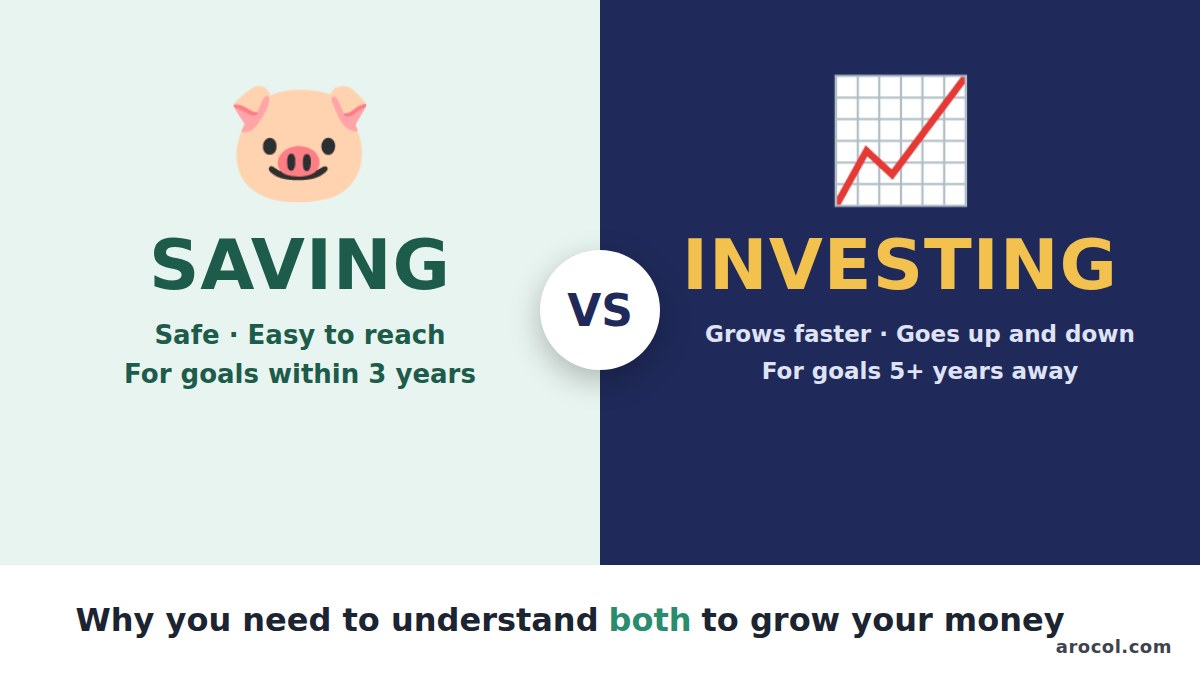
Saving and investing both help you prepare for the future, but they work differently. Learn when each matters, where to keep each kind of money in India, and why your goals should guide your choices.
You get your salary, pay the bills and find that you have a little money left. Now comes the question: should you keep it in savings or invest it?
It sounds like a simple choice, but the answer depends on what you need that money for.
If your phone stops working next week, you’ll probably want money you can access quickly. If you’re putting money aside for retirement, you may be thinking about a much longer period.
Those two situations call for different decisions. That’s where understanding the difference between saving and investing becomes useful. If you’re not sure how much is actually left over each month, start with where your salary goes every month, then come back here.
Saving is about having money when you need it
Think about the expenses that don’t arrive with much warning. A medical bill, a broken appliance or a few weeks without regular income can put pressure on your budget.
Savings can help you handle those situations without immediately turning to borrowing.
You might also save for something you already know is coming, such as an annual insurance premium, school fees or a planned trip. In both cases, the main concern is having the required amount available at the right time.
Where you keep that money matters. A savings account, for example, may offer convenient access, but you should still understand the account’s terms and any applicable protections.
The important thing is not to assume that every place you can put money is equally suitable for short-term needs.
Where to keep your savings in India
For money you need soon, safety and easy access matter more than return. These are the most common places Indians keep it:
- Savings account. Best for money you may need any day. Interest is usually low, often around 2.5% to 4% a year at big banks.
- Fixed deposit (FD). A fixed rate for a fixed time. Good for money you’ll need on a known date, like fees due in 12 months. Breaking it early usually means a small penalty. You can check what your deposit will grow to with our FD calculator.
- Recurring deposit (RD). You put in a fixed amount every month. Useful if you want to build a planned expense slowly, like a festival budget or an insurance premium.
- Sweep-in or auto-sweep account. Extra money above a limit moves into an FD automatically but comes back if you need it. A nice middle path for an emergency fund.
Bank deposits in India also have a safety net. Deposits are insured by the DICGC, a subsidiary of the Reserve Bank of India, up to ₹5 lakh per depositor per bank, including interest. If you keep more than that, spreading it across two banks is a simple way to stay fully covered.
Investing has a different job
Investing usually means putting money into an asset or financial product because you hope it will earn a return over time.
In India, that might mean mutual funds through a SIP, shares, bonds, gold, or long-term government schemes like PPF and NPS. Each works differently, and each comes with its own risks and costs.
The part that’s easy to overlook is that an investment doesn’t have to grow just because you’ve held it for a while. Its value may rise or fall, and the return you actually receive can differ from what you expected.
Say you invest money that you’ll need for a house deposit in three months. If its value drops just before the payment is due, you may have to sell at a loss or find the shortfall elsewhere.
That doesn’t mean investing is a bad idea. It means the date you need your money is just as important as the return you hope to earn.

The hidden cost of only saving: inflation
Keeping everything in a savings account feels safe, and in one sense it is. Your balance never goes down. But prices go up.
Suppose prices rise by about 6% a year. Something that costs ₹1 lakh today would cost around ₹1.79 lakh in 10 years. Put the other way, ₹1 lakh sitting idle for 10 years would buy only about ₹56,000 worth of today’s things.
If your savings account pays 3% while prices rise 6%, you are slowly losing buying power, even though the number in your passbook is going up.
That’s fine for money you’ll need soon. You’re paying a small price for safety and access. It’s not fine for money you won’t touch for 10 or 20 years. For that money, you need something that has a real chance of growing faster than prices. That’s the job of investing.
What ₹5,000 a month can become in 10 years
Let’s make this real. Say you set aside ₹5,000 every month for 10 years. That’s ₹6 lakh of your own money. Here is roughly what it could grow to in three different places:
| Where the money goes | Example yearly return | Value after 10 years |
|---|---|---|
| Savings account | 3% | about ₹7.0 lakh |
| FD or RD | 7% | about ₹8.7 lakh |
| Equity mutual fund SIP | 12% (not guaranteed) | about ₹11.6 lakh |
The gap is large. But look closely at the last row. The 12% is an assumption, not a promise. In some years an equity fund may be down 10% or 20%. Over a long period it has a better chance of doing well, but there is no fixed answer.
So the lesson isn’t “always invest.” It’s this: money with a long runway can afford to take some risk, and over time that risk is usually rewarded. Money with a short runway can’t. You can try your own numbers with our SIP calculator.

You don’t have to choose one and forget the other
People sometimes talk about saving and investing as though one is the sensible option and the other is the exciting one.
In everyday life, most people have more than one financial goal.
You might need money for next month’s expenses, want a cushion for emergencies and also hope to build funds for something many years away.
Instead of asking where all your spare money should go, give each goal its own place in your plan.
For example:
| What the money is for | What matters most |
|---|---|
| Next month’s rent | Having the full amount available on time |
| An unexpected expense | Being able to access the money when needed |
| A long-term goal | Understanding the time horizon, possible returns and risks |
This isn’t a rule that tells everyone exactly where to put their money. It’s a way to think about the job each amount needs to do.
A simple way to picture it is three buckets. The spend bucket is your salary account for this month’s bills. The safety bucket is your emergency fund. The grow bucket is for goals five or more years away. Fill them in that order.

Why an emergency fund deserves its own space
Imagine your washing machine breaks down and needs an expensive repair.
If you have money set aside for unexpected costs, you can consider paying for the repair without immediately disturbing money meant for other goals.
Without that buffer, you might have to use a credit card, borrow from someone or sell an investment earlier than planned. And if that card bill isn’t paid in full, you can end up in the trap we explain in why paying only the minimum due is costly.
An emergency fund won’t prevent unexpected expenses. It simply gives you another way to deal with them.
How much should you keep in one? There’s no number that fits everyone. Someone with steady income and few financial commitments may have different needs from someone supporting a family or earning an irregular income. Many people aim for three to six months of essential expenses.
Start by looking at your essential monthly expenses and the kinds of interruptions you would need to manage. We go deeper on this in why you should have an emergency fund before investing, and if it feels like too much to save, read how to build an emergency fund without feeling the pinch.
The right order: a simple 5-step plan
If you’re starting from zero, this order works for most salaried people in India:
- Know your numbers. Track one month of spending. A free AI chatbot can help; see how to use AI to plan your monthly budget.
- Clear expensive debt. Credit card dues and costly personal loans charge far more than any investment is likely to earn.
- Build a starter emergency fund. Even one month of expenses is a strong start. Grow it to three to six months over time.
- Protect your family. Get term life cover and health insurance before you invest heavily, so one bad event doesn’t wipe out your savings.
- Start investing for long-term goals. A small SIP is enough to begin. Our guide to starting a SIP with just ₹500 walks you through it, and how to invest ₹10,000 a month shows sample portfolios once you’re ready to do more.
Retirement is the longest goal of all, so it’s the one where investing matters most. Our guide to retirement planning with EPF, PPF and NPS explains how these pieces fit together.
Investing involves more than watching returns
When people discuss investments, the conversation often turns quickly to how much a particular fund or stock has earned.
Returns matter, but they’re only part of the picture.
You also need to understand what could go wrong.
An investment might lose value. You might find it difficult to sell quickly at a reasonable price. Fees can reduce what you earn. And some products are much more complicated than they first appear.
Before putting money into anything, ask yourself:
When will I need it? Money needed soon has less time to recover from a decline.
Could I manage if its value fell? Think about both the financial impact and how comfortable you are with uncertainty.
Do I understand the product? You should know what you’re buying, what it costs and what risks you’re taking. Every mutual fund in India shows a riskometer, and the AMFI investor corner explains what the levels mean.
If you can’t answer those questions, it’s worth learning more before making a decision. SEBI’s investor education website is a good free place to start.
What about spreading your investments?
You’ve probably heard the phrase “don’t put all your eggs in one basket.”
That’s the basic idea behind diversification.
Instead of relying entirely on one investment, you spread your money across different holdings or types of assets. This can reduce your dependence on the performance of a single investment.
But diversification isn’t a guarantee against losses.
Owning several funds, for example, may not provide much variety if they all hold similar investments. And when broad markets fall, many holdings can lose value at the same time.
The point is to understand what you own rather than simply counting how many products you’ve bought.
Last year’s winner might not be next year’s winner
A fund’s impressive past return can catch your attention. So can a stock that everyone seems to be discussing.
Past performance can tell you what happened during a particular period. It cannot tell you with certainty what will happen next.
Markets change. Businesses face new challenges. Interest rates and economic conditions move.
Be especially careful with claims that make investment profits sound certain. If a return is being presented as guaranteed, understand exactly what product is involved, who is making that promise and what conditions apply. “Double your money” messages on WhatsApp and Telegram are a common start to fraud, which we cover in how to protect yourself from UPI and online banking fraud.
Common mistakes to avoid
- Investing your emergency fund. If the market falls the same month you lose your job, you’ll be forced to sell low.
- Keeping 10 years of savings in a savings account. It feels safe, but inflation quietly eats it.
- Treating insurance as investment. Many endowment and money-back policies give low returns and too little cover. Keep protection and investing separate.
- Stopping a SIP when markets fall. Falls are when your SIP buys more units for the same money.
- Chasing tips. If you don’t understand why you’re buying something, you won’t know when to hold or sell.
Tools that make this easier
You don’t need many apps or products. A few simple tools are enough:
- To invest in mutual funds and shares: you need a demat and trading account. Open a free demat account with Angel One, then start with a small SIP.
- To understand money behaviour: The Psychology of Money by Morgan Housel explains why patience matters more than picking the “best” fund.
- For an Indian, step-by-step guide: Let’s Talk Money by Monika Halan covers saving, insurance and investing for Indian families.
- To change how you think about assets: Rich Dad Poor Dad by Robert Kiyosaki is an easy first read on the difference between earning and building wealth.
- To keep track on paper: a simple budget planner notebook works as well as any app for many people.
Some links above are affiliate links. If you sign up or buy through them, Arocol may earn a small commission at no extra cost to you. Read our affiliate disclosure.
Start with your goals, not the latest trend
You don’t need an elaborate spreadsheet to begin thinking clearly about your money.
Write down what you’re setting money aside for and roughly when you expect to need it.
Separate the amount required for regular bills from money intended for emergencies. Then consider what you can genuinely leave untouched for longer-term goals.
As your income or responsibilities change, revisit the plan. Something that made sense two years ago might not suit your situation today.
The goal isn’t to make every rupee work as hard as possible. It’s to make sure your financial choices match what you actually need.
Frequently asked questions
Should I save or invest first?
Save first. Build at least a small emergency fund and clear high-interest debt. Then start investing for goals that are five or more years away.
Is an FD saving or investing?
It sits in the middle, but most people treat it as saving. It’s low-risk and the return is fixed, but after tax it often only just keeps up with inflation.
How much of my salary should I save and invest?
A common starting point is 20% of take-home pay across savings and investments. If that feels hard, start with 10% and raise it by 1% to 2% each time your salary goes up.
Can I lose money in a mutual fund?
Yes. Equity mutual funds can fall in value, especially over short periods. That’s why they suit goals five or more years away, not money you need soon.
Is money in my savings account safe?
Deposits in banks are insured by DICGC up to ₹5 lakh per depositor per bank. Above that, there’s no insurance cover, so it’s sensible to spread large balances.
The bottom line
Saving and investing aren’t interchangeable, and they don’t need to compete.
Savings can help you deal with planned expenses and unexpected problems. Investing gives you a way to pursue potential returns, but those returns come with uncertainty.
Before deciding what to do with your money, ask a simpler question: What am I going to need this money for, and when?
Once you know that, the difference between saving and investing becomes much easier to understand.
Recommended reads
- How to Invest ₹20,000 a Month in India: Plan for ₹1 Crore
- Got ₹1 Lakh? How to Invest a Lump Sum in India
- Emergency Fund in India: How Much You Need and Where to Keep It
- New to SIPs? Here’s How to Start With Just ₹500
- How to Invest ₹10,000 a Month in India: A Simple Plan for Beginners
- FD Calculator: Find Your Fixed Deposit Maturity Value
- How to Build an Emergency Fund When Money Is Tight: 12 Practical Ways
Disclaimer: This article is for general financial education, not personalized investment advice. Financial products have different risks, costs, liquidity conditions and protections. Investment returns are not guaranteed. Interest rates mentioned are examples and change over time.