Planning to put money in a fixed deposit? Enter your deposit amount, the bank’s interest rate and how long you’ll keep it. The calculator shows your interest and the total amount you’ll get back when the FD matures.
Disclosure: This post has affiliate links. Arocol may earn a small commission at no extra cost to you. As an Amazon Associate I earn from qualifying purchases. Read our disclosure.
FD Calculator
Find out how much your fixed deposit will be worth at maturity.
| Year | Interest that year | Total interest | Balance |
|---|
Estimate only. Banks may calculate interest differently for very short deposits, and interest is taxable. Check your bank’s current rates before investing.
If you’re also thinking about investing for the long term, try our SIP calculator to compare how a monthly SIP could grow.
How to use this FD calculator
Deposit amount: the money you’ll put in the FD. You can type any amount, or use the slider.
Interest rate: the yearly rate your bank offers. Rates differ between banks and change from time to time, so check your bank’s website. Senior citizens usually get an extra 0.25% to 0.50%.
Years and extra months: how long the deposit stays in. For a 2-year-6-month FD, set 2 years and 6 extra months.
Interest compounded: how often interest is added to your balance. Most Indian banks compound FD interest quarterly, which is the default here. More frequent compounding earns slightly more.
How FD interest is calculated
This calculator uses the standard compound interest formula for a cumulative FD, where interest is added back to your deposit instead of being paid out:
Maturity value = P × (1 + r ÷ n)n × t
Where P is your deposit, r is the yearly interest rate (as a decimal, so 7% is 0.07), n is how many times a year interest is compounded (4 for quarterly), and t is the time in years.
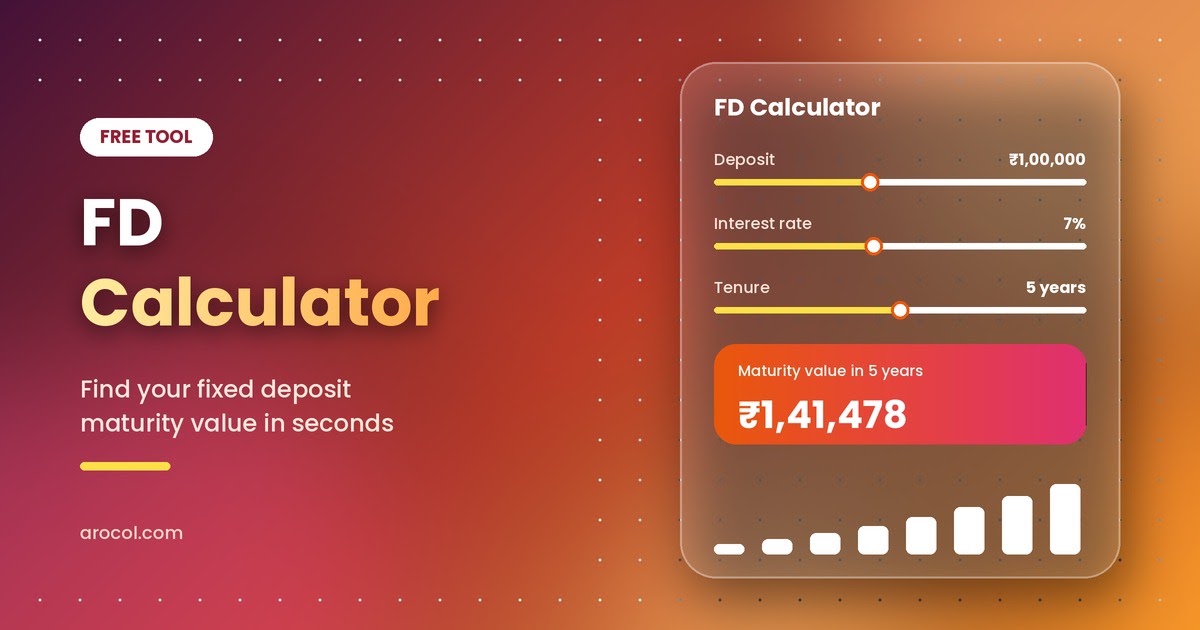
For example, ₹1,00,000 at 7% for 5 years, compounded quarterly, grows to about ₹1,41,478. That’s roughly ₹41,478 in interest.
Worried about what happens to your FD if the bank fails? I’ve explained it in is your FD safe up to ₹5 lakh. And if you’re holding a bigger amount, read where to put ₹1 lakh before you lock it all in one FD.
FD vs SIP: which is better?
They do different jobs. An FD gives you a fixed, guaranteed return and your money is safe, which makes it ideal for short-term goals and your emergency fund. A SIP in equity mutual funds is market-linked: it can go up and down, but over long periods it has historically grown faster than FDs.
A simple rule many people follow: use FDs for money you’ll need within a few years, and SIPs for goals five or more years away. Our guide on saving vs investing explains the difference in more detail.
If you do try SIPs or shares next to your FD, you’ll need a demat or mutual fund account. Angel One is one option many beginners use. For a guaranteed, long-term option, also look at the PPF account.
Things to keep in mind
FD interest is taxable. Interest is added to your income and taxed at your slab rate. Banks also deduct TDS if your yearly FD interest crosses a set limit, currently ₹50,000 for most people and ₹1 lakh for senior citizens. You can check which tax regime suits you in our old vs new tax regime guide.
Your money is insured up to ₹5 lakh. Deposits in a bank are covered by DICGC insurance up to ₹5 lakh per person per bank, including interest. If you have more than that, consider spreading it across banks.
Breaking an FD early costs money. Most banks charge a penalty, often 0.5% to 1% of the interest rate, if you withdraw before maturity. For money you might need suddenly, see our guide on building an emergency fund.
Inflation matters. After tax, FD returns can come close to the inflation rate, so your money may grow only a little in real terms over long periods.
Here’s a small trick people miss. Some banks give you a credit card against your FD, like the AU NOMO Credit Card. Your FD keeps earning interest, and the card helps build a credit score. FD interest is taxed at your slab, and you show it in your return (most salaried people use ITR-1; see the ITR-1 Sahaj FAQ). Interest rate rules for deposits are in RBI’s Master Directions.
Common questions
Is the FD calculator result exact?
It’s very close for most cumulative FDs, but banks may round differently or use simple interest for very short deposits. Your bank’s FD receipt will show the exact maturity amount.
What is the difference between cumulative and non-cumulative FD?
In a cumulative FD, interest is added to your deposit and paid at maturity, which is what this calculator shows. In a non-cumulative FD, interest is paid out to you monthly or quarterly, so your deposit doesn’t grow.
Which compounding option should I choose?
Choose whatever your bank uses. Most Indian banks compound quarterly, so leave it on Quarterly if you’re unsure.
Is an FD a good place for an emergency fund?
Yes, especially a sweep-in FD linked to your savings account, which lets you withdraw quickly. Read why you need an emergency fund before investing.
Want to understand money beyond FDs? Two easy books: Let’s Talk Money by Monika Halan (written for Indian families), and The Psychology of Money.
What does your FD result look like after tax?
The calculator shows the full interest. But FD interest is added to your income and taxed at your slab rate, so what you keep is less.
Here’s a rough example. ₹1,00,000 at 7% for 5 years, compounded quarterly, grows to about ₹1,41,478. That’s ₹41,478 of interest. If you’re in the 20% tax slab, around ₹8,600 of it goes in tax (including cess), so you keep roughly ₹32,800.
Also check TDS. If your FD interest from one bank crosses the yearly limit, the bank cuts tax before paying you. If your total income is below the taxable limit, you can submit Form 15G (or Form 15H if you’re a senior citizen) so the bank doesn’t deduct it. The limits change from time to time, so confirm them with your bank.
Is your FD keeping up with rising prices?
If prices rise around 6% a year and your FD earns 7% before tax, your real gain after tax is very small. That’s fine for money you need safe, like an emergency fund or a goal two or three years away. It’s not great for goals ten years away.
For long goals, compare it with what a SIP calculator shows, and keep in mind that SIP returns aren’t fixed.
What is FD laddering, and why does it help?
Instead of putting ₹3 lakh in one 3-year FD, split it into three FDs of ₹1 lakh each, for 1, 2 and 3 years. Each year one FD matures, so you always have some money coming free without breaking a deposit early.
My aunt does this with her savings. She says it’s the only way she’s never had to pay a penalty for breaking an FD in an emergency.
How safe is your FD money?
FDs in banks are covered by deposit insurance up to ₹5 lakh per person per bank, including interest. If you have more than that, think about spreading it across banks. We explain how this works in FD insurance: is your ₹10 lakh safe in one bank?
Can you check your FD result with AI?
Copy this prompt into any free AI tool to double-check:
I am putting ₹1,00,000 in a bank FD at 7% interest for 5 years with quarterly compounding. What is the maturity amount? If I am in the 20% tax slab, roughly how much interest do I keep after tax? Explain it simply.
Never share your account number or PAN with an AI tool. Your bank’s own FD calculator is the final word on the exact amount.
Recommended reads
- SIP Calculator: See How Much Your Monthly SIP Can Grow
- Emergency Fund in India: How Much You Need and Where to Keep It
- PPF Account in India: Interest, Rules and How to Open One
- Got ₹1 Lakh? How to Invest a Lump Sum in India
- Saving vs Investing: The Difference and Why You Need Both
Disclaimer: This calculator and article are for general information only and aren’t financial advice. Interest rates and tax rules change, so please check the latest details with your bank or a financial adviser.