Disclosure: This post contains affiliate links. If you sign up or buy through them, Arocol may earn a small commission at no extra cost to you. We only recommend products we think are useful. As an Amazon Associate I earn from qualifying purchases. Read our affiliate disclosure.
Most of us buy insurance the same way. We compare a few premiums, pick one that feels reasonable, pay, and file the policy away somewhere safe. Then we forget about it and hope we never need it.
The trouble starts when we do need it. Suddenly, all those details we skimmed past, like exclusions, waiting periods and claim deadlines, become the most important thing in the world.
That’s why comparing premiums alone isn’t enough. A cheaper policy looks attractive, but what really matters is what you get for that money. Here are the things to check before buying insurance in India, whether it’s health insurance, term life cover, or motor and home insurance.
1. Know exactly what’s covered
Start with the most basic question: what does this policy actually pay for?
Health, life, motor and home insurance all do different jobs. And even two policies in the same category can offer quite different benefits. One health plan might cover certain hospital costs but put conditions on specific treatments. One motor policy might cover some kinds of damage and leave out others.
Don’t rely on the ad or the salesperson’s quick summary. Read the coverage section of the policy itself. If there’s something you really care about being covered, find it in the actual terms.
Here’s the one question to answer for each type:
- Term life: does it pay only on death, or also on critical illness or disability through riders?
- Health: does it cover hospital stays only, or also day-care treatment and costs before and after the stay? Our family health insurance guide goes through every feature.
- Motor: is it third-party only, or does it also pay for damage to your own vehicle?
- Home: does it cover the building, the things inside it, or both?
2. Read the exclusions
The coverage section tells you what the insurer will pay for. The exclusions tell you what it won’t. Both matter just as much.
An exclusion can apply to a particular event, activity, situation or type of expense, and every policy is different. A policy with a name like “comprehensive” or “complete” doesn’t automatically include everything.
Health policies usually leave out cosmetic treatment and some dental costs. In term insurance, suicide within the first year is usually excluded. In motor insurance, driving without a valid licence or under the influence can void a claim.
If an exclusion isn’t clear, ask the insurer to explain it in writing.
3. Check when your cover actually starts
Paying the premium doesn’t always mean you’re covered from that minute. Each type of policy has its own start rules:
- Health: most policies pay only accident claims in the first 30 days, and some illnesses and existing conditions are covered only after a waiting period of up to three years. Our health insurance guide explains each one.
- Term life: cover starts once the insurer accepts your proposal and the first premium, not when you fill the form.
- Motor: a new policy bought on time starts right away. If your old policy has already expired, the insurer may ask for a vehicle inspection first, and damage before that date isn’t covered.
So before you rely on any policy, find the line in the document that says when cover begins. It’s usually on the first page, called the policy start date or risk commencement date.
4. Look past the premium
The premium is what you pay to keep the policy running. It’s important, but it’s not the full cost. Depending on the policy, you may also need to think about:
- Deductible: the amount you pay yourself before the insurance starts paying.
- Co-payment: a share of each eligible expense that you have to pay, often 10% to 20%, especially in senior citizen plans.
- Coverage limit (sum insured): the most the policy, or a particular benefit, will pay out in a year.
- Sub-limits: separate caps on specific expenses, like room rent or certain surgeries.
Picture two policies with different premiums. The cheaper one might make you pay a bigger share of certain costs when you claim. If you compare only the prices, you’ll miss that completely. Compare the full terms, not just the yearly premium. In health policies, room rent caps are the sub-limit that surprises families most, and the family health insurance guide shows how they cut the whole bill.

5. Understand how claims work
A policy isn’t much use if you don’t know how to use it when the moment comes.
Find out how to inform the insurer, which documents you’ll need and the deadline for telling them. Each type works a little differently:
- Motor: inform the insurer before you get the vehicle repaired, because a surveyor usually has to see the damage first. For theft, file a police FIR straight away.
- Term life: your nominee files the claim with the death certificate, the policy document and their own ID and bank details. That’s why the nominee should know the policy exists.
- Health: you can go cashless at a network hospital or pay and claim back later. Check which good hospitals near you are in the network.
Keep your policy number, the insurer’s helpline and your key documents somewhere easy to reach. In an emergency, you don’t want to be scrolling through old emails looking for basic details. Tell your spouse or a family member where these are kept.
6. Check the insurer’s claim settlement record
Before you choose an insurer, look at how reliably it pays claims. The claim settlement ratio shows the percentage of claims an insurer settled in a year. IRDAI publishes these figures in its annual report, and many insurers show them on their websites.
For life insurance, check the ratio by amount as well as by number of claims. An insurer can settle 98% of claims by count and still reject a few big ones. Also see how many complaints it got for every 10,000 policies. A high number tells you something about how it treats customers.
No single number tells the whole story, but an insurer with a consistently strong record over several years is usually a safer choice.
7. Be honest on the application
Insurance forms ask questions that help the insurer judge the risk. Answer them fully and truthfully.
This is especially important for health and life insurance. Leaving out parts of your medical history, smoking or drinking habits, or even things that seem minor, can cause serious problems later, including a rejected claim. It depends on the situation and the rules, but it’s never worth the risk.
If you don’t understand a question, ask. Don’t guess. We’ve covered this in more detail in our guide on how to pick the right term insurance plan, where honest disclosure makes all the difference.
8. Use the free-look period
After you receive a new policy, you get a free-look period to read the full document and cancel it if it isn’t what you were promised. Under current IRDAI rules, this is usually 30 days for life and health policies. Check your policy document for the exact period.
If you cancel within this period, you get your premium back, minus a few small charges such as stamp duty or medical test costs. Use these days to read the policy wording properly. Many mis-sold policies could have been returned this way.
9. Don’t mix insurance and investment
This is one of the most expensive mistakes Indian families make. Endowment plans, money-back policies and many traditional “savings” plans promise both insurance and returns, but they usually give too little of both.
Here’s a rough comparison for a healthy 30-year-old non-smoker:
| Plan type | Life cover | Approximate yearly premium |
|---|---|---|
| Pure term insurance | ₹1 crore | About ₹10,000 to ₹15,000 |
| Endowment / money-back plan | About ₹10 to 12 lakh | About ₹1 lakh |
With the endowment plan, your family gets about a tenth of the cover for many times the premium, and the “returns” are often only around 4% to 6% a year. A better approach for most people is to buy a pure term plan for protection and invest the difference separately, for example through a SIP. Our guide on saving vs investing explains why keeping them separate works better.

10. Think about what happens after year one
Buying insurance isn’t a one-time decision. Depending on the product, you may need to renew it, review how much cover you have, or update your details.
Life changes. You get married, have kids, take a home loan, or your parents start depending on you. A policy that was perfect a few years ago might not fit your life today. Revisit it every so often.
Also update your nominee after marriage or a child’s birth, and keep your mobile number and email current with the insurer. Health policies can even be moved to a new insurer at renewal without losing the waiting time you’ve served.
Quick tips for motor and home policies
The same checks apply to your car, bike and home, with a few extra points:
- Third-party vs comprehensive. Third-party cover is compulsory by law but only pays for damage you cause to others. A comprehensive policy also pays for damage to your own vehicle.
- IDV (Insured Declared Value). This is roughly what your vehicle is worth today and the most you’ll get if it’s stolen or written off. A very low IDV cuts the premium but also cuts your payout.
- No Claim Bonus. Every claim-free year earns a discount at renewal. For small scratches, paying yourself can sometimes be cheaper than losing the bonus.
- Useful add-ons. Zero depreciation and engine protection covers are worth comparing, especially for newer cars and in flood-prone cities.
- Home cover. Banks often bundle home insurance with a home loan. Check that it covers the structure and contents you care about, not just the loan amount. Our home loan guide explains what else to watch for.
Being sold the wrong policy? How to spot it and complain
A lot of bad insurance in India isn’t bought, it’s sold. A bank manager pitches a “special FD with life cover”, or a relative needs one more policy to hit a target. Watch for these signs:
- “Guaranteed returns” or “better than FD”. That’s an investment pitch, not insurance. Ask for the benefit illustration and look at the actual yearly return.
- “Pay for only 5 years.” Often true about premiums but hides that the money is locked in for 15 to 20 years, with big losses if you stop early.
- “You must buy this to get the loan.” Lenders can ask you to insure the loan or the property, but you can usually pick your own policy as long as it covers what the lender needs. Ask for the requirement in writing.
If you’ve already been mis-sold, first check if you’re still inside the free-look period and cancel. If not, write to the insurer’s grievance officer (the email is on the policy and their website) and keep the reply. If they don’t fix it, you can raise it on IRDAI’s Bima Bharosa portal, and after that go to the Insurance Ombudsman, which doesn’t charge any fee and doesn’t need a lawyer.
How much insurance cover do you need?
There’s no single answer, but these common rules of thumb are a good starting point:
- Term life insurance: around 10 to 15 times your annual income, plus any big loans like a home loan. If you’re planning for your children’s future, our child education fund guide shows how to add that goal.
- Health insurance: enough to cover one big hospital stay in your city, plus a buffer. The health insurance guide shows how to work out the number and why your office cover alone isn’t enough.
- Home: insure the cost of rebuilding the structure plus the things inside, not the market price of the flat (that includes land, which can’t burn down).
Common insurance mistakes to avoid
- Buying from a cold call or a relative without reading the policy. Ask for the policy wording and the brochure, and read the exclusions yourself.
- Choosing the lowest premium. A cheap policy with heavy sub-limits and co-pays can cost more when you claim.
- Never telling the family. A policy nobody knows about can’t be claimed. Make sure the nominee knows which policies exist and where the papers are.
- Letting the policy lapse. Missing a renewal can mean starting the waiting periods all over again. Turn on auto-renewal.
- Falling for fake insurance calls. Fraudsters pose as insurers or the regulator to “refund” premiums. Never share OTPs or pay “processing fees”. Read how to protect yourself from UPI and online fraud.
Insurance, tax and your budget
Under the old tax regime, life insurance premiums can qualify for deduction under Section 80C, and health insurance premiums under Section 80D. Under the new tax regime, most of these deductions aren’t available. Our old vs new tax regime guide helps you compare.
But buy insurance for protection, not to save tax. The right order is: an emergency fund for small shocks, health insurance for medical bills, and term insurance to protect your family’s income. Only then build long-term investments for goals like retirement.
If the premiums feel hard to fit into your budget, see where your salary goes every month. Small cuts elsewhere often free up enough to protect your family properly.
A quick checklist before you pay
Make sure you can answer each of these:
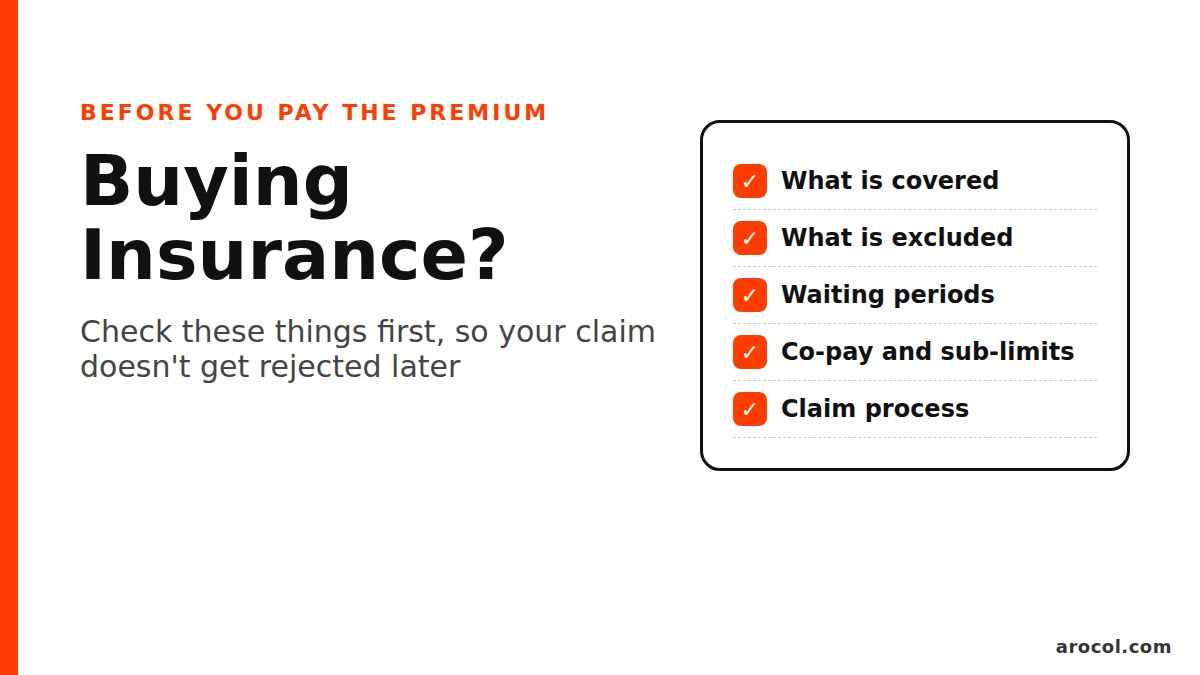
- What’s covered?
- What’s excluded?
- Are there any waiting periods?
- How much will I have to pay out of my own pocket?
- What are the coverage limits and sub-limits?
- Are good hospitals near me in the cashless network?
- How do I make a claim?
- What are the renewal conditions?
- How long is the free-look period?
- Have I disclosed everything honestly?
If you can’t find a clear answer to any of them, slow down and take more time to understand the policy before you sign.

Let AI explain the confusing parts of your policy
Policy wordings are long and written by lawyers. An AI chatbot like ChatGPT or Gemini can turn a dense exclusions page into plain English, so you know what to look for when you read the original.
Copy one section at a time (coverage, exclusions or claims), remove your name, policy number and any health details, and paste it with a prompt like this:
Prompt to copy
I am buying a [term / health / motor / home] insurance policy in India. Below is a section of the policy wording. Explain it in simple English. List: (1) what is covered, (2) what is NOT covered, (3) any waiting period, limit or condition I must follow, (4) three questions I should ask the insurer before I pay. Do not guess anything that is not in the text. Here is the section: [paste text]
Two cautions. AI can misread a clause, so treat its answer as a list of things to check, not the final word, and confirm anything important with the insurer in writing. And never paste your policy number, Aadhaar, PAN or medical reports into any chatbot.
Helpful reads and tools
- Best Indian guide to insurance and money: Let’s Talk Money by Monika Halan explains term, health and why to avoid mixing insurance with investment.
- On risk and room for error: The Psychology of Money by Morgan Housel.
- Keep every policy in one place: a simple document organiser folder so your family can find policy papers quickly.
- Invest the money you save: if you switch from an endowment plan to term insurance, open a free demat account with Angel One and put the difference into a SIP.
Insurance buying FAQs
What is the free-look period in insurance?
It’s the time after you receive a new policy when you can cancel it and get your premium back, minus small charges. It’s usually 30 days for life and health policies under current IRDAI rules.
Is term insurance better than an endowment plan?
For most people, yes. Term insurance gives far more cover for a much lower premium. You can invest the money you save separately for better long-term growth.
Can my insurance claim be rejected?
Yes, if the treatment is excluded, falls in a waiting period, or you didn’t disclose a health condition. Reading the policy and being honest on the form are the best protection.
Which insurance should I buy first?
Health insurance first, because a hospital bill can hit anyone. Then term insurance if anyone depends on your income. Motor third-party cover is compulsory if you own a vehicle.
Is third-party motor insurance enough?
It’s enough to drive legally, but it pays nothing for your own vehicle. For a new or costly vehicle, a comprehensive policy is usually worth it.
Where can I complain if the insurer doesn’t help?
Start with the insurer’s grievance officer. If that doesn’t work, use IRDAI’s Bima Bharosa portal, and then the Insurance Ombudsman, which is free.
The bottom line
Insurance isn’t just a product with a price tag. It’s a contract, with benefits, limits and conditions. Spending a little extra time reading before you buy means you’ll know exactly what protection you’re paying for, instead of relying on assumptions.
The goal isn’t to pick the policy with the flashiest ad. It’s to understand the cover, the costs and your responsibilities before you commit.
Recommended reads
- Health Insurance for Your Family: What to Check Before You Buy
- Buying Term Insurance in India? Read This First
- Emergency Fund in India: How Much You Need and Where to Keep It
- Planning Your Retirement in India With EPF, PPF and NPS
- Old vs New Tax Regime: Which One Saves You More Tax in 2026-27?
Disclaimer: This article is for general information only and isn’t advice about any specific insurance product. Premiums and figures are rough examples. Policy terms and rules differ and can change, so always read the policy documents and check with the insurer or a licensed advisor.