Disclosure: This post contains affiliate links. If you apply or buy through them, Arocol may earn a small commission at no extra cost to you. As an Amazon Associate I earn from qualifying purchases. We only mention cards and products we think are worth a look. Read our affiliate disclosure.
Your first credit card usually shows up in one of two ways. Either your bank’s app keeps flashing “pre-approved for you”, or a friend tells you they got ₹500 cashback on a Swiggy order and you start wondering what you’re missing.
Both are fine reasons to look. But the first card matters more than people think. It starts your credit history, it shapes your CIBIL score for years, and it either becomes a useful tool or a slow leak in your salary. The card itself is rarely the problem. Picking the wrong type, and using it the wrong way, is.
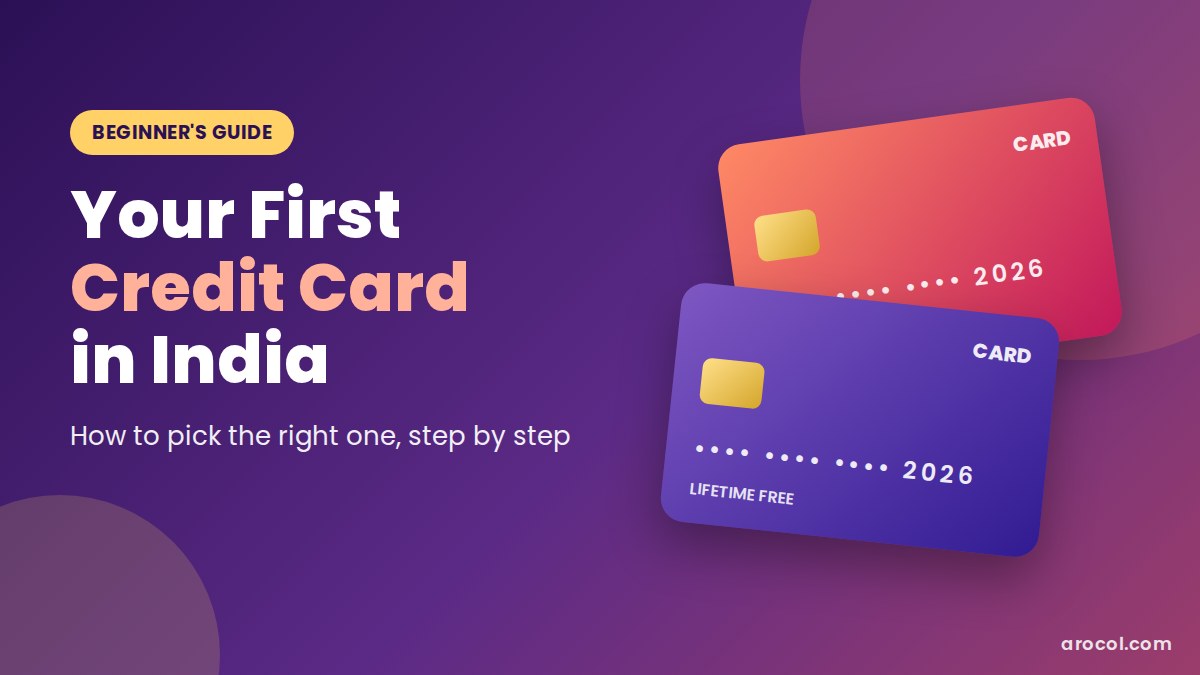
This guide walks you through choosing your first credit card in India in plain language: which type suits a beginner, how to match a card to the way you actually spend, the fees to check before you apply, and the habits that keep you out of trouble from month one.
Do you actually need a credit card yet?
Let’s be honest about this first. A card is worth getting if:
- You have a regular income (salary, steady freelance work or a stable business).
- You already pay most bills on time without stress.
- You want to build a credit history so a future home loan or car loan is easier and cheaper.
Wait a little if you’re already carrying expensive debt, if your spending regularly goes past your income, or if you don’t yet have even a small cushion of savings. In that case, start with a simple monthly budget and a small emergency fund. A card makes good habits better and bad habits worse.
The four types of beginner credit cards

Most first cards fall into one of these groups.
1. Lifetime-free cards
No joining fee and no annual fee, ever. The rewards are usually modest, but there’s nothing to “earn back”, so the card can sit in your wallet for years without costing you a rupee. That long, quiet history is exactly what helps your credit score. For most beginners, this is the safest starting point.
One example is the AU LIT Credit Card, which is lifetime free and lets you switch on only the features you want (like extra cashback or lounge access) for a small fee, for as long as you need them.
2. Cashback cards
These give a percentage of your spending back, usually higher on online shopping. They often have an annual fee of around ₹500 to ₹1,000, but most waive it if you spend a certain amount in a year. If a lot of your money already goes online, a cashback card can easily pay for itself.
3. UPI-enabled RuPay cards
A newer type that many people don’t know about. You can link a RuPay card to UPI apps and pay at regular QR codes, at the vegetable shop or the chai stall, while the money comes from your credit limit. It’s handy because UPI is accepted almost everywhere. It’s also easy to overspend with, because small payments don’t feel like spending.
4. Secured cards (against a fixed deposit)
No salary slip? Just started working? Low or no credit score? Many banks give a card against an FD, usually with a limit of around 75% to 90% of the deposit. Your FD keeps earning interest, and you build a credit history. After a year of clean use, you can usually move to a regular card.
Match the card to how you actually spend
The best card isn’t the one with the biggest numbers in the ad. It’s the one that rewards money you were going to spend anyway. Before you compare anything, open your bank statement and look at the last three months. Roughly how much went to:
- Online shopping (Amazon, Flipkart, Myntra)
- Food delivery and quick commerce
- Groceries and bills paid at shops
- Small UPI payments
- Travel and fuel

Then use this simple guide:
- You want zero fees and zero worry: a lifetime-free card like the AU LIT Credit Card.
- Most of your spending is online, on many different sites: a broad cashback card such as the SBI Cashback Credit Card, which pays higher cashback on online spends.
- You mostly shop on big apps like Amazon, Flipkart, Swiggy or Zomato: a partner-based card such as the HDFC Millennia Credit Card, which gives extra cashback on selected brands.
- You pay almost everything by scanning QR codes: a RuPay card you can link to UPI, like the HDFC Bank RuPay Credit Card.
- You don’t have income proof yet: a secured card against an FD from your own bank.
Cashback rates, caps and the list of excluded spends (rent, fuel, wallet loads and so on) change from time to time. Always read the current terms on the bank’s page before you apply.
Fees and charges to check before you apply
Ads talk about rewards. The fees are in the small print. Look for these five before you say yes to any card:

- Joining and annual fee, and the waiver. A ₹999 fee that’s waived once you spend ₹1 to ₹2 lakh a year is fine if you’ll reach that number naturally. If you won’t, it’s just a yearly cost.
- Interest rate. Usually around 3% to 3.75% a month, which works out to more than 40% a year. You should never pay it, but you should know how big it is.
- Late payment fee. A flat charge that rises with your outstanding amount. One late payment can also hurt your credit score.
- Forex markup. Often around 3.5% on international or foreign-currency payments. It matters if you shop on foreign sites or travel.
- Cash withdrawal charges. Taking cash from an ATM on a card has a fee and interest from day one. Treat it as an emergency-only option.
The Reserve Bank of India also gives you some protections: banks need your consent before activating a card or raising your limit. You can read the full rules in the RBI’s Master Direction on credit and debit cards.
The three dates on your card, and your limit
This is the part most beginners never get explained, and it’s the part that decides whether the card helps you or costs you. Every card has three dates you should know:
- Statement date: the day the bank adds up everything you spent in the last month and creates your bill. Say it’s the 5th.
- Billing cycle: the 30 or so days between two statement dates. Everything you buy from the 6th of one month to the 5th of the next goes on one bill.
- Due date: usually 15 to 20 days after the statement date. If your statement comes on the 5th, the payment might be due on the 23rd.
Buy right after the statement date and you get the longest free period, close to 50 days. Buy just before it and you get only the 15 to 20 days until the due date. All of it is free only if you pay the total amount due on time. How to use these dates so you never pay interest is in my guide to using a credit card without ever paying interest.
Credit limit and “available limit”
Your credit limit is the most the bank will let you owe at one time. Your available limit is what’s left after your unpaid spending. If your limit is ₹60,000 and you’ve spent ₹12,000 this month, your available limit is ₹48,000. When you pay the bill, the limit frees up again, usually within a day or two. Beginners usually get a limit of one to three times their monthly salary. It grows over time if you pay well.
How to read your first statement
Your first bill can look confusing because it has more numbers than a bank passbook. Only a few of them matter:
- Total amount due: the number to pay in full. Always.
- Minimum amount due: usually around 5% of the bill. Paying only this avoids a late fee but starts interest on everything. Ignore it unless you’re in a real emergency.
- Payment due date: the last day the money must reach the bank. UPI and net banking payments usually reach the same day, but don’t wait for the last evening.
- Transactions list: read every line. Look for things you don’t recognise, double charges, or a subscription you forgot to cancel.
- Fees and taxes: any annual fee, late fee or GST shows up here. If you see a charge you weren’t told about, call the bank and ask. Many first-year charges get reversed if you ask politely.
- Reward points or cashback earned: check that it matches what the card promised.
Ten minutes on your first two or three statements teaches you more about cards than any ad will.
Reward points vs cashback: which is better for you?
Some cards give cashback, which comes straight off your bill. Others give reward points, which you redeem later for vouchers, flights or products. For a beginner, cashback is usually simpler and more honest, because ₹1 of cashback is always ₹1.
Reward points are trickier. One point might be worth 25 paise on one card and ₹1 on another, and the value often depends on what you redeem it for. Points can also expire, and some redemptions have a fee. If you choose a points card, find out what one point is really worth before you get excited about “10X rewards”. Until you know your own spending well, a simple cashback or lifetime-free card is easier to judge.
How to apply (and get approved the first time)
- Start with your own bank. If you have a salary account, check the app for pre-approved offers. Approval is faster and often needs no documents.
- Check your credit report. Get a free report from CIBIL or another bureau. If you’ve never borrowed, a “no score” is normal and not a problem.
- Apply for one card, not five. Every application is a hard enquiry. Several in a few weeks can lower your score and make banks nervous.
- Keep these ready: PAN, Aadhaar, latest salary slips or ITR, and a bank statement.
- Read the key fact statement the bank sends before you accept. It lists every fee in one place.
Most banks want you to be at least 21 with a regular income, though the exact numbers vary.
Your first six months: habits that build a good score

The first few months set the pattern. Keep it boring and you’ll be fine:
- Set auto-pay for the total amount due, not the minimum. If that feels risky, set auto-pay for the minimum as a safety net and pay the rest manually before the due date. Here’s why paying only the minimum due is a trap.
- Use less than 30% of your limit. On a ₹50,000 limit, try to keep the bill under ₹15,000. Lower usage looks better to lenders.
- Put one or two regular bills on the card, like your phone or electricity bill, so it stays active, and pay it off in full.
- Never take cash from an ATM with it.
- Check every statement. It takes two minutes and catches wrong charges and fraud early.
- Don’t chase the limit increase. When the bank offers one, accept it only if you trust yourself with it. A higher limit can lower your usage percentage, but only if your spending stays the same.
Do this for six to twelve months and your credit score usually climbs on its own. If you want to understand exactly how, read our guide to improving your CIBIL score.
Mistakes first-time cardholders make
- Treating the limit as extra salary. A ₹1 lakh limit is not ₹1 lakh of money. It’s money you’ll owe in about 50 days.
- Converting everything to EMI. “No-cost EMI” often has processing fees and GST, and many small EMIs quietly eat your monthly budget. I’ve worked out what a no-cost EMI really costs on a ₹60,000 laptop.
- Getting a premium card too early for the lounge access and paying a fee that’s bigger than the benefit.
- Closing your first card too soon. Your oldest card is the start of your credit history. If it’s lifetime free, keep it open.
- Sharing card details on calls or links. Banks never ask for your CVV or OTP. If something feels off, read our guide on staying safe from online banking fraud.
What to do if you miss a payment
It happens, especially in the first few months when you’re still getting used to the dates. Don’t panic and don’t ignore it:
- Pay the full amount as soon as you notice. The sooner you pay, the less interest builds up.
- Call the bank or use the chat in the app. If it’s your first slip and you’ve paid quickly, many banks will waive the late fee once if you ask.
- Know the 3-day rule. Under RBI rules, a payment is reported as overdue to credit bureaus only if it’s more than three days past the due date. So paying within a day or two usually saves your score, even if a late fee still applies.
- Set auto-pay right away so it can’t happen again.
When to upgrade or close your card
After a year of clean use, the bank will probably start offering upgrades, higher limits or a second card. A good time to upgrade is when your spending has clearly grown, you’re already crossing fee waivers easily, and a better card would give you more back than it costs.
If you want to close a card, pay off everything first, redeem any points, and then ask the bank in writing (email or app). Banks must close it within seven working days once there are no dues. But think twice before closing your oldest card. It holds the longest part of your credit history and adds to your total limit, which keeps your usage percentage low. If it’s lifetime free, the smarter move is often to keep it and use it for one small bill a month.
A quick example
Say you’re 24, earning ₹35,000 a month, and you spend about ₹8,000 a month: ₹3,000 online, ₹2,500 on food delivery and the rest at local shops through UPI.
A lifetime-free card is the easy first choice, because there’s no fee to recover. If you want rewards, a cashback card that gives around 5% on online spends would return roughly ₹150 to ₹275 a month on your ₹3,000 to ₹5,500 of online spending (depending on which spends count), which is about ₹1,800 to ₹3,300 a year. At ₹8,000 a month you won’t cross a ₹2 lakh fee waiver, so you’d pay the ₹999 fee plus GST, about ₹1,180. The card still comes out ahead, but only by a few hundred to two thousand rupees. Do this simple maths with your own numbers before you apply.
Learn a little more before you swipe
If you’d like to understand money habits more deeply, these two books are easy reads and very practical for Indian readers:
- Let’s Talk Money by Monika Halan: a simple system for salary, savings, insurance and credit.
- The Psychology of Money by Morgan Housel: why we spend the way we do, and how to change it.
Frequently asked questions
Which credit card is best for a beginner in India?
For most people, a lifetime-free card is the best first credit card because it costs nothing to keep and builds a long credit history. If most of your spending is online, a cashback card can be better, as long as the rewards are higher than the annual fee.
Can I get a credit card without a salary slip?
Yes. A secured card against a fixed deposit doesn’t need income proof. Students and first-time earners often start this way.
Does getting a credit card lower my CIBIL score?
The application causes a small, temporary dip. Using the card well, paying in full and on time, raises your score over the following months.
How many cards should a beginner have?
One is enough for the first year. Add a second only if it clearly fits a different kind of spending and you’re managing the first one well.
Is a lifetime-free card really free?
There’s no joining or annual fee. Interest, late fees, forex markup and cash withdrawal charges still apply if you trigger them, just like on any other card.
What is a good credit limit for a first card?
Whatever the bank offers is usually fine. What matters is that your monthly bill stays well below the limit, ideally under 30%.
Can a student get a credit card?
Students without income usually can’t get a regular card, but they can get a secured card against an FD, or an add-on card on a parent’s account. An add-on card uses the parent’s limit and the parent is responsible for the bill.
Should I pay my rent with a credit card?
Usually not. Rent payment apps charge a fee of around 1% or more, and many banks now give no rewards on rent. Unless you’re paying it to reach a fee waiver you’d miss by a small amount, it rarely makes sense.
Your next step
Look at your last three months of spending tonight. Decide which type fits you: no-fee, cashback, UPI or secured. Then apply for just one card, set up auto-pay for the full amount, and let it quietly build your credit history in the background. If you want the full picture of how cards work, read our longer guide on using a credit card without ever paying interest.
Recommended reads
- How to Use a Credit Card Without Ever Paying Interest
- How to Improve Your CIBIL Score: A Practical Guide
- Credit Card Minimum Due: What Happens If You Pay Only the Minimum?
- Where Does Your Salary Go Every Month?
- All our loan and credit card guides
This article is for general information only and isn’t financial advice. Card features, fees, cashback rates and eligibility change often and are decided by each bank. Please check the latest terms on the bank’s website before you apply.