Disclosure: This post contains affiliate links. If you buy through them, Arocol may earn a small commission at no extra cost to you. As an Amazon Associate I earn from qualifying purchases. Read our affiliate disclosure.
Ask your parents about PPF and there’s a good chance they’ll smile. For a whole generation of Indian families, the Public Provident Fund was the one investment that never disappointed: safe, steady, tax-free, and quietly growing in the background while life happened.
It still works that way. Market-linked investments get all the attention today, but the PPF account remains one of the best places in India for money you want to grow safely over 15 years. It’s backed by the Government of India, the interest is tax-free, and you can start with just ₹500 a year.
This guide explains everything in plain language: how PPF works, the current interest rate, how much it can grow to, the rules on deposits, loans and withdrawals, the tax benefits, how to open a PPF account, and the small mistakes that cost people money.
What is PPF, in simple words?
The Public Provident Fund is a long-term savings scheme run by the Government of India. You put money in every year for 15 years, it earns a fixed interest rate set by the government, and at the end you get the whole amount back, tax-free.
Because it’s a government scheme, your money is about as safe as it can be in India. That’s why PPF is a favourite for the “safe” part of a long-term plan, like retirement or a child’s education fund.
PPF rules at a glance

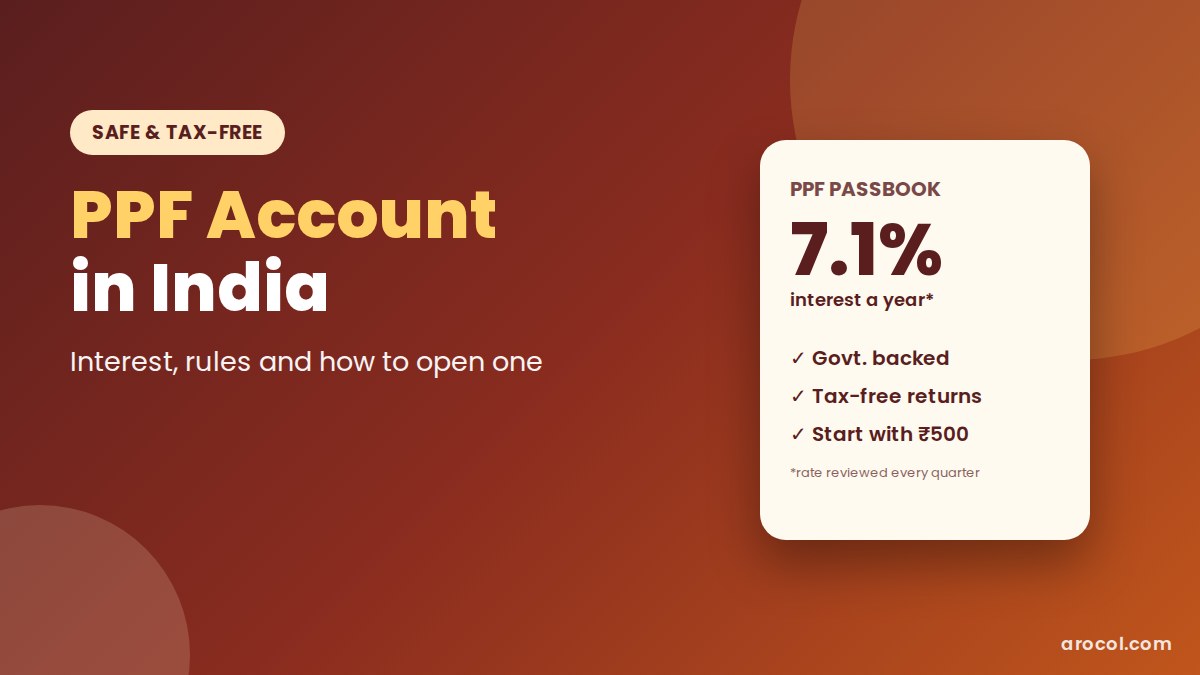
- Interest rate: 7.1% a year, compounded yearly. The government reviews it every quarter. It has stayed at 7.1% for a long time, but always check the latest rate.
- Minimum deposit: ₹500 in a financial year.
- Maximum deposit: ₹1.5 lakh in a financial year (this includes any PPF account you run for a minor child).
- How to deposit: in one go or in parts, in multiples of ₹50.
- Lock-in: 15 full financial years after the year you open the account.
- Extension: after 15 years, you can extend in blocks of 5 years, with or without new deposits.
- Who can open one: any resident Indian, one account per person. A parent can open one for a minor child.
The official rules are on the India Post website and the National Savings Institute.
How much can a PPF account grow?
Here’s roughly what yearly deposits can become at 7.1%, if you deposit at the start of each financial year:

| Yearly deposit | Same as monthly | After 15 years | After 20 years | After 25 years |
|---|---|---|---|---|
| ₹12,000 | ₹1,000 | ₹3.25 lakh | ₹5.33 lakh | ₹8.25 lakh |
| ₹60,000 | ₹5,000 | ₹16.27 lakh | ₹26.63 lakh | ₹41.23 lakh |
| ₹1 lakh | ₹8,333 | ₹27.12 lakh | ₹44.39 lakh | ₹68.72 lakh |
| ₹1.5 lakh | ₹12,500 | ₹40.68 lakh | ₹66.58 lakh | ₹1.03 crore |
Illustrative, assuming the rate stays at 7.1% throughout. The actual rate can change.
Look at the last row. If you put the maximum ₹1.5 lakh into your PPF account every year, you invest ₹22.5 lakh over 15 years and get back about ₹40.7 lakh, all of it tax-free. Extend twice, to 25 years, and it crosses ₹1 crore.
The “5th of the month” rule that most people miss

PPF interest for each month is calculated on the lowest balance between the 5th and the last day of that month. So money that reaches your account on the 6th earns nothing for that month.
Two simple habits fix this:
- If you deposit monthly, make sure the money lands on or before the 5th.
- If you can, deposit the full year’s amount before 5 April. That way the whole amount earns interest for all 12 months of the financial year.
It sounds small, but over 15 years it can add up to tens of thousands of rupees.
A small example of the 5th rule
Say you deposit ₹60,000 for the year. If the money reaches your account on 2 April, it earns interest for all 12 months: ₹60,000 × 7.1% = ₹4,260 for that year. If it reaches on 10 April instead, April is missed, so you earn interest for only 11 months: about ₹3,905. That’s ₹355 lost in one year just because of eight days. Over 15 years, with the balance growing and compounding, the gap gets much bigger. The interest is worked out monthly but added to your account only once, on 31 March each year.
PPF tax benefits: why it’s called EEE
PPF is one of the few investments in India that’s tax-free at all three stages, which people call EEE (exempt, exempt, exempt):
- When you invest: deposits up to ₹1.5 lakh a year qualify for the familiar Section 80C deduction, but only if you choose the old tax regime. Under the new Income-tax Act, 2025 the section number has changed, but the benefit works the same way.
- While it grows: the yearly interest is not taxed.
- At maturity: the full amount you withdraw is tax-free, under both the old and new regime.
If you’re on the new regime, you lose the deduction but still get tax-free interest and maturity, which is still very attractive for safe money. Not sure which regime suits you? Read our old vs new tax regime comparison.
Can you take money out before 15 years?
Yes, in a limited way. PPF is meant to be locked, but it isn’t completely stuck:
- Loan (3rd to 6th year): you can borrow up to 25% of the balance at the end of the second year before the year you apply. The interest is just 1% above the PPF rate.
- Partial withdrawal (from the 7th year): once a year, you can take out up to 50% of a specific earlier balance (the lower of the balance at the end of the 4th year before, or the year just before).
- Premature closure (after 5 years): allowed only for serious illness, higher education, or if you move abroad, and you lose 1% of the interest.
Because of these limits, PPF should never be your emergency fund. Keep that money somewhere you can reach in a day. Here’s where to keep your emergency fund.
What happens after 15 years: your two choices
When your account completes 15 years, you can withdraw everything tax-free and close it. But if you don’t need the money yet, extending is often the smarter move, because very few safe options give tax-free returns. There are two ways to extend, each for a block of 5 years, as many times as you like:
1. Extend with new deposits
You keep adding money every year, just like before, and the full balance keeps earning interest. To do this, you must submit the extension form (Form 4) at your bank or post office within one year of maturity. If you miss this window, any new deposits won’t earn interest. During each 5-year block, you can withdraw up to 60% of the balance you had at the start of that block, once a year.
2. Extend without new deposits
This happens automatically if you do nothing after maturity. You don’t add money, but the whole balance keeps earning tax-free interest. The bonus here is flexibility: you can withdraw any amount once a year. This works well in the years just before retirement, when you want safety and some access.
Either way, the key is to decide a year before maturity, not after. Put a note in your calendar for the year your account turns 14.
Opening a PPF account for your child
Many parents open a PPF account in a child’s name as a slow, safe fund for higher studies or a first big step in life. A parent or legal guardian can open and run it until the child turns 18, after which the child takes over and can sign for themselves.
There are a few things to keep in mind:
- Your own PPF and your child’s PPF share one ₹1.5 lakh yearly limit for the tax deduction and the deposit cap together. You can’t put ₹1.5 lakh in each.
- Only one parent can open an account for the same child.
- The 15 years count from when the account is opened, not from the child’s 18th birthday. An account opened when a child is 3 matures around age 18 or 19, which lines up nicely with college.
- Rules for minors’ accounts were tightened in 2024, so ask your bank or post office for the current rules before opening one.
PPF works best here as the safe base, alongside a long-term equity SIP for growth. Our child education fund guide shows how to combine the two.
How to open a PPF account
You can open a PPF account at a post office or at most public and private sector banks, like SBI, ICICI Bank, HDFC Bank and Axis Bank. If you already bank with one of them, opening it online is the easiest way:
- Log in to your net banking or bank app.
- Find “PPF” under Investments, Deposits or Services.
- Check your details, add a nominee, and choose your first deposit (at least ₹500).
- Confirm with an OTP. The account usually opens instantly or within a day.
At a post office or bank branch, you’ll need the account opening form, PAN, Aadhaar, a photo and the first deposit. Once it’s open, set up a standing instruction so money goes in automatically before the 5th of every month.
Moving your account between a post office and a bank
If you opened PPF at a post office years ago and now want to manage it online, you can transfer it to a bank, or from one bank to another, without breaking it. Your balance, years completed and maturity date all stay the same. Visit the branch where your account is now, fill in the transfer request, and the documents move to the new branch. It usually takes a few weeks. After that, you can see the balance and deposit through net banking like any other account.
PPF vs FD vs ELSS: which is better?

| PPF | Bank FD | ELSS mutual fund | |
|---|---|---|---|
| Returns | Fixed by government (7.1% now) | Fixed by bank | Market-linked, not guaranteed |
| Risk | Very low | Low | High in the short term |
| Lock-in | 15 years | Your choice (5 years for tax-saver FD) | 3 years |
| Tax on returns | Tax-free | Taxed at your slab | 12.5% on gains above ₹1.25 lakh a year |
They aren’t really competitors. PPF is for safe, long-term money. ELSS and other equity funds are for growth over long periods, with ups and downs. FDs suit short-term goals. Many people use PPF for the safe part and an index fund SIP for the growth part. You can see how to combine them in our plan for investing ₹10,000 a month.
Mistakes to avoid with your PPF account
- Missing the ₹500 minimum in a year. The account becomes inactive. You can revive it by paying ₹500 for each missed year plus a ₹50 penalty per year, but it’s easier to set a reminder.
- Depositing after the 5th and losing a month of interest, again and again.
- Putting in more than ₹1.5 lakh a year. The extra earns no interest and gets no tax benefit.
- Opening a second PPF account in your own name. Only one is allowed. A second one will be closed without interest.
- Letting it mature without a plan. Decide a year before maturity whether you’ll withdraw or extend. If you want to keep adding money during the extension, you must apply within a year of maturity.
- Using PPF for everything. At 7.1%, it beats inflation only slightly. For goals 10+ years away, keep part of your money in equity too.
Where PPF fits in a long-term plan
Think of your long-term money in two buckets. One bucket is for growth, where you accept ups and downs for higher returns, like an index fund SIP. The other bucket is for stability, where you want to know exactly what you’ll get. PPF is one of the strongest options for the second bucket.
Here’s a simple example for someone in their late twenties who can save ₹15,000 a month for the long term. They might put ₹5,000 a month into PPF (₹60,000 a year, deposited before 5 April if possible) and ₹10,000 a month into an equity index fund. The PPF part could become about ₹16 lakh in 15 years, guaranteed by the government and fully tax-free. The equity part could grow faster, but with no guarantee. Together, they give both safety and growth, and the PPF part also acts as a cushion if markets have a bad year just when you need the money.
For retirement in particular, PPF sits nicely alongside EPF and NPS. Our retirement planning guide explains how the three work together.
Books worth reading
- Let’s Talk Money by Monika Halan: shows exactly where PPF fits in a simple Indian money plan.
- The Psychology of Money by Morgan Housel: a reminder of why slow, steady saving wins.
Frequently asked questions
What is the current PPF interest rate?
It’s 7.1% a year, compounded yearly. The government reviews it every quarter, so check the latest rate with your bank or post office.
Can I open a PPF account online?
Yes. Most big banks let you open a PPF account through net banking or their app if you already have a savings account with them.
Can NRIs open a PPF account?
No, NRIs can’t open a new PPF account. If you opened one while you were a resident, you can usually keep it until it matures, but check the latest rules for NRIs.
Can I have two PPF accounts?
No. One person can have only one PPF account in their own name. You can also run a separate one for your minor child, but the ₹1.5 lakh yearly limit covers both together.
Is PPF better than an FD?
For long-term safe money, usually yes, because PPF interest is tax-free and FD interest is taxed. For short-term goals, an FD is better because PPF is locked for 15 years.
What happens to PPF after 15 years?
You can withdraw everything tax-free, or extend in 5-year blocks, with or without new deposits. The money keeps earning interest during the extension.
Can a court or lender take my PPF money?
Generally, no. PPF balances are protected from being attached under a court order for your personal debts, which is one more reason families like it as a safe base. Certain government dues can be an exception.
My account became inactive. What now?
Visit your bank or post office and ask to revive it. You’ll pay ₹500 for each missed year plus a ₹50 penalty per year. Until it’s revived, you can’t take a loan or partial withdrawal from it, but the old balance keeps earning interest.
Your next step
Log in to your bank app tonight and look for “PPF”. If you already have an account, set a standing instruction for before the 5th of every month. If you don’t, open one with ₹500 to start. Fifteen years feels long today, but it passes, and your future self will be very glad you started now.
Recommended reads
- Planning Your Retirement in India With EPF, PPF and NPS
- How to Build Your Child’s Education Fund in India
- Old vs New Tax Regime: Which One Saves You More?
- How to Invest ₹5,000 a Month in India
- All our tax and salary guides
This article is for general information only and isn’t financial or tax advice. PPF interest rates and rules are set by the Government of India and can change. Please check the latest details with your bank, post office or a tax professional.