Disclosure: This post has affiliate links. Arocol may earn a small commission at no extra cost to you. As an Amazon Associate I earn from qualifying purchases. Read our disclosure.
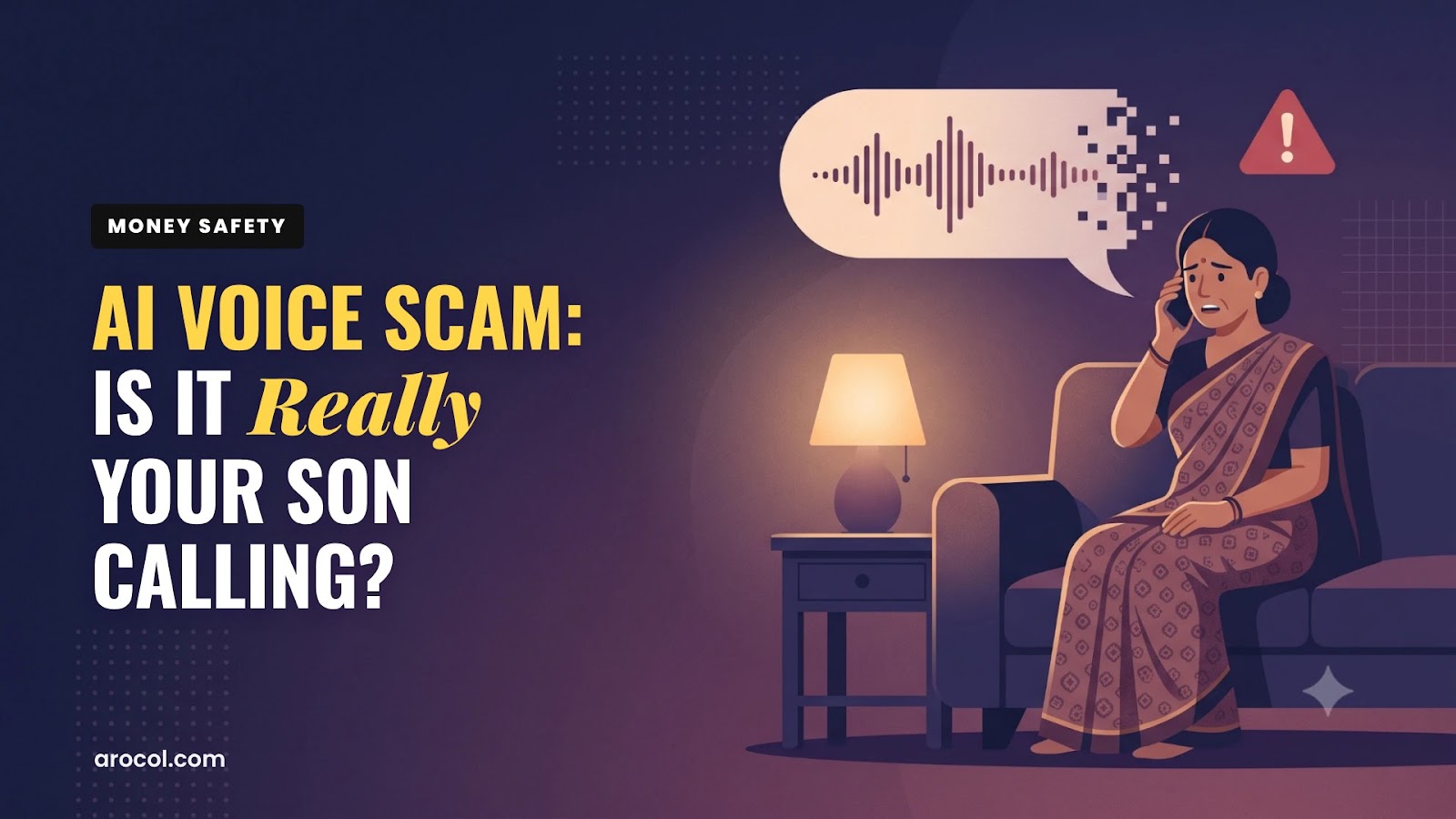
An AI voice scam doesn’t sound like a scam. It sounds like your son.
That’s what Sunita aunty, my neighbour, found out last month.
Her phone rang at 11:20 at night. Unknown number. She almost didn’t pick up.
“Mummy… Mummy, it’s me. Rahul.”
He was crying. His voice was shaking. He’d had an accident in Pune, he said. The other bike rider was hurt. The police wanted ₹40,000 right now, or he’d be locked up till morning.
“Please don’t tell Papa. Just send it on this number. Please, Mummy.”
It was Rahul’s voice. His exact voice. The way he says “Mummy” with a little drag at the end.
Her fingers were already on the UPI app.
And then she asked one small question.
What was it? And did she send the money? Stay with me. I’ll tell you at the end, because that one question is the best protection you’ll read about today.
What exactly is an AI voice scam?
Short answer: a fraudster uses AI to copy the voice of someone you love, then calls you asking for money.
It’s also called voice cloning. A few years ago this needed a film studio. Now free and cheap apps can do it.
The scammer feeds the app a short clip of someone’s voice. The app learns how that person talks. Then the scammer types what they want to say, or speaks into the app, and it comes out in the copied voice.
Scary? Yes. But here’s the good news. Once you know how it works, it’s surprisingly easy to beat.
How do scammers get your family’s voice?
From you. Without you knowing.
- Instagram reels and YouTube shorts. Even a 15-second birthday video is enough.
- WhatsApp voice notes forwarded in big family groups.
- A “wrong number” call. They keep you talking for 30 seconds. “Hello? Who is this? Hello?” That’s all they need.
- Public videos from weddings, college events or office talks.
Then they find your number. Usually from the same social media, a leaked database, or a cousin’s public profile that lists “Mom” and “Dad”.
Have you posted a reel with your voice this year? Most of us have. That’s fine. You don’t need to delete your life online. You just need a plan, which we’ll make in a minute.
What does an AI voice scam call usually sound like?
The story changes. The pattern doesn’t.
- The accident call. “I hit someone, the police want money, don’t tell anyone.”
- The arrest call. “I’ve been caught with something in my bag at the airport.”
- The hospital call. “Friend is in ICU, need deposit, my card isn’t working.”
- The boss call. Your manager’s voice asking you to “urgently pay a vendor” from the company account.
- The abroad call. A son or daughter working in Dubai or Canada, stuck at immigration, needing money “for a fine”.
Families with someone working abroad get this one a lot. If that’s you, keep this article handy, and also read how to send money from UAE to India the safe way, so everyone knows what a real transfer looks like.
Notice what all these calls have in common?
Panic. Secrecy. Hurry. And money by UPI, right now.
Is it only voice? What about deepfake videos?
No. Deepfake video scams are growing too.
A deepfake is a fake video made with AI, where someone’s face and voice are copied. You may have seen famous actors or business leaders “recommending” a trading app or a scheme. Most of those are fakes.
Here’s a recent example from the news. In September 2026, police in Tamil Nadu arrested a man from Rajasthan for spreading AI deepfake videos of the state’s Chief Minister. The videos “promised” scholarship money and pushed people to a WhatsApp number. The voice was a clone.
Then there’s the “digital arrest” trick. You get a video call from people dressed like police or CBI officers, sitting in what looks like an office. They say your Aadhaar is linked to a crime and you must transfer money to “clear your name”.
Let’s be very clear: no real police officer, court or government department arrests anyone on a video call. And none of them ask you to send money by UPI. Another trick going around is a stranger who “accidentally” sends you money and then begs for it back. Here’s what to do when a stranger sends money by mistake.
And if a famous face promises “guaranteed returns” in a video, check whether the company is even registered. You can do that on SEBI’s investor website. Fake trading apps are the same old story we covered in trading vs investing: no one can promise you sure-shot profits.

Why do smart people fall for an AI voice scam?
Because it doesn’t attack your brain. It attacks your heart.
When you hear your child crying, logic switches off for a few seconds. Scammers know that. That’s why they call late at night, when you’re sleepy. That’s why they say “don’t tell anyone”. That’s why they never give you time to think.
Doctors, bank managers, engineers, even retired police officers have lost money this way. Being educated doesn’t protect you. Having a plan does.
How can you spot a fake call in 10 seconds?
Look for these red flags:
- Unknown number, familiar voice. Why is your son calling from a number you’ve never seen?
- Extreme hurry. “Right now, or it’s too late.”
- “Don’t tell anyone.” Real emergencies involve more people, not fewer.
- Money to a stranger’s UPI ID or a “lawyer’s” account.
- The voice avoids your questions and keeps repeating the emergency.
- Background noise that feels “too perfect”, like a TV police station.
Even one red flag? Stop. Don’t argue. Don’t pay. Just hang up.
What’s the one rule that stops almost every AI voice scam?
Hang up and call back on the number you already have saved.
That’s it.
If it’s really your son, he’ll pick up and you’ll sort it out together. If it’s a scam, you’ll hear his normal, sleepy “Haan Mummy, kya hua?” and you can breathe again.
A scammer can copy a voice. They can’t take over your son’s real phone number.
Should your family have a code word?
Yes. This is the second-best trick, and it costs nothing.
Pick a simple word or question only your family knows. Not a birthday. Not a pet’s name that’s all over Instagram. Something silly and private, like “What did Dadi burn on Diwali 2019?”
If anyone calls in an “emergency” asking for money, you ask the code question. An AI clone won’t know the answer.
I set one up with my parents after reading about these scams. My mother laughed and said, “Who will copy your voice?” Then she saw a news video about it. Now she asks the code question even when I call to say I’m late.

What should you never do on a suspicious call?
- Never share an OTP or your UPI PIN. Not to “police”, not to “bank staff”, not to “your son’s friend”.
- Never install a screen-sharing app because someone on the phone asked you to.
- Never scan a QR code to “receive” money. You enter a PIN only to send money, never to receive it.
- Never pay a “fine” to make a problem disappear. Real fines don’t come by phone call.
RBI’s own financial awareness page repeats these basics, and they’re worth showing your parents once. We’ve covered more tricks like fake refunds and QR codes in our guide to UPI and online fraud protection.
Can AI also help you stay safe from an AI voice scam?
Funny, but yes. A little.
Got a strange message asking for money? Remove names and numbers, paste the text into ChatGPT or Gemini, and ask: “Is this a scam? What are the warning signs?” It’s quite good at spotting the usual patterns.
Banks are also using AI on their side. Some flag unusual transfers, like a large late-night UPI payment to a new person, and pause it for a quick check.
But here’s the limit. No app on your phone can reliably tell you whether a voice on a live call is real or cloned. So don’t wait for technology to save you. The call-back rule and the code word work better than any app.
And please, never type your PAN, Aadhaar, bank details or OTP into any AI chat. If you want to use AI for your money the safe way, here’s how I use it for budget planning with AI, without sharing anything private.
Lost money to an AI voice scam? What should you do right now?
Every minute matters. Do these in this order:
- Call 1930. It’s the national cyber fraud helpline. If you call quickly, the money can sometimes be frozen before it’s moved again.
- Report it on cybercrime.gov.in with the number, UPI ID, time and amount.
- Call your bank and block your UPI, cards and net banking if you shared anything.
- Report the fake call number on Sanchar Saathi (Chakshu) so it can be blocked for others.
- Save everything. Screenshots, call logs, the UTR number of the payment. Our guide on how bank transfers work explains where to find the UTR.
Don’t feel ashamed. Shame is what keeps people silent, and silence is what helps scammers.
Will the bank give my money back after an AI voice scam?
Honest answer: it depends. But the rules are getting better.
Right now, under RBI’s rules, if the fraud happened because of a third party’s breach (not your carelessness) and you report it to your bank within 3 working days, your liability can be zero. If you report it in 4 to 7 working days, your loss can be capped at up to ₹25,000 depending on the account. So report fast.
But AI voice scams are tricky, because you usually made the payment yourself. Banks often call that your mistake.
That’s where the news comes in.
What’s changing in 2027? The news you should know
In June 2026, the Reserve Bank of India issued new directions on fraudulent electronic banking transactions. They come into effect on 1 January 2027. Here’s what news reports say they include:
- Cover for “tricked” payments. Cases where you were fooled into making the payment are also covered now.
- Small-loss compensation. For losses up to ₹50,000, you can get 85% of the net loss, up to ₹25,000. It’s a once-in-a-lifetime benefit.
- Faster decisions. Banks get up to 45 days to settle domestic cases.
- Burden on banks. Even in these “tricked” cases, the bank has to prove you were at fault, not the other way round.
There are conditions. If you ignored clear fraud warnings, or your mobile number and email aren’t updated with your bank, you may not get it. So update your contact details with your bank this week. Seriously, do it today.
Not happy with how your bank handles your complaint? After 30 days, you can complain to the RBI Ombudsman at cms.rbi.org.in, free.

Is a credit card safer than UPI in a scam?
A little, yes. Here’s why.
When a scammer gets money from your UPI or debit card, it leaves your bank account instantly. Your rent money, your savings, gone.
With a credit card, it’s the bank’s money first. You can raise a dispute before you pay the bill, and banks have a clear process for that. RBI’s card transactions FAQ explains your rights.
That’s one reason I use a credit card for most online shopping, not UPI. A simple cashback card like the SBI Cashback Card works fine for this, as long as you pay the full bill every month. Love paying by UPI? A RuPay credit card like the HDFC RuPay Card links to UPI, so scan-and-pay comes from the card, not your savings. If you’re new to cards, read how to use a credit card without paying interest first.
Shop on many apps? The HDFC Millennia Card gives cashback on popular shopping sites.
But remember, no card protects you if you willingly send money to a scammer on a call. The call-back rule comes first.
How do you protect your parents from an AI voice scam?
Parents and grandparents are the biggest targets. They pick up unknown calls, they trust voices, and they’d do anything for their kids.
Sit with them for 15 minutes this weekend:
- Play them a short news clip about AI voice scams. Seeing it once makes it real.
- Set up the family code word together.
- Write the call-back rule and everyone’s real numbers in a small phone number diary near their phone: “Emergency call? Hang up. Call back on the saved number.”
- Turn on transaction alerts and a lower daily UPI limit on their bank app.
- Save 1930 in their phone as “Cyber Fraud Helpline”.
And keep a small emergency fund in the family. When people know there’s a real backup plan for real emergencies, fake ones lose their power.

Which free official tools protect you from voice cloning and cyber fraud?
India has a few free tools that most people never use. Take ten minutes and try these:
- See every SIM in your name. On Sanchar Saathi, the “Know Your Mobile Connections” option shows all numbers linked to your ID. Don’t recognise one? Report it. Scammers love SIMs taken in someone else’s name.
- Check before you invest. If a deepfake “expert” pushes an app or a tip, search for the company on SEBI’s website. Not registered? Walk away.
- Complain about investment fraud. If a registered broker or adviser is involved, you can file a complaint on SEBI SCORES.
- Know the real UPI rules. NPCI, which runs UPI, keeps reminding people that you never need a PIN to receive money.
Festival season brings its own tricks too: fake “Diwali bonus” messages, fake sale links and fake courier calls. Our festive sale shopping guide lists the most common ones.
Voice cloning is new. But the scam behind it is old. Someone creates panic, then asks for money fast. The tools above simply make that harder for them.
Should you stop posting videos and voice notes?
You don’t have to disappear from the internet. Just be a bit smarter:
- Keep personal accounts private, especially ones with family videos.
- Don’t list family members’ names and numbers on public profiles.
- Be careful with “wrong number” calls that keep you talking. Say less, hang up early.
- Ignore “free AI voice changer” apps that ask for microphone and contact access.
The same goes for “AI job” offers that want your voice recordings or ID. That’s often a scam in disguise, much like the task scams in our guide to earning money from home.
Scammers also go after loans in your name using leaked details. Check your credit report a couple of times a year. Our guide on checking and improving your CIBIL score shows how.
So what did Sunita aunty ask?
Remember her? Finger on the UPI app, Rahul crying on the phone.
She asked: “Beta, what did you eat at Nani’s house last Sunday?”
Silence.
Then the voice started crying louder. “Mummy, this is not the time! Please!”
That’s when she knew. Rahul would have said “rajma chawal” without thinking, because he’d eaten three plates.
She hung up and called Rahul’s saved number. He picked up on the second ring, half asleep, in his hostel room. No accident. No police.
She didn’t lose a rupee. She just lost a little sleep.
An AI voice scam can copy a voice perfectly. It can’t copy your family’s memories. So hang up, call back, and ask the question only your people can answer.
And if you’d like one simple book to help your family think about money calmly, Let’s Talk Money by Monika Halan is written for Indian families and easy to read.
Has anyone in your family got a call like this? Tell me in the comments. Your story might save someone else’s money.
Recommended reads
- UPI and Online Fraud in India: How to Keep Your Money Safe
- UPI Limit Exceeded? How to Transfer Money Between Banks
- How to Use AI to Plan Your Monthly Budget in India (Free Tools + Prompts)
- Can You Really Earn Money from Home? 10 Real Ways in India
- First Credit Card in India? How to Pick the Right One
This article is for general awareness only and isn’t legal or financial advice. The new RBI compensation rules start on 1 January 2027 and details may be clarified further, so check with your bank. Sunita aunty’s story is an illustrative example based on common scam patterns, with names changed.